Success Stories
This Viva EA is behind Abl’s process improvement
Dec 13, 2023
7 min read


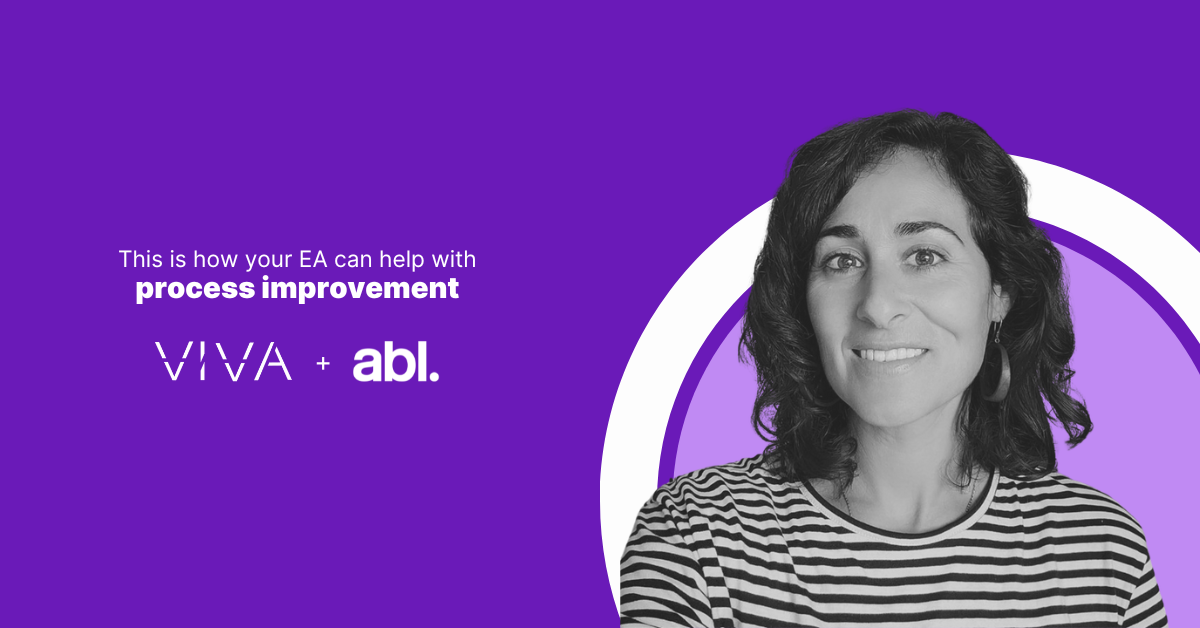
If your startup needs to increase efficiency, start with process improvement. This is how your Viva executive assistant can help you identify, analyze, and improve your operations.
Is it time for process improvement?
Improving your processes is important for companies of any size, but is especially valuable for early-stage startups. More than a buzzword, process improvement is a proactive effort to identify, analyze, and improve any existing process you’ve put in place. It can range from your onboarding process to your communication strategies. If any of the processes you’ve put in place are taking too much of your time, they probably need improvement.
Table of contents
- What can you gain from process improvement?
- Why should a Head of Operations get an EA?
- Which processes can I delegate to my EA?
- Internal and external process improvement
- Process improvement in 10 steps

What can you gain from process improvement?
Executives at Series A startups are constantly moving fast. But watch out: acting with a sense of urgency can lead to making poor, rushed decisions. What you should aim for is to make all processes as efficient as they can be. That’s what you get from improving your operations: You make sure that the approach you’re taking in any given situation, is the most efficient it can be.
What to do if you don’t have time for process improvement?
If you can’t take on process improvement initiatives, it’s best to delegate them to a team member who understands your needs as a leader and the goals you want to achieve. That’s why the ideal team member to delegate these responsibilities to, is your executive assistant. Because your EA is used to working closely with you, they know the way you think, they can put themselves in your shoes, make executive decisions, and deliver the results you expect to see. That’s exactly what Abl was looking for.
What’s Abl?
As a mission-driven startup, we were thrilled when we had the chance to start working with Abl. Their mission is inspiring: “We believe each student deserves a high-quality education and that we need to remove structural barriers so every student has the support and resources they need to succeed.” We couldn’t be happier to help them grow.
Abl is a SaaS startup with a big mission: to transform public education in the United States and to ensure that students from all genders and ethnicities have exposure to the same subjects as all students in school. This improves the quality of education students receive and improves the odds of accessing college.
This Series A startup has around 40 full-time employees, and Briana Krompier, Head of Operations, was looking for an executive assistant who could help her with operations and special projects. When we saw her needs, we decided to pair her up with Daniela, an executive assistant with a skillset so wide, that she could help Briana make an impact across the organization.
Why should the Head of Operations get an EA?
Briana Krompier is the Head of Operations at Abl, a role that directly affects the entire company and everybody in it, one with a to-do list that keeps on growing, and for that reason, one of the leadership roles that could benefit the most from having an executive assistant. As a leader, your work is much more impactful when you propose transformative strategies, rather than spending all of your time implementing them yourself.
When Daniela joined, she immediately spotted gaps and non-documented processes that she could start tackling right away.
Which processes can I delegate to my EA?
The more you involve your executive assistant in your work, the greater the results you’ll get. That’s why we highly recommend allowing your new EA to shadow you, especially when they first join the company. This enables them to gain a deeper understanding of the company culture and processes by observing first-hand how you navigate and operate within the organization. This experience provides valuable context, empowering the EA to make informed decisions and contribute across various areas.
Thanks to Briana’s effective delegation skills, she now has the headspace to focus on strategic thinking, ensuring that customers have a seamless experience from procurement to renewal.
These are some of the processes Briana has delegated to Daniela:
Department process improvement: Operations requests
One of the operations’ department’s biggest priorities was handling employee requests. These requests range from creating policies, coordinating hardware deliveries, hiring new contractors, and signing NDAs, and they can come from any team member: someone who needs to hire a new contractor, an employee with a broken laptop, and many more.
The common thread among all the different requests is that they tend to have a high level of urgency, which means that whoever is in charge of request handling, needed to drop anything they were doing, switch contexts, address the problem, and proceed to find a solution.
The context switching alone was a big drain on Briana’s productivity because every request became a fire that needed to be put out immediately. This disrupted her state of flow and got in the way of her focus time. That’s why, when Daniela joined, she became the owner of the ops requests process and made the timeline much shorter.
Daniela made this her number one priority. No matter what she’s doing, the moment a request comes from the team, she drops everything and focuses solely on solving whichever issue she is presented with. Her response time is so short, that the operations team dared to make a bold promise that they have fulfilled every single time: No matter the issue, they will provide a solution in less than 24 hours.
Now that Daniela can answer all operations requests, Briana doesn’t have to switch contexts, allowing her to stay hyper-focused and be more productive.
Internal process improvement: Employee portal
When startups grow faster than expected, they cannot always keep up with the initial processes they put into place. This was the case for company documentation at Daniela’s organization. Briana noticed that team members repeatedly asked for basic company information, getting lost when looking for something specific. As a result, they wasted a lot of time researching info that should’ve been at hand in the first place.
Briana thought that the best way to centralize company information was through an employee portal, and decided to delegate a big project to her EA.
Daniela didn’t shy away from the implementation; instead, she created an intranet with valuable information for everyone, such as team pages, marketing resources, the employee handbook, FAQ, key docs, and much more.
To determine if that initiative was effective, the operations team decided to launch a survey before and after the intranet implementation. They asked team members one simple question: How easy is it to find company information? The results were clear: The entire team thought accessing the intranet made the entire process much faster and much easier than before. The quantitative results squared with the qualitative ones: There was a 17% improvement in employee access to data and information in 3 months.
External process improvement: Vendor management
One of the most impactful areas of Daniela’s work was when she found there were 228 contractors, but no central place that held all the necessary vendor information.
Critical data like start and end dates, background checks, and payment terms were scattered across different places. Dani took it upon herself to create a database that housed all vendor details, making it accessible to all company leaders. She also set up reminders for leaders to review and decide on renewing vendor contracts.
Thanks to her efforts, Briana and all company leaders gained full visibility into the status of contractors and avoided missing any deadlines. Her practical approach to establishing the database significantly improved the company’s vendor management, ensuring better organization and efficiency in handling contracts.
Process improvement in 10 steps
- Establish a clear objective by asking yourself what are you trying to improve and why should that be your first priority.
- Identify one process you’d like to improve and map out every step of it.
- Analyze the performance of the current process by choosing relevant KPIs.
- Identify bottlenecks, inefficiencies, or areas for improvement.
- Brainstorm improvement ideas and prioritize based on feasibility and potential impact.
- Develop an improvement plan.
- Implement changes.
- Pilot test changes on a small scale if possible before full-scale deployment.
- Monitor and measure results by tracking OKRs.
- Document and standardize.
- Optimize the process by automating all possible steps.
Having an executive assistant can be crucial for process improvement, especially if you have too much on your plate. Look at what other startup executives are saying about their Viva EAs and learn new ways of boosting your productivity.
FAQs
- How do I prioritize which processes to improve first, especially when all seem equally important?Consider focusing on areas that have the most significant impact on your business’s bottom line or efficiency. Start with processes that are causing bottlenecks or those that are closely tied to customer satisfaction. It’s also helpful to involve key stakeholders in identifying which processes are most critical to address.
- What are some potential pitfalls or challenges when delegating process improvement tasks to an Executive Assistant?When delegating process improvement tasks to an Executive Assistant, challenges may arise if they lack deep knowledge of certain business areas. Miscommunication or unclear expectations can also lead to suboptimal outcomes, so it’s crucial to provide clear guidance and regular check-ins. At Viva, we provide continuous training to ensure our EAs are up to date with industry-specific policies and best practices. Plus, their drivers mindset and superior communication skills make them ask questions in a timely manner, clarify and overcommunicate their progress on any ongoing task.
- How can I measure the long-term impact of process improvements on overall business performance?To measure the long-term impact of process improvements on overall business performance, establish key performance indicators (KPIs) before implementing changes. Regularly track these KPIs over time, comparing them against baseline metrics to assess progress. Additionally, gather feedback from employees and customers to gauge qualitative improvements, ensuring that the changes have the desired effect.