Social Impact
Breaking free from gender roles: The path to financial freedom
Jul 3, 2025
5 min read


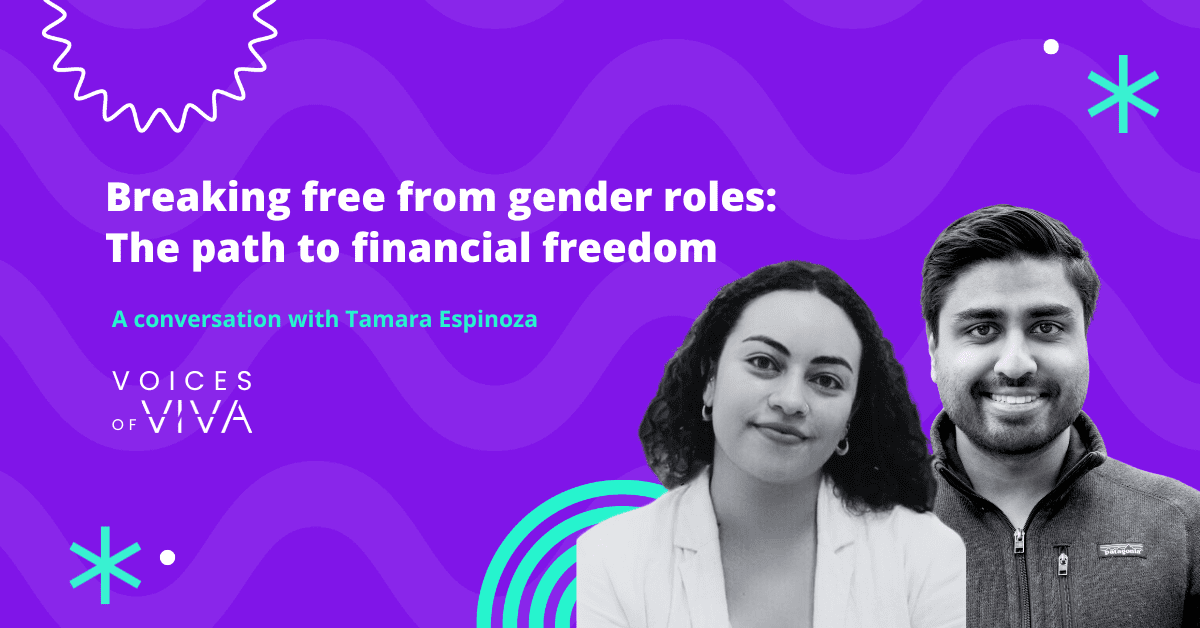
Voices of Viva is a conversation-style blog series that explores the “why” behind our mission through the lens of our team at Viva – Executive Assistants.
Viva is on a mission to enable executives to maximize their impact while creating meaningful opportunities for women in Latin America. One of our values is Use Your Voice.
In this second episode, I spoke to Tamara Espinoza, who brings depth, courage, and honesty to her journey – from her roots in Nicaragua to her path toward financial independence, career growth, and personal agency. This conversation explores family, education, career limitations, and finding one’s voice in a world shaped by gender norms.
Adnan Khan: This is our second episode of Voices of Viva. I’m really excited for this conversation. I know a little bit about your connection to our mission from the personal reflection you wrote and shared a few months ago, and I’ve seen your involvement with our the Community Impact team. This conversation is going to focus on your why: why you’re connected to our mission, why it matters to you, and how we can move the mission forward as a team and globally.
To start, what does gender equality mean to you?
Tamara Espinoza: I’ve thought about that a lot. To me, gender equality means freedom to choose the life I want, without being boxed in by expectations tied to my gender.
I grew up in Latin America, in a very traditional family where women were expected to become wives and mothers above all else. That was seen as our purpose. But I chose a different path – or maybe I rebelled against it.
I never married or had children, not because I couldn’t, but because I wanted something else. I built a career, became financially independent, and created a life my mother and grandmother never had the chance to imagine. For them, the roles were already written. Their value was measured by how they fulfilled those roles. I’ve had to fight for my place at school, at work, even in my own family.
So for me, gender equality isn’t about being the same as men. It’s about having the same right to define what I want to do with my life – and being respected for who I am, not what I’m expected to be.
Adnan: That really resonated. I just wrote down, “Freedom to choose the life I want without being boxed in because of my gender.” You mentioned the pressure for women to get married early. Why do you think that is?
Tamara: I can only speak from experience. In my family, generations of women were expected to hold everything together. Nicaragua is still a very traditional place. Women are expected to take care of the home and the children. Men were supposed to provide, but they often left.
There’s a long history of absent fathers in my family. My grandmother never had that stability, so she ingrained the expectation of building a “complete” family into my mother and aunt, and eventually, into me.
Adnan: Why do you think fathers become absent in the first place? And how has that dynamic shaped things?
Tamara: There’s no pressure for men to be fathers. The only expectation for them is to be strong or to serve their country, especially in a place like Nicaragua, where war has shaped a lot of our history. Raising a child? That’s not seen as their responsibility.
What’s strange is that even when fathers were absent, they were still respected. We were taught to honor men, even when they didn’t show up. I had a father, but many women in my family didn’t. Still, we were expected to show respect.
Adnan: That’s really interesting: being expected to show respect for someone you’ve never had a real connection to. How was that usually communicated to you?
Tamara: My grandmother is a big example. She had my mom through an affair, and the man was absent. But to her, he was still “the only man she ever loved.” She always told my mom to call him, visit him, give him something. My mom did it out of respect for my grandmother, even though the man never played a role in her life. I think my grandmother longed for that respect for herself, and asked us to give it on her behalf.
Adnan: What’s your earliest memory of experiencing gender inequality?
Tamara: In primary school, we had a class called Hogar (home), which was only for girls. We were taught how to cook, dress properly, knit, how to be homemakers. Boys weren’t allowed. They took Industrial Arts, where they learned to build and explore life through creativity. I remember wanting to be in that class so badly-but I wasn’t allowed.
It wasn’t just about the content. It was about the message: our futures were already decided. We also weren’t allowed to wear certain clothes because they might “entice” boys. Those rules didn’t exist for them.
Adnan: So you had restrictions on what you could wear, but boys didn’t?
Tamara: Exactly. On Fridays, when we didn’t have to wear uniforms, there were still rules for girls. None for boys. They had more freedom, even in something as small as clothing.
Adnan: What about in the workplace? When did you first experience inequality there?
Tamara: Most of my experience comes from teaching. Even though it’s seen as a nurturing, female-led field, it’s still shaped by gender norms. In the school where I taught, all the primary school tutors were women, teaching “easy” subjects. Secondary tutors were mostly men, teaching calculus, chemistry – more complex subjects, and they were better paid.
I was supporting students with autism, ADHD, dyslexia, and more, but I was never offered the higher-paid roles. Even though I studied math and had experience in calculus, I was told “not at this time” every time I asked for a raise. Meanwhile, my male peers advanced quickly.
Adnan: That’s a clear example, and difficult to hear. What would you say to yourself back then, when you were just starting out?
Tamara: I would say: don’t wait for permission to take up space. If you know you’re capable, claim the opportunities. Advocate for yourself, even if it feels uncomfortable.
And also, be intentional about where you work. Look for places where gender equality isn’t just a value on a poster, but something you experience every day. And above all: trust yourself. Don’t wait until you feel 100% ready. Men don’t. Women often hold back, even when we’re more than qualified.
Adnan: You mentioned you’ve learned this more recently. When did that shift start for you?
Tamara: When I joined Viva. I came in with hesitation. I had negative experiences where my voice wasn’t heard. I was used to holding back. But here, I was encouraged to speak and it felt strange at first. I’d never experienced that before, not even at home. But little by little, I found my voice.
Even if I was afraid my opinions wouldn’t be heard or welcomed, I’ve learned that I deserve to be heard.
Adnan: From my point of view, seeing someone find their voice is one of the most beautiful moments to experience as a leader. It doesn’t always happen right away, but when it does, it’s powerful. And I’ve definitely seen that happen with you. What role do you think organizations should play in combating gender inequality?
Tamara: Organizations have a huge responsibility. It’s not enough to say you support equality. You have to build systems that actively support it.
That means equal pay, transparent growth paths, and evaluating people based on talent, not gender. It means investing in women like me, who didn’t grow up seeing female leaders. Representation matters.
Companies also need to address the confidence gap that women face. I’ve seen less-qualified men put forward for roles over more qualified women. Organizations need to encourage, mentor, and promote women intentionally.
Adnan: If women are waiting until they’re “ready” and men apply even when they’re not, how do we close that gap?
Tamara: I felt that myself when I applied to Viva. I wasn’t sure I was ready. But I took a leap, and I’m grateful you and Camila took a chance on me. It’s a two-way street: I applied despite the fear, and you trusted me. We also need representation. When we see other women doing it, we believe we can too.
Adnan: That makes a lot of sense. Could you tell me more about your experience with the Community Impact team?
Tamara: That’s one of my favorite things I’m involved in, and one of the reasons I joined Viva. The company I support, Mi Crédito, is based in Nicaragua. So I was able to connect on a deeper level with people and communities I relate to.
I’ve seen firsthand how much the sessions we lead impact others. Just one hour of someone’s time sharing their knowledge can change how someone sees their future. That’s powerful. And as a former teacher, it’s really meaningful for me to continue contributing to education in this way.
Adnan: I love that your teaching background is still part of your impact here, and it’s part of what shapes a career instead of just having a job. You also recently shared on your birthday that at 21, you dreamed of being financially independent, living in a home you love, and surrounded by kind people by the age of 30. Did that feel realistic to you back then?
Tamara: Honestly, no. I grew up poor. I was still in college at 21. I didn’t see a path to being financially independent. But I dreamed anyway, and I was intentional about it, even when I didn’t believe it could happen.
Adnan: And how do you feel now that you’ve reached those goals?
Tamara: I feel beyond proud. I want to go back and show 21-year-old me a picture and say, “Look. This is you in 10 years.” I never thought it would be possible. But I’m here. And I’m proud.
Adnan: What’s next for you?
Tamara: One of the reasons I wanted to change companies was to grow. I was inspired by someone at my previous company, Morgan, who was a Chief of Staff. She became a mentor, even if she didn’t know it. Now, that’s my goal. I want to gain experience, build my skills, and eventually step into a Chief of Staff role.
Adnan: I love that. One thing I wanted to go back to, you talked about rebelling against your family’s expectations. How did you walk that line between honoring your family and still choosing your own path?
Tamara: It was hard. I didn’t get along with my mom for nearly 10 years. We were always fighting. My grandmother would say things like “If you don’t have children, God will punish you.” That really hurt me.
But I also didn’t want to hurt them. So through therapy and lots of difficult conversations, I started making it clear: this is the kind of person I want to be. I’m not against becoming a wife or mother, but I want to choose that freely, not because it’s expected.
Over time, they’ve started to respect that. We don’t fight like we used to. We’ve come to terms.
Adnan: I’m really glad to hear that. And I admire how you’ve stayed true to yourself while still honoring those relationships. What’s your vision for the future of women in the workforce?
Tamara: I want women, especially those from traditional backgrounds, to no longer feel like they have to fight just to dream big. I want a future where we’re recognized not just for our resilience, but for our leadership and intelligence.
I want organizations to include women not for optics, but because we belong there. And I want mentorship, not judgment, for women navigating confidence gaps. I want women to stop feeling like we have to constantly prove ourselves just to be taken seriously.
Adnan: What role do you think Viva is playing in that vision?
Tamara: When I joined Viva, I came with modest expectations based on past experiences. But Viva has been different.
I’ve felt seen, heard, and supported here. I’ve been able to take on leadership. I’ve been able to decide what I want to be, and I’ve been empowered in ways I’ve never experienced before.
And I know I’m not the only one. Viva is building a real community: one where women are truly encouraged to thrive. I hope many more women get to experience what I’ve experienced here.
Adnan: That’s wonderful to hear. I’ve really appreciated this conversation. You’re a very thoughtful person, and your reflections are powerful. I know this will resonate with the team and the broader team and community.
Tamara: Thank you so much for the space and the opportunity.