Executive Assistants
How much does an executive assistant cost?
May 14, 2024
5 min read


You might think executive assistants are a luxury that only post-IPO corporations can afford, but do you actually know how much an executive assistant costs? In this blog, you’ll learn how much you can expect to pay for EA support, the best options for staying within your budget, and how to measure the ROI of having EA support.

Table of contents
- Factors affecting executive assistant costs
- Budgeting tips for hiring an executive assistant
- How to measure your EA’s ROI
- Final thoughts
Factors affecting executive assistant costs
Many variables can dramatically impact the cost of hiring your own executive assistant. As with any other position, factors like the type of contract, the EA’s experience level, and additional costs – such as employee benefits – can result in significantly different figures.
How much do executive assistants make? In a 2022 article published in The Wall Street Journal, one executive assistant was reported to earn as much as $400,000 a year, but that’s an outlier. You can find plenty of job postings where EA salary offers start at $31,000.
How do you make sense of that enormous salary spread, and what are the biggest factors that determine what an executive assistant might cost you and your startup?
Experience level
As with any position, an executive assistant will have different salary expectations based on their previous experience. An EA who just started their career might settle for a modest salary, while an EA with 5+ years of experience at successful startups might be seeking a much higher salary.
This is especially true for EAs whose resumes boast big brands that are industry leaders in their fields. That’s why LinkedIn is full of individuals who present themselves not only with their current title but also with “ex-Uber,” “ex-Google,” or “ex-Amazon” right by their names.
If an executive assistant has worked at one of these companies, supporting CEOs, COOs, and VPs of product, it’s unlikely that they will be willing to scale down to join a smaller company – or settle for a less than competitive salary.
Full-time vs. contract
Another big factor that changes the cost of hiring an executive assistant is the type of support you’re looking for. Should you get an administrative, virtual, or executive assistant? Hiring an on-site EA doesn’t cost the same as hiring a remote executive assistant. There’s an even bigger difference once you start looking for a virtual assistant or administrative assistant who provides fractional support.
Sure, getting a part-time virtual assistant is much cheaper than hiring an executive assistant, but keep in mind that you will also get less support. A VA will most likely limit their aid to helping you with administrative tasks such as email and calendar management. A VA is a good solution if you are looking for support for a limited amount of time, but if what you’re looking for is a strategic business partner who can fill in for you, reduce your workload, and help you be more productive, you might want to start looking for an EA.
Additional costs
When hiring an executive assistant, it’s important to consider all the costs involved, not just their paychecks. In addition to the salary, you can expect to absorb expenses related to finding and keeping the right person. Providing a laptop, securing an office space, and employee benefits are costs you need to factor in when it comes to hiring an on-site EA.
When you hire an in-house EA, you can expect to spend $120,000 per year in total: $20,000 in recruiting, $3,000 on onboarding, plus yearly retention or hidden costs like training, performance bonuses and paid time off. Overall, hiring an on-site EA can add up to about $143,000 per year.
How does location affect the cost of an executive assistant?
The most expensive cities in the U.S. are located in states that tend to offer the highest salaries. According to Forbes, the states with the highest average salaries are Massachusetts ($76,600), New York ($74,870), and California ($73,220). It turns out that those states are also the most popular among startups. If you’re a startup executive, chances are your headquarters are located in Boston, New York, Los Angeles, or San Francisco.
Considering that tech companies like Apple, Google, and Facebook all started in Silicon Valley, or that Veho, or Axonius all have their headquarters in New York, it makes sense that most startups would want to be in these tech hubs, surrounded by other founders, incubators, and accelerators. In addition, it’s worth noting that VC firms have a significant presence in the same cities, so there is a constant flow of capital.
That’s why, if you happen to look for an on-site executive assistant in these tech hubs, the investment required can get pretty high. We collected data regarding salaries from job postings all around the country and consulted Bureau of Labor Statistics to identify other costs, like employee benefits, to get accurate data.
If you’re set on hiring an in-house executive assistant despite the costs, calculate the return of investment of getting an EA and see if those numbers add up. This is how you can determine whether hiring an EA is a good investment or if you’re better off hiring a remote EA.
How to calculate the ROI of an in-house executive assistant?
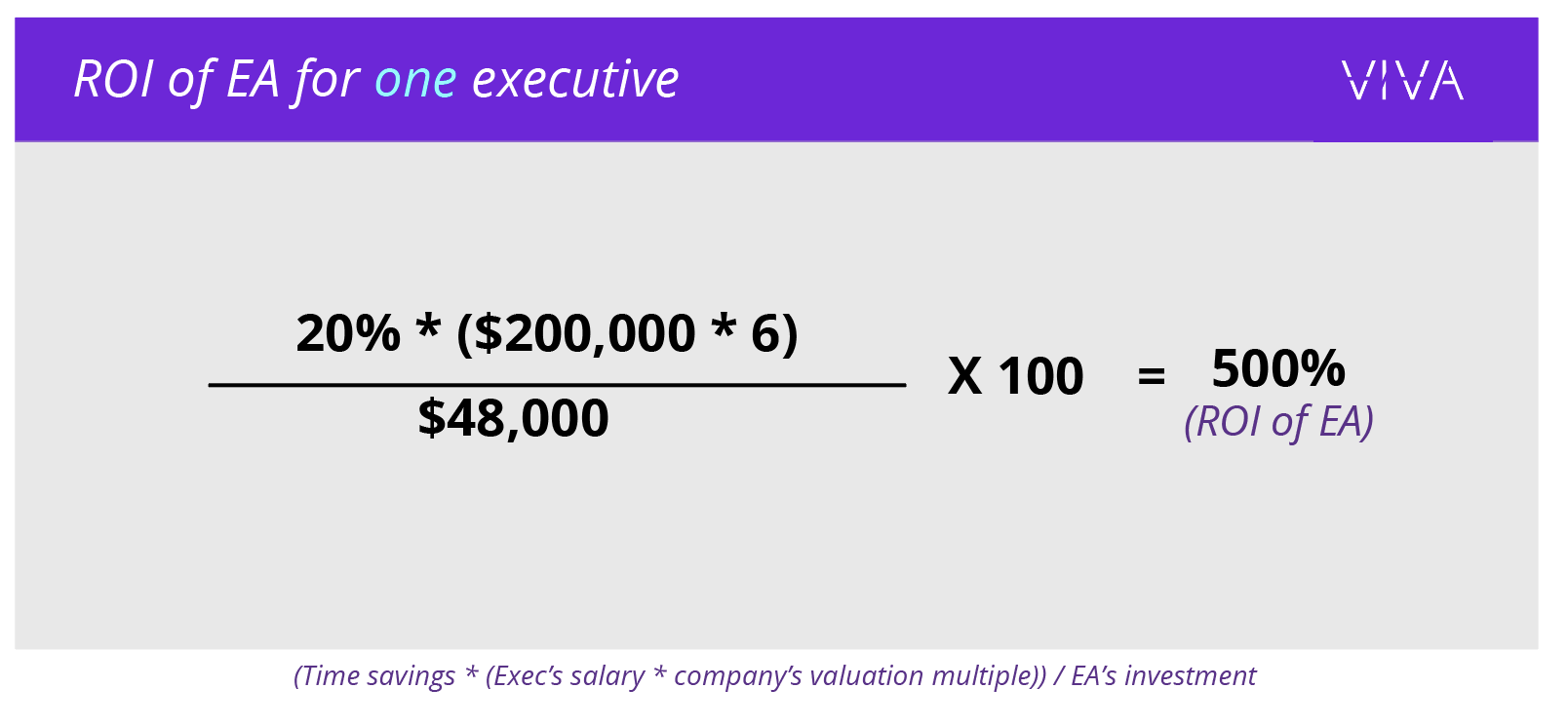
To determine the return on investment (ROI) of hiring an executive assistant, you should factor in the EA’s salary, the company’s valuation, and the proportion of time saved.
Given that a software startup typically commands a valuation of 5x to 7x its revenue, we use a time valuation multiplier to show that an executive’s time is similarly valued at 5x to 7x their salary, a conservative number, now that the boom ages of 2021 are over. For this example, we’re using 6x to calculate the ROI.
- Executive annual salary: $200,000
- Valuation multiplier applied to executive’s time: 6x their salary = $1,200,000
- EA time savings: We asked 10 executives who report saving 8 to 15 hours a week on average. We took a conservative figure of 10 hours per week as our estimate, which equals about 20% of their time.
Maximizing EA value within your budget
A good alternative to an in-house EA is to hire a remote executive assistant. Contrary to what you might think, a remote EA can perform the same tasks as an in-house EA. How? They are power users of some of the most popular tools and software in the startup world and can deliver outstanding results while being off-site, even in a different country.
If we were to use the same calculation above to see what the ROI of a Viva EA would be, it becomes evident that you get a much higher return on investment than you would with an in-house EA, especially if two of your executives need support.
Executive’s salary: $200K a year.
Executive’s valuation multiple on their time: 6x times their salary = $ 1,200,000
EA time savings: On average, our EAs save 20% of their executive’s time. In Viva’s Enhanced plan, they can provide full-time support to 2 executives.
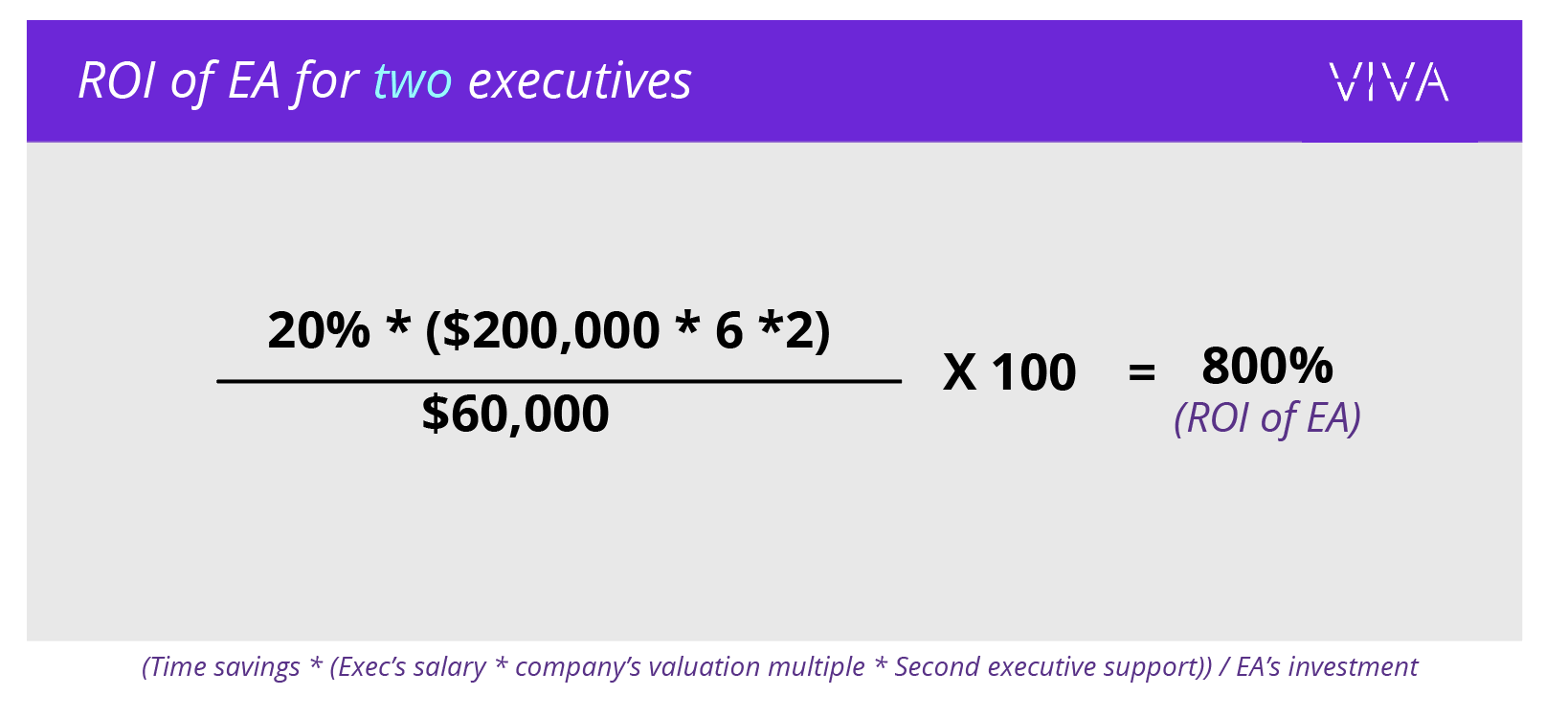
In summary, hiring an executive assistant might vary wildly in terms of how big the investment has to be. If you feel like you’d be missing out if you hire a remote EA, make sure the ROI of hiring in-house is justified. If you want to maximize the impact you get for the budget you can allocate to EA support, choose to hire remotely.
If you’re interested in exploring the latter or just want to debate us on our math, chat with our team and get the guidance you need for such a crucial hire.