Success Stories
Viva EA reduces cognitive overload for Gridwise CEO
Dec 1, 2023
5 min read


It’s quite common for startup executives to reach cognitive overload. Work starts piling up and before you know it, you have back-to-back meetings for 10 hours a day, then you have a full day’s worth of work you have to complete either before or after your workday. How can you keep that from happening? This is what we learned from Gridwise’s successful approach.
Are you close to reaching cognitive overload?
Cognitive overload is a state of mind in which your work memory reaches its capacity, resulting in mental exhaustion. A recent study from Microsoft suggests that your brain works differently when you take breaks. Not just to make you less exhausted by the end of the day, but to actually improve your ability to focus and engage while in meetings. Taking time out between calls prevents stress from building up.

*This chart represents the difference between having a break after each meeting and having no breaks.
The causes range from multitasking to working on complex tasks, receiving too much information, or ineffective time management. Cognitive overload can manifest in different ways: decreased performance, poor decision-making and, ultimately, it can lead you straight to burnout.
If the first thing that comes to mind when you wake up is work-related or if you cannot fall asleep at night because you keep on mentally going through your to-do list, you may be close to reaching cognitive overload.
How can you keep that from happening? Learn from Ryan Green, one of our customers and CEO at Gridwise. His successful approach and all the practical ways in which he leverages his executive assistant are the perfect way to reduce cognitive overload and avoid burnout.

What’s Gridwise?
Gridwise is, in their own words, “a delivery driver and rideshare assistant app that helps drivers maximize earnings and increase profitability.” At Viva, we see them as the perfect ally for ridesharing drivers. They have real-time features like “where to drive” and mileage tracking.
Besides that, they have two more lines of business: ads and analytics. The driver app allows them to capture very valuable mobility data through their network of around 500,000 active drivers, which benefits companies from different industries like Uber, Lyft, Volkswagen, Walmart, and more.
The service of this Pittsburgh-based startup is available for drivers to use all over the United States. As a remote-first company, it made sense for their CEO to look for a remote executive assistant. He was looking for someone who could deliver much more than admin work; that’s why we paired him up with Sara: a strategic and outspoken EA who quickly became his thought partner.
How to turn your EA into your thought partner?
A common misconception about executive assistants is that all they do is manage your email, arrange your meetings, and plan your trips. That’s only the tip of the iceberg. The reality is that an EA can easily become a thought partner, someone who challenges your thinking, helps you re-evaluate your beliefs, and constantly urges you to grow in your role.
The onboarding process is key
Some executives see onboarding processes as a waste of time. Even though they know this learning phase is necessary, they often refrain from delegating something just to avoid teaching that specific skill to a member of their team. That’s why at Viva we train and upskill all our executive assistants so that they’re up to speed by the time they start working with you.
Now, you’re probably wondering: How can I coach my EA into becoming a thought partner? The executive assistant role is a malleable one, which means that they can grow and evolve in any direction you need them to. The catch? You need to allow that growth to happen by letting them shadow you, delegating relevant work, giving them freedom to propose new approaches, and seeing them as a strategic business partner, not merely as office generalists.
The impact an executive assistant can have on your team
One of your most important jobs as CEO and team leader is to make sure you not only hire top performers but actually put in the time and effort to guide and train them. Unfortunately, startup executives can’t afford to take the time to upskill their team; that’s why having an executive assistant who knows your working style and understands company goals is just what you need.
Your EA can easily fill in for you while you’re busy or away, and lead team initiatives in the same way you would if you were present.
Appoint your executive assistant as your tech stack power user
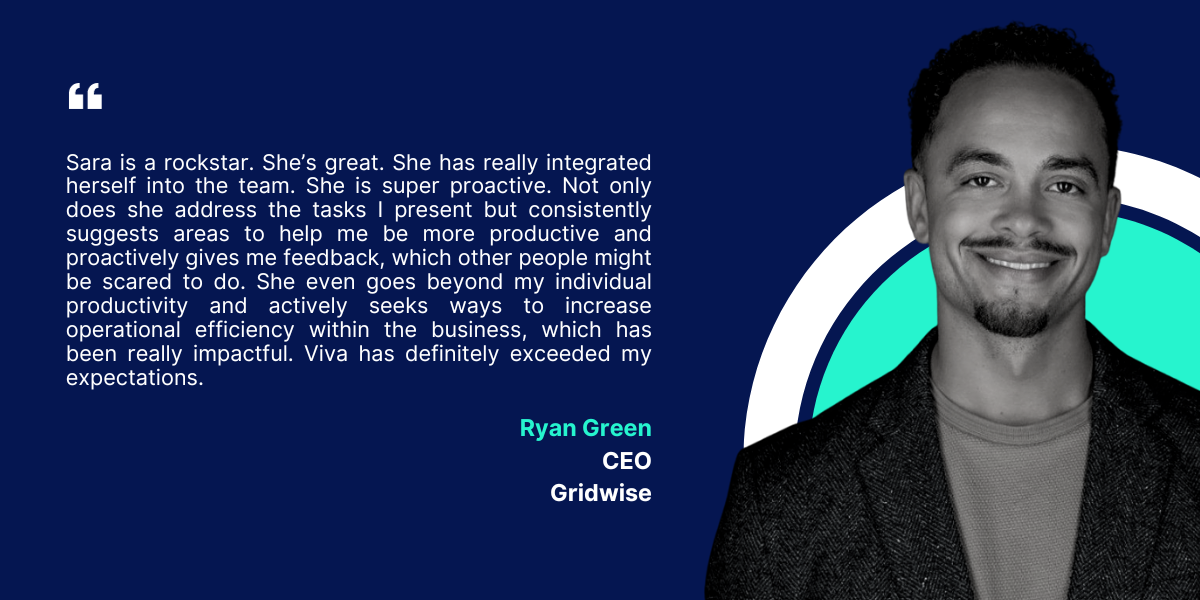
When you introduce a new tool in your tech stack, your job is far from done. Make sure you appoint a tool-adoption leader who can be there to support your team and help with implementation. Ryan knew the importance of this, so he appointed Sara as the power user of two very important tools Gridwise uses daily: Notion and Slack.
Sara put together a Notion masterclass for the whole team and did an entire Slack revamp, so everyone could learn best practices and make the best out of both work spaces. The resulting docs from these initiatives were so insightful, that Ryan decided to include them as part of the new hire onboarding checklist.
Leverage your EA as your second brain
Think about your cognitive capacity as a browser with multiple tabs open. You can easily switch between tabs and reopen one if you close it by mistake. But when it comes to our brains, recovering a forgotten idea is not that simple. If you’re lucky, you’ll eventually remember, but often, a lot of thoughts are just gone forever. That’s why you should write them down right when they come to you.
Ryan taught us a simple approach that is an effective way to avoid cognitive overload: he texts Sara as soon as he thinks of something, even if it’s not urgent, and even if it’s going to take a while before she needs to act on it. This allows him to get those thoughts out of his head and stay focused on his current work.
Board meeting prep
It doesn’t matter if the next board meeting is still a few weeks or even months away; anytime Ryan thinks of something that should be added to the deck, he texts Sara about it. It can be a note about doing research, pulling up some data, organizing it in a more visual way, or simply sharing a thought that occurred to him. By doing so, he gets it out of his head, Sara picks it up and starts preparing the content outline for the deck. By the moment the board meeting comes near, a big part of the work is already done.
Delegate email management
Staying on top of your email is incredibly important but it can also be overwhelming and time-consuming. That’s why Ryan’s approach is so practical and effective. Sara makes executive decisions to determine what’s important, what’s a distraction, and what needs to be addressed instantly.
She proudly says: “No cold email gets past me” and shares only the truly urgent via Slack so Ryan can answer on the spot without even having to open his email.
Approve travel planning in three clicks
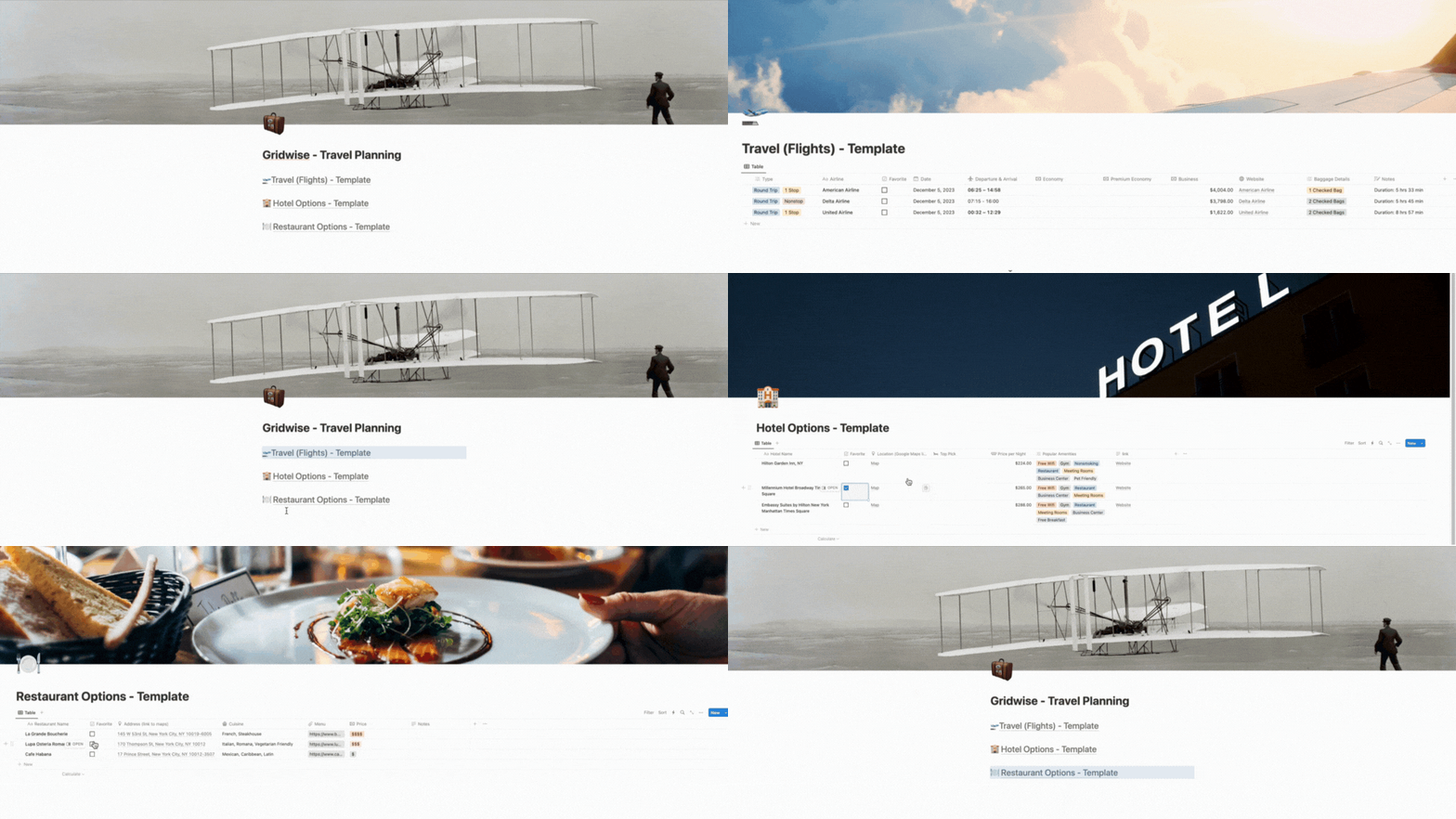
All our EAs plan offsites as part of their training, so Sara is no stranger to travel planning. This kind of task normally takes a lot of research, a number of hours, and a few iterations between executive and EA, but with Ryan’s approach, it can be done async and by clicking only three boxes.
Sara created a series of Notion pages she shares with Ryan before booking. They include airline, hotel, and restaurant options, and just by clicking on his favorite one, Ryan approves them. Sara then proceeds to booking and an entire trip is planned from beginning to end with the executive not having to get involved for more than five minutes.
The impact an EA can have on a CEO
Effective delegating contributes to time-saving
One of the first things we recommend for startup executives is to learn how to delegate. Ryan has this skill completely pinned down, and thanks to the divide and conquer strategy he and Sara have put into place, he can point at a problem, identify a need, or suggest a process improvement, and Sara will execute it from beginning to end. Ryan’s involvement is limited to making the request and reviewing it at the end.
Thanks to Sara’s involvement, Ryan only spends a fraction of the time he used to put in for email management, meeting prep, and travel planning, and the time he gets back is now focused on much more impactful work, like hiring key roles and growing his leadership team.
The benefits of having a thought partner
A good executive assistant can take notes at a meeting, a great executive assistant can capture action items and follow up on them, but a true thought partner can go the extra mile.
Sara doesn’t only attend board meetings, she helps Ryan prep for them and after the meeting is over, the two of them recap the questions or concerns voiced by the board members and establish a strategy to share them with the ELT in order to address all the board’s requests. Afterward, she follows up with all action items to ensure any necessary changes are made.
How did it help reduce cognitive overload?
There’s work that you only do once and work that keeps on popping up, like onboarding new team members; and when you delegate this kind of repetitive training, you don’t have to worry about your team being in sync with your processes. Your EA will make sure they are.
How can I reduce my cognitive overload?
Adopt Ryan’s approach and save time and – more importantly – cognitive capacity. This is a good way to start:
- Delegate repetitive tasks, such as onboarding new hires.
- Appoint the EA as tool-adoption leaders for your tech stack.
- Give them access to your email and reach inbox zero every day.
- Ask them to share an EOD Slack message with a summary of your email.
- Have them attend all meetings, take notes, track action items, put decks together, and give you feedback on what they think is most relevant.
- Share your travel preferences so they can book better trips for you.
- Ask them to create a Notion page that includes flight, hotel, coworking, restaurant, and car rental options.
- Text or send them a voice message whenever you think of something important – it goes out of your mind and gets on their to-do list.
If you want to reduce cognitive overload and think an executive assistant might be the way to go, chat with our team to see all the innovative ways in which you can leverage your Viva EA as your second brain.