Executive Assistants
Virtual sales assistant: How sales leaders decide, compare, and scale efficiently
Sep 2, 2025
8 min read


TL;DR
- Sales teams often lose a significant portion of the day to operational and administrative work
- A virtual sales assistant provides structured support without adding internal headcount complexity
- Virtual sales assistants improve CRM hygiene, follow-up consistency, and calendar quality
- In a real-world case, sales leaders reduced excessive meetings by combining automation with a sales EA
- The real advantage comes from delegation that preserves control, not from outsourcing blindly

Pressure on sales teams increases as companies scale, especially when operational work grows faster than selling capacity. In many U.S. companies, sales leaders and account executives spend a significant portion of the day managing CRM updates, scheduling, lead qualification, and follow-ups.
Cross functional research by the McKinsey Global Institute indicated that approximately one-third of sales and sales operations can be automated easily. That’s why having a sales assistant can give you 30% of your time back.
A virtual sales assistant is a remote professional who provides sales assistant support by handling these execution tasks so sales teams can stay focused on conversations, pipeline movement, and strategy.
Rather than replacing sellers, virtual sales assistants operate as an execution layer. They maintain data quality, manage coordination, and ensure follow-through across tools and workflows. This role is increasingly used by growth-stage teams that want to scale without adding unnecessary overhead or losing control of their sales process.
The decision is no longer whether to delegate sales operations, but how to structure delegation in a way that protects focus, improves consistency, and supports revenue growth.
Table of contents
- Why do sales teams use virtual sales assistants as they scale?
- What is the decision sales leaders face during growth?
- What does a virtual sales assistant do in a sales team?
- What should virtual sales assistants NOT be responsible for?
- How does sales assistant support improve pipeline consistency?
- Case study: How do sales teams combine virtual sales assistants with automation?
- How do virtual sales assistant vs. in-house sales support compare?
- When is a virtual sales assistant the right decision?
Why do sales teams use virtual sales assistants as they scale?
In growth-stage B2B environments, operational work often expands faster than headcount, creating hidden drag on sales execution. According to Forbes, 64.8% of reps’ time, on average, is spent in non revenue-generating activities, leaving only 35.2% for functions related to selling.
As pipeline volume increases, sales leaders are pulled into coordination work that distracts from coaching, strategy, and deal progression. CRM updates, meeting logistics, and inbox management are essential, but they dilute focus when handled by revenue owners.
This is why many U.S. companies turn to virtual sales assistants. The goal is not to outsource selling, but to introduce reliable sales assistant support that absorbs execution work and stabilizes daily operations.
When this layer is missing, sales teams often feel busy without feeling effective.
What is the decision sales leaders face during growth?
When execution load increases, sales leaders typically evaluate three options:
- Hire additional in-house sales support
- Rely more heavily on software and automation
- Introduce a virtual sales assistant with clearly defined ownership
In-house roles add capacity but increase overhead. Automation improves speed but struggles with edge cases and context. A virtual sales assistant sits between the two, combining human judgment with process discipline.
Across modern GTM teams, this model is increasingly treated as infrastructure rather than headcount.
3. What does a virtual sales assistant do in a sales team?
A virtual sales assistant is a remote professional trained to support sales execution. Their role is to ensure consistency, accuracy, and follow-through across the sales process.
Most teams document these responsibilities in playbooks so execution remains consistent as volume changes.
Typical responsibilities include:
- Lead research and enrichment based on ICP criteria
- CRM data management and pipeline hygiene
- Inbox and calendar coordination across time zones
- Sales email preparation and follow-ups
- Call preparation and post-call summaries
- Sales reporting and tool updates
This is another task a virtual sales assistant can take over according to one of our customers: “I appreciate that I can delegate the logistics of my job and lean on my EA to lead special projects like Quarterly Business Review planning, database creation, input on our Commercial Team Hub, etc.” – Head of Commercial Sales.
This form of sales assistant support allows account executives and sales leaders to remain focused on conversations and decisions rather than administration.
What should virtual sales assistants NOT be responsible for?
Clear boundaries are essential for success. A virtual sales assistant supports execution but does not own revenue, forecasting, or closing decisions.
They should not be responsible for:
- Closing deals or negotiating terms
- Making strategic sales decisions
- Owning quotas or forecasts
- Replacing SDRs or account executives
High-performing teams are explicit about these boundaries to avoid role confusion and protect forecast ownership.
How does a sales assistant support improves pipeline consistency?
Delegation works when it is structured. By assigning execution ownership to a virtual sales assistant, teams reduce context switching and eliminate operational noise that slows momentum. Follow-ups happen on time, CRM data remains accurate, and meetings are booked with better context.
Sales leaders often report:
- Fewer missed follow-ups
- Cleaner lifecycle stages
- Improved calendar quality
- Greater confidence in pipeline visibility
These outcomes are difficult to achieve with software alone and inefficient when handled by senior sellers.
As one of our customers said: “My EA has been amazing since the day she joined us. We wouldn’t have been able to pull off the sales kick-off without her; it was a logistical nightmare and she took full control of it. Her contributions have been game-changing, not only for me but for my entire team.” – Head of Revenue Strategy
How do sales teams combine virtual sales assistants with automation?
According to McKinsey, early adopters of sales automation consistently report increases in customer-facing time, higher customer satisfaction, efficiency improvements of 10 to 15 percent, and sales uplift potential of up to 10 percent.
And in this blog we bring you an example that shows how virtual sales assistants complement automation rather than replace it. One Viva executive assistant created an inbound lead automation that is saving the sales team hours every week.
The challenge
Receiving inbound leads is great, but getting them through different sources and having to determine whether they’re qualified based on different criteria created a lot of manual work for the sales team. That’s when one of our EAs decided to create an automation to reduce the amount of work and move the pipeline faster.
The automation workflow
With sales assistant support and a virtual sales EA overseeing execution, the team implemented an inbound lead automation that works like this:
- A meeting is booked through the website, blog, or any active scheduling link
- A short delay is introduced so the interaction feels natural
- Based on form responses, the system asks clarifying questions to assess qualification
- Leads are categorized based on predefined criteria
- If responses suggest a mismatch, a personalized email is sent from the account executive’s inbox to confirm accuracy and expectations
- The virtual sales assistant reviews responses and updates the CRM:
- Unqualified leads are moved to closed-lost
- Qualified leads are set to MQL and routed correctly

This pattern reflects how sales leaders balance speed with control as inbound volume increases.
The outcome
Sales teams reported fewer wasted meetings, cleaner lifecycle stages, and less time spent correcting CRM data. Calendar quality improved, and leadership regained focus previously lost to manual triage.
“The lift that I have gotten to focus on revenue-generating activities vs. administrative activities has been changing my ability to drive impact.” – Head of New Business Sales at a Series C startup
7. Virtual sales assistant vs in-house sales support
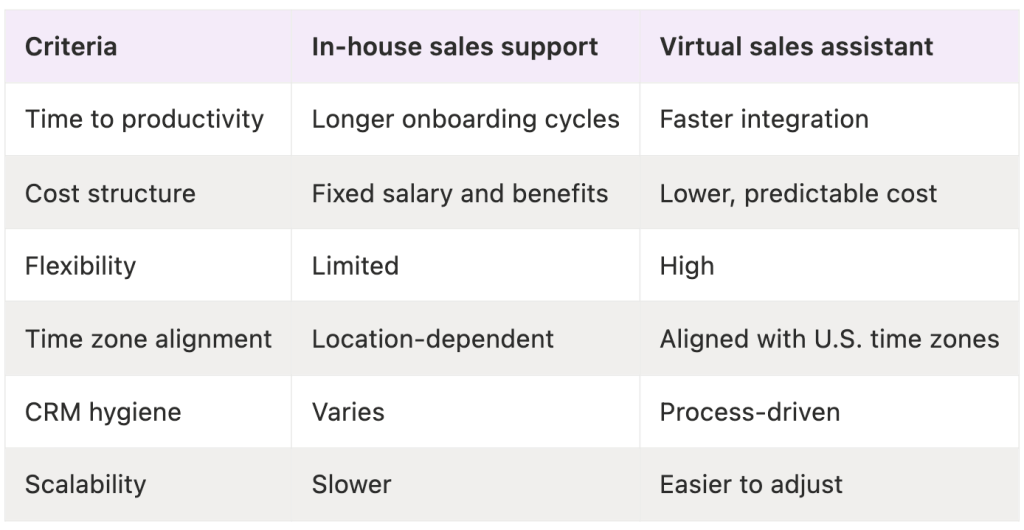
For many U.S. companies, this comparison clarifies the decision.
8. When is a virtual sales assistant the right decision?
A virtual sales assistant is a strong fit when:
- Sales reps spend a significant portion of the day on admin work
- Pipeline volume grows faster than internal execution capacity
- CRM accuracy affects forecasting confidence
- Founders or CROs still manage scheduling and follow-ups
In these scenarios, sales assistant support becomes a lever for focus and consistency.
9. Is your team ready for a virtual sales assistant?
Delegating execution to a virtual sales assistant creates space for the work that drives revenue.
Instead of managing inboxes, follow-ups, and CRM hygiene, sales leaders stay focused on deals, coaching, and strategy.
Executives at fast-growing companies have found that structured sales assistant support delivers leverage without the complexity of additional headcount. Is your team ready? Book a call today to find out how Viva can help your team work better and close more deals.
FAQs
What is a virtual sales assistant?
A virtual sales assistant is a remote professional who supports sales teams with operational and administrative tasks, allowing sellers to focus on conversations and pipeline movement.
What tasks can virtual sales assistants handle?
Virtual sales assistants manage CRM updates, lead research, scheduling, follow-ups, and reporting. This sales assistant support improves consistency across the sales process.
Can a virtual sales assistant close deals?
No. A virtual sales assistant supports execution but does not own closing, negotiation, or forecasting decisions.
How do virtual sales assistants work with automation?
Many teams combine automation with virtual sales assistants to ensure qualification, follow-through, and lifecycle updates remain accurate.
Are virtual sales assistants aligned with U.S. time zones?
Many companies work with Latin American talent aligned with U.S. time zones, enabling real-time collaboration.
.