Productivity
Ways to increase productivity in the workplace
May 31, 2024
7 min read


It’s a busy day, full of meetings, OKR planning, and fundraising activities. Are you achieving results or going into a meeting loop without making any real progress? This thought can leave you looking for ways to increase productivity in the workplace. Learn to prioritize your tasks using the impact effort matrix. This essential tool helps you focus on high-impact projects while reducing wasted effort.
One of the best strategies to become more productive is to learn how to prioritize tasks, especially those involving key stakeholders or large volumes of work/team members. When the stakes are high, like in building OKRs or fundraising, the process shouldn’t be left to luck.
It’s crucial to build processes and to have coherent structures for each task in order to prioritize appropriately and effectively. These structures and processes will make tasks easier to tackle and will make follow-up easier, too. Productivity thrives with accountability.
The impact/effort matrix is a powerful tool for prioritizing and creating structure. Let’s see how it can be used for these 3 high impact tasks:
- Building OKRs (and following up)
- Planning and leading meetings
- Fundraising

Table of contents:
- Prioritizing tasks with the impact/effort matrix
- Building and following up on OKRs
- Planning and leading meetings
- Fundraising
Prioritizing tasks with the impact/effort matrix
The impact/effort matrix is a prioritization tool that uses quadrants to divide tasks (or any other criteria) into 4 buckets. The purpose of the matrix is to divide tasks into high-impact/low-impact and high-effort/low-effort.
For example, a task that is easy to perform and impactful would be considered low-effort/high-impact. These are the best tasks because they are the low-hanging fruit of productivity in the workplace.
- An example of this task can be implementing a referral program. It’s relatively easy to implement using existing tools or software, and it can have a significant impact on customer acquisition and revenue growth.
The least productive tasks are high-effort/low-impact tasks. It’s because they will require a large amount of input but produce very little output.
- An example of a task can be building a custom internal project management tool. This can be time-consuming, and expensive. There are readily available tools that any company can use. Unless this is a feature of your product, don’t waste your time.
Here’s how the impact/effort matrix works:
- Impact: Impact is defined as the potential benefit or significance of a task or project. It can include factors such as revenue generation, customer satisfaction, and strategic alignment.
- Effort: Effort is defined as the amount of time, resources, and difficulty involved in completing a task or project. It can include factors such as time required, complexity, and cost.
The quadrants are divided like this:
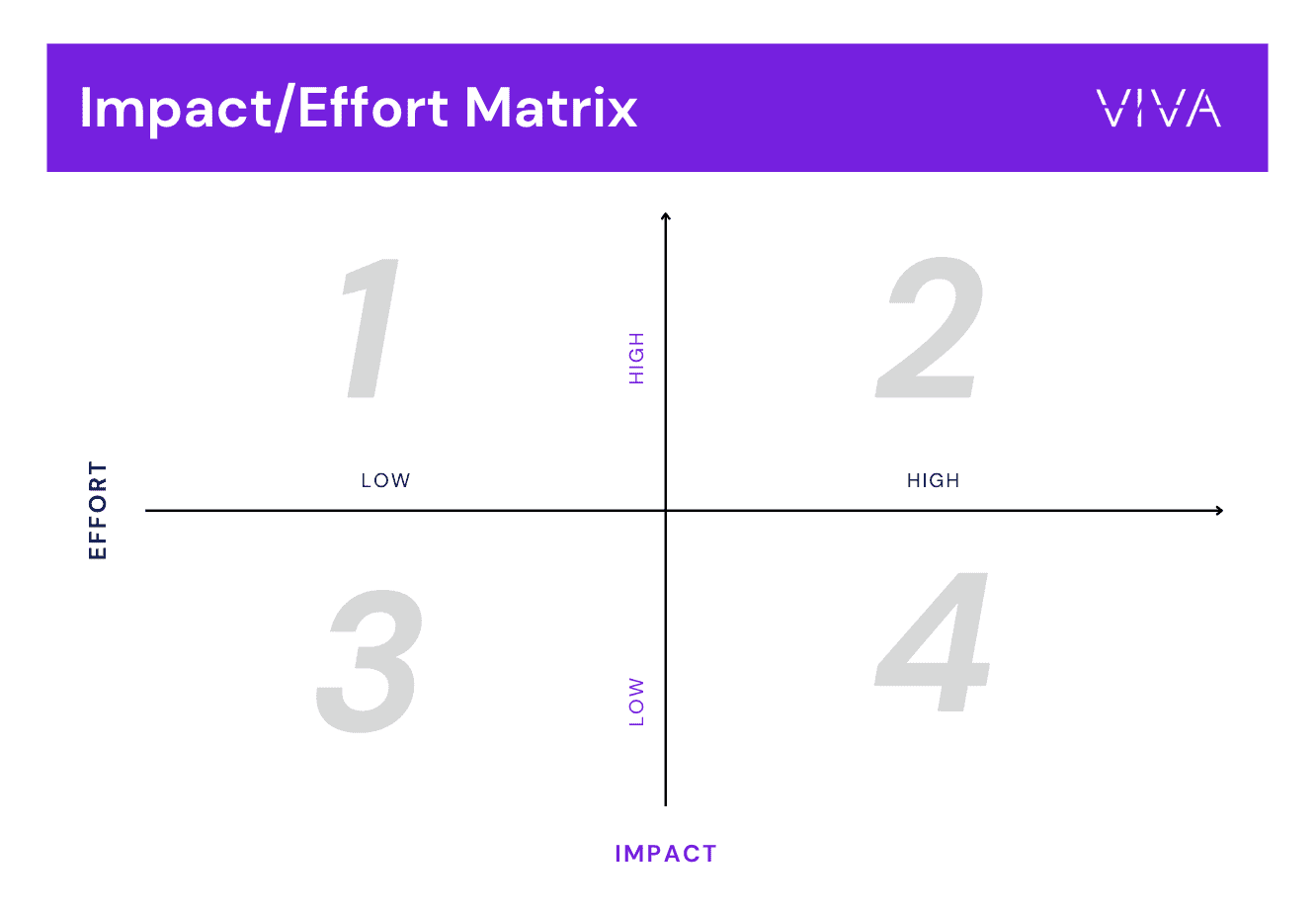
- Low-effort & high-impact: These are the quick wins.
- High-effort & high-impact: Although these tasks require more resources, they also provide effective results.
- Low-effort & low-impact: Don’t mistake these for quick wins. Because they are seemingly easy to complete, these may consume all your time and leave you scraping for results that actually matter.
- High-effort & low-impact: These are the tasks that, after completing them, leave you feeling like you’ve wasted your time and resources, with very little effect on your expected results.
Is using the impact/effort matrix worth the effort?
It can be. Taking the time to build a matrix for tasks like OKR planning, meetings, and fundraising activities can have a high impact on your team’s productivity. Because these tasks are also high effort, we recommend that you leverage help in getting them done.
A great way to make this high-impact task less effort for you is by delegating it to your executive assistant.
OKR planning with the impact/effort matrix
Objectives and Key Results, or OKRs, are tools that leaders use to have their teams reach specific goals on a quarterly and yearly basis. The transparency and accountability of OKRs help companies grow in intentional directions. Prioritizing accordingly improves workplace productivity.
However, while planning and executing OKRs, teams can get lost pursuing paths that lead nowhere. Where to start? What initiatives should be prioritized? How long should each task take? Use the impact/effort matrix to assess.
OKR planning and reviewing tends to be a time-consuming task. Every task related to it may seem urgent, but it’s crucial to have a framework that clearly defines what tasks to prioritize. Here’s our example of how to use the impact/effort matrix effectively for OKR planning and follow-up:

Here’s a breakdown of the tasks:
(Note that these are examples of tasks for the OKR process; it’s not an exhaustive list of tasks.)
Low effort, high impact (Q1)
- Develop a communication plan to introduce OKRs to the team
- Set up tools for tracking and managing OKRs
High effort, high impact (Q2)
- Draft objectives
- Ensure alignment across go-to-market teams and stakeholders
- Conduct partial reviews to assess progress
Low effort, low impact (Q3)
- Send out regular email updates highlighting progress and achievements related to OKRs
High effort, low impact (Q4)
- Have overly bureaucratic OKR review processes
Prioritizing meetings with the impact/effort matrix
Prioritizing meetings is a great way to increase productivity in the workplace. Which meetings are important and must be held, and which ones can come off the calendar and be handled via email or async communication?
The effort of a meeting can be measured by the amount of resources that are invested into it: preparation time, logistics and coordination, stakeholder involvement and follow-up actions.
Meetings tend to take a considerable amount of time. Every meeting that involves your entire team represents a significant investment for your company.

Breakdown of meetings:
(Note that these meetings are an example; they are not an exhaustive list of meetings.)
Low effort, high impact (Q1)
- 1:1 meetings (since you are not the host)
- Feedback meetings
- Employee recognition and celebrations
- Brainstorming meetings
High effort, high impact (Q2)
- Customer meetings
- Board meetings
- Fundraising meetings
- Product launch
- Compliance and regulation meetings
Low effort, low impact (Q3)
- Any meeting that you didn’t plan and just attend; there is no requirement or expectation
High effort, low impact (Q4)
- Unnecessary or poorly defined meetings with unclear agendas, unfinished decks, or low attendance.
Fundraising with the impact/effort matrix
Fundraising has become one of the most challenging tasks a company faces. Ensuring the necessary funds to operate is definitely a priority, but so is growing the business.
Most companies don’t have dedicated fundraising teams, and the process of raising money tends to be very time-consuming. This makes prioritizing a top concern for teams that want to get it all done: fundraising plus the critical daily tasks that will lead to growth.
To use this matrix for fundraising, break down fundraising tasks and sort them according to their priority (ask your executive assistant to do this).

Breakdown of fundraising tasks:
(Note that these tasks are an example; this is not an exhaustive list of fundraising tasks.)
Low effort, high impact (Q1)
- Craft a compelling elevator pitch
- Utilize online fundraising platforms
- Create an investor repository to keep track of meetings and investments
High effort, high impact (Q2)
- Build a diverse investor network
- Develop a scalable growth strategy
- Conduct due diligence
Low effort, low impact (Q3)
- Update social media profiles with minor changes
- Send generic email blasts to a broad list of potential investors without personalization or segmentation
High effort, low impact (Q4)
- Pursue grants with low success rates
- Building lengthy decks that investors won’t review
Conclusion: Impact Effort matrix
When time is a commodity, ruthless prioritization becomes crucial.
Using structured methods to prioritize can help executives and their teams make decisions on a regular basis without having to waste resources.
Planning OKRs, managing meetings, and coordinating fundraising efforts impact the executive’s role – and the company as a whole.
Are there other tasks that you need support prioritizing? Contact us so we can provide you with ideas on how to structure your workflow and maximize productivity in your startup journey.