Executive Assistants
How to evaluate executive assistant recruitment agencies
Jan 13, 2026
5 min read



TL;DR:
This guide helps People leaders assess agencies using clear criteria like speed to productivity, quality, specialization, scalability, and accountability, while highlighting the tradeoffs across common agency models and the signals that separate strong partners from transactional recruiters. “When the EA hire is right, you feel it immediately, not just in your calendar, but in how the entire leadership team operates,” one People leader shared, underscoring why EA quality matters as organizations grow.
Table of contents
- Why is choosing the right executive assistant recruitment agency harder than it looks?
- What criteria should executives use to evaluate EA recruitment agencies?
- How do EA recruitment agencies differ across speed, quality, and specialization?
- What tradeoffs should People leaders expect when working with different agency models?
- What questions should executives ask recruitment agencies on the first call?
- What signals separate strong EA recruiters from weak ones?
- Why do enterprise teams increasingly treat EA hiring as a strategic function?
Why is choosing the right executive assistant recruitment agency harder than it looks?
Hiring an executive assistant is no longer a simple staffing decision when you’ve reached enterprise scale: it’s a leverage decision. The right EA shapes how executives spend time, protects confidential information, and moves work across functions with minimal friction. Yet many executive assistant recruiting firms still approach the role transactionally, even though the average cost to hire a new employee is $4,700 and the average time to hire stretches beyond 20 days before you being to see a productivity pay-off
This is where resume-based or speed-only approaches break down. A resume rarely reflects a candidate’s judgment, discretion, or their ability to operate across finance, HR, legal, and operations. And a recruiter for executive assistants who optimizes for fast placement often trades long-term impact for short-term speed. As Forbes puts it, a poor fit can disrupt executive effectiveness and organizational efficiency, and at the enterprise level, that disruption compounds far beyond a single executive’s calendar.
What criteria should executives use to evaluate executive assistant recruitment agencies?
The table below highlights where executive assistant recruiting firms truly differ. Speed to productivity distinguishes agencies that deliver real executive leverage from those that optimize for fast placement, while the quality and consistency criterion reveals how weak screening or limited training creates risk beyond a single role.
Specialization matters because senior leaders require judgment and discretion, not just administrative execution, and scalability separates one-off solutions from models built to grow. Finally, attention to risk management can make or break your business, so it’s key to consider, too.
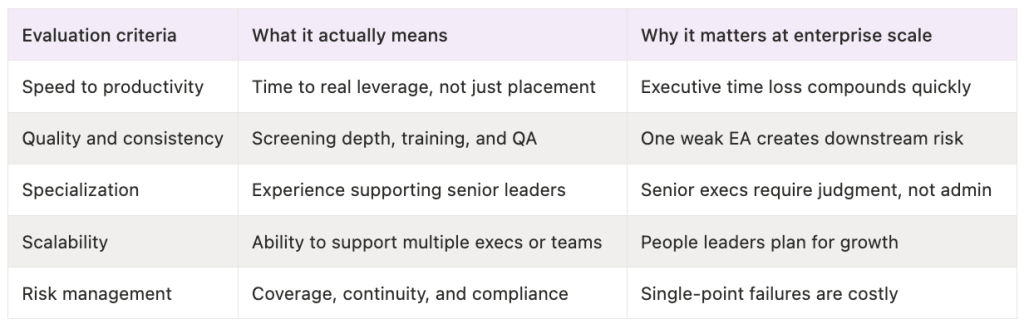
These criteria also expose the difference between a recruiter for executive assistants and a long-term partner that reduces operational and continuity risk as demands increase. With Viva, EA support can expand as needed, allowing teams to move from one assistant to a shared pool over time.; It’s an approach we’ve seen work in practice, including at how Notion, which scaled from a single EA to a broader EA team.
How do executive assistant recruitment agencies differ across speed, quality, and specialization?
How fast do agencies actually get EAs productive?
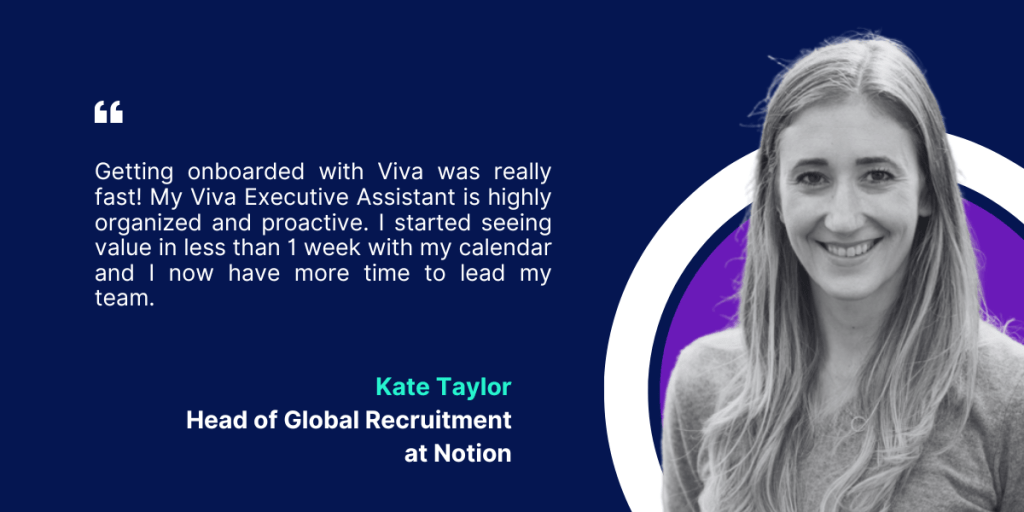
Many executive assistant recruiting firms optimize for fast placement, but speed to impact depends on onboarding, tooling, and how quickly an EA understands an executive’s priorities and working style.
How do agencies ensure consistent quality across hires?
Interviews alone rarely predict on-the-job performance, which is why quality breaks down without structured training and ongoing management. This matters because replacing an employee can cost anywhere from half to two times their annual salary, according to Gallup, turning a single weak hire into a major business expense. A recruiter for executive assistants who relies only on resumes and interviews leaves that risk with the buyer.
How specialized are agencies in executive-level support?
True executive support goes far beyond admin work. It involves confidentiality, board prep, and cross-functional visibility – areas People leaders can’t afford to get wrong.

What tradeoffs should People leaders expect when working with different agency models?
Different agency models present different tradeoffs. Understanding these helps People leaders choose intentionally rather than defaulting to what’s familiar. Traditional recruiting firms offer custom searches but often move slowly and deliver uneven results, while staffing or temp agencies prioritize speed over goodness of fit.
Freelancer marketplaces provide flexibility for specific needs but usually lack quality assurance or long-term accountability.
Managed EA partners, where many executive assistant recruiting firms now cluster at the enterprise end of the market, trade a higher upfront investment for consistency, scalability, and shared ownership of outcomes, making them better suited for supporting multiple executives over time than a transactional recruiter for executive assistants.

What questions should executives ask recruitment agencies on the first call?
Strong executive assistant recruiting firms can clearly explain how they drive outcomes after placement, not just how they source candidates. Asking specific, pointed questions helps executives and People leaders assess whether a recruiter for executive assistants is equipped to support real executive leverage, continuity, and growth.
Suggested questions to ask:
- How do you measure EA success after placement, and who owns those outcomes?
- What happens if the match doesn’t work in the first 30–90 days?
- How do you handle onboarding and knowledge transfer for new executives?
- Who manages performance, feedback, and ongoing development over time?
- How do you ensure continuity if an EA is unavailable or leaves?
- What experience do your EAs have supporting senior leaders or multiple executives?
- How do you adapt support as executive needs or team sizes change?
What signals separate strong EA recruiters from weak ones?
The difference becomes clear early in the conversation. Strong executive assistant recruiting firms focus on outcomes, not resumes, and can clearly explain how an EA ramps, what “good” looks like after the first few weeks, and how they’ve handled real executive-level scenarios. They speak confidently about accountability beyond placement and show how success is measured over time.
Weaker signals often come from a recruiter for executive assistants who over-indexes on speed, avoids ownership once the hire is made, or treats EAs as interchangeable resources. When questions about ramp plans, continuity, or executive impact are met with vague answers, it’s usually a sign that the burden of risk will sit with the People team, not the recruiter.
Why do enterprise teams increasingly treat EA hiring as a strategic function?
As organizations scale, executive support becomes directly linked to leadership effectiveness, burnout prevention, and overall organizational health. When executives have strong support, their focus is protected, their decision fatigue is reduced, and they operate more sustainably.
Forbes notes that “the prevalence of burnout is 58% lower among employees who experience strong manager support for mental well-being,” reinforcing how support systems, especially at the top, shape performance across the company.
This is why People leaders increasingly own EA hiring decisions. As Alexander Kirss, Senior Principal in the Gartner HR Practice, explains, “Fewer than one in four CxOs say their CHRO is effective at strengthening the C-suite’s ability to function as a cohesive team.”
Building a strong executive support function is one lever People teams can control. To explore how others have done this in practice, we interviewed leaders at MongoDB, Notion, and Datadog on how they built and scaled executive support at their organizations – their insights are worth reading for any team taking this function seriously.
Looking for the right EA partner? Viva helps People leaders hire executive assistants who deliver real leverage. Book a call with our team and let us help you find the best EA for your needs.
FAQs about executive assistant recruitment agencies
What does an executive assistant recruitment agency actually do?
An executive assistant recruitment agency sources, evaluates, and matches executive assistants to senior leaders based on experience, skill set, and working style.
At the enterprise level, stronger agencies go beyond placement by handling vetting, onboarding, performance management, and continuity so People leaders aren’t managing the role themselves.
How long does it take to hire an executive assistant through a recruitment agency?
Timelines vary by agency model.
Traditional recruiting firms may take several weeks to months, while staffing agencies can place candidates quickly but often with limited screening.
Enterprise-grade EA partners typically focus on faster time to productivity, meaning executives feel real leverage within weeks.
Are executive assistant recruitment agencies worth it for enterprise teams?
Recruitment agencies are most valuable for enterprise teams when the cost of executive time, burnout, or mis-hiring is high.
When an EA supports senior leaders across complex organizations, the right partner reduces risk, improves consistency, and frees People teams from repeated hiring cycles.
What’s the difference between a staffing agency and an enterprise EA partner?
Staffing agencies focus on filling roles quickly, often prioritizing availability over long-term fit.
Enterprise EA partners operate with an ongoing support model, providing trained assistants, structured onboarding, quality control, and backup coverage to support multiple executives over time.
How should People leaders measure success after hiring an executive assistant?
Success should be measured by executive outcomes, not task volume.
Strong indicators include improved calendar discipline, faster follow-through on priorities, reduced executive context switching, and positive feedback from stakeholders who interact with the EA regularly.
–