Executive Assistants
Virtual assistant costs for executives: What to know in 2026
Jul 22, 2025
5 min read


Evaluating support options in fast-growing companies often starts with one key question: How much does a virtual assistant cost? According to the Bureau of Labor Statistics, benefits alone add over 30% to civilian employee compensation costs per hour.
The real answer depends on much more than just pricing. It includes the assistant’s ability to integrate quickly, the level of training they receive, and how well they support leadership effectiveness over time.
“I’m thrilled with how quickly my EA has picked things up. She was able to jump right in and has done a phenomenal job. On day 2 of working together she was already transforming my whole calendar and managing my email.“ – CEO at a Series C tech company
This guide is built for decision-makers who want to understand the cost of virtual assistant services through the lens of performance, not just affordability.
Table of contents
- How the cost of a virtual assistant compares across models
- Comparing hiring models and cost implications
- What is the ROI of a virtual assistant?
- What Viva’s virtual assistant costs include
- Conclusion
- FAQ
How the cost of a virtual assistant compares across models
When leaders ask how much does a virtual assistant cost, they’re often expecting a single, simple answer. In reality, virtual assistant cost varies widely depending on the pricing model, level of coverage, and how support is delivered day to day.

Looking at the table above, it becomes clear that virtual assistant pricing is less about the sticker price and more about the structure behind it. Different models: full-time, fractional blocks, and fractional packages, create very different virtual assistant rates and overall VA fees once you normalize for hours and executive effort.
The real takeaway on virtual assistant pricing
Across all models, the key insight is this: virtual assistant pricing is not just about monthly fees, it’s about usable support. Lower VA fees don’t always translate to better value if executives spend extra time managing hours, reallocating tasks, or filling gaps themselves.
When comparing virtual assistant rates, the most cost-effective option is often the one that reduces friction, handoffs, and oversight. In other words, the true virtual assistant cost includes not just what you pay but how much time and energy you get back in return.
Comparing hiring models and cost implications
Different hiring models vary not just in cost, but in how much work they take off their executive’s plate. Some EA services provide only candidates, leaving training and oversight to you. Others, like Viva, deliver fully-supported assistants who are ready to perform from day one. For a side-by-side comparison, see the best executive assistant services in 2026. Wondering how to hire an executive assistant? Follow our 10 steps to hire the best EA for your team.
Full-time, dedicated assistants: predictable VA fees and lower hourly rates
Full-time models offer the most straightforward answer to how much does a virtual assistant cost when you need consistent, ongoing support. With 160 hours per month included, the virtual assistant cost is easy to calculate and the effective virtual assistant rates tend to be the lowest on the market.
When broken down hourly, full-time models typically land in the low-to-mid $20/hour range, making VA fees both predictable and cost-efficient. This approach to virtual assistant pricing works best for executives who need daily support and want to avoid the hidden cost of managing limited hours.
Fractional monthly blocks: higher virtual assistant rates for flexibility
Fractional block models are often positioned as flexible alternatives, but the table shows a very different story once you analyze virtual assistant cost at scale. While the monthly entry price may appear lower, the effective virtual assistant rates frequently exceed $65/hour when normalized to a full-time workload.
For leaders evaluating how much does a virtual assistant cost under this model, it’s important to account for more than just VA fees. Limited hours mean more prioritization, more context-switching, and more time spent deciding what doesn’t get done, all of which increases the real cost of virtual assistant pricing beyond the invoice.
Fractional packages: lower upfront cost, constrained coverage
Fractional packages typically advertise the lowest monthly VA fees, making them attractive for light or occasional use. However, these plans often rely on shared resources and capped availability, which can limit responsiveness and continuity.
Although virtual assistant rates may improve slightly at higher tiers, overall virtual assistant cost remains high relative to coverage. For executives asking how much does a virtual assistant cost in terms of dependable support, this model is best viewed as supplemental rather than foundational.
Ready to delegate without the overhead? Viva delivers high-performing executive assistants without the hiring complexity. Book a consultation to see how our model can support your current priorities.

What is the ROI of a virtual assistant?
The average cost of a virtual assistant only makes sense when viewed in context: What time, focus, and progress do they enable?
In this case, the return on investment (ROI) refers not only to cost savings but also to the measurable time and decision-making capacity reclaimed by executive leaders. It reflects the value of having more hours in the day to focus on priorities that drive growth.
Viva executive assistants typically reclaim 2 to 3 hours per day for senior leaders by taking on repetitive tasks like calendar and inbox management, meeting preparation, project management, and team communication. For a CEO earning $200,000, whose time is often valued at 6× their average salary, that time can translate into an ROI of up to 8×, especially when the assistant supports multiple leaders or business units.
Location matters, too. Assistants working overnight to match U.S. hours often face fatigue and slower response times. Viva’s Latin America–based assistants work in their natural daytime hours, improving clarity, responsiveness, and execution quality.
The result: less time spent managing tasks, and more time focused on driving growth.
Looking to hire an executive virtual assistant? Explore how to make the business case for an executive assistant.
Faster onboarding means faster ROI
Hiring costs include more than salary or a monthly rate. According to the Society for Human Resource Management, the average cost to hire a new employee is $4,700, Time spent ramping up new team members slows momentum and adds operational burden, especially when onboarding is left entirely to the executive team.
“The hiring process and speed is really strong and makes Viva stand out from other options. We have onboarded with Viva multiple times and trusted their judgment to select the best EAs for us based on our needs.” – CEO at a Series A gaming company
Viva shortens that runway. Assistants complete business training before placement and receive structured coaching throughout onboarding. Most are integrated within two to three weeks and start delivering value from day one.
This preparation reduces ramp-up overhead, limits executive time spent on training, and ensures that productivity gains begin earlier in the relationship.
How much is a virtual assistant when quality, onboarding, and support are all included? Viva’s flat-rate pricing gives you a full picture, with no added overhead or hidden costs. Book a consultation to see what it looks like for your team.
What Viva’s virtual assistant costs include
Most virtual assistant services quote hourly rates that often exclude the real costs that make support effective, like hiring, training, and oversight. Viva’s flat monthly rate removes that ambiguity and includes the full infrastructure needed for executive-level support.
For $3,999 per month, Viva’s pricing includes:
- A top 0.2% talent pool of skilled professionals
- Business bootcamp and role-specific onboarding
- Integration with your systems and workflows
- Equipment, security, and tool setup
- Weekly coaching and development
- Support during PTO and transition periods
- A 30-day trial to validate fit. Viva takes care of replacements if need be.
- Assistants based in Latin America, ensuring full alignment with U.S. hours
This approach reflects the true cost of a virtual assistant: not just time spent on tasks, but the systems, support, and context that make them effective. Viva assistants arrive ready to contribute, without requiring extra training or performance management.
Here’s a quick visual summary of what goes into the cost of a virtual assistant and how Viva compares:
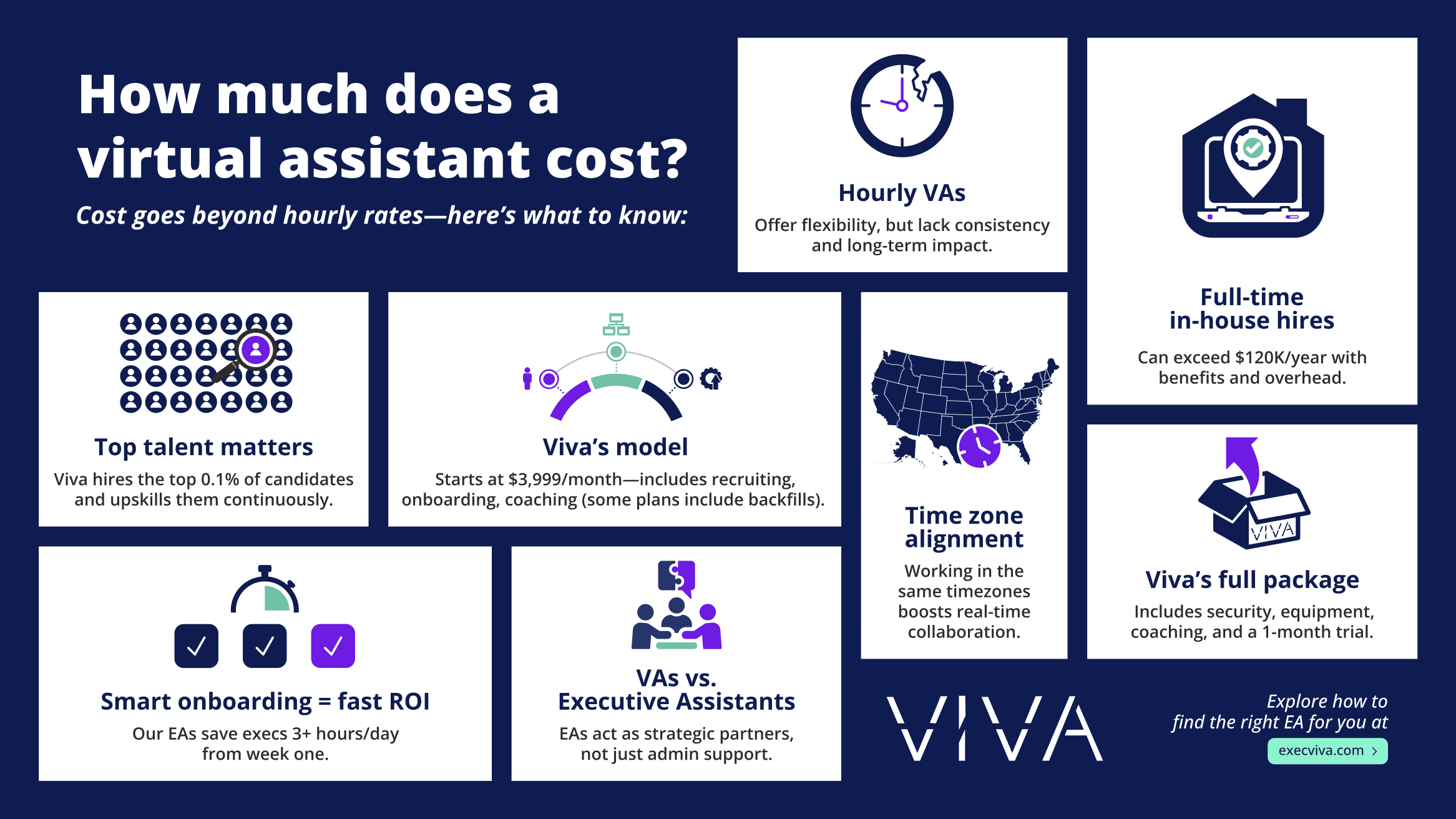
Designed for impact. Priced for performance.
Executives don’t necessarily invest in support to cut costs. They invest to protect their time, focus, and decision velocity.
Viva delivers readiness, reliability, and operational lift in ways traditional hiring models can’t. Each assistant is vetted, business-trained, and backed by systems that support consistent delivery. There’s no need for executive-led onboarding, performance management, or correction.
Executives choose Viva not just for our transparent virtual assistant cost, but for the long-term capacity and the ROI it brings.
Book a call to see how executive support at this level pays off in every hour you reclaim.
Related reading
- Executive assistant cost calculator
- Virtual assistant ROI calculator
- Best executive assistant services in 2026
FAQ: Executive Virtual Assistant Cost
What makes Viva’s flat-rate pricing more cost-effective than hourly models?
Flat-rate pricing eliminates hidden costs like onboarding time, hourly overages, or the need to manage multiple assistants. Viva’s assistants are embedded, fully trained, and ready to perform from day one saving executives time and operational friction.
How quickly can Viva EAs start delivering value?
Most Viva assistants begin delivering value within their first week, thanks to pre-placement training and structured onboarding support. Customers report time-to-value in as little as 72 hours, especially when assistants are supporting multiple executives.
Can a Viva EA support more than one executive?
Yes. Viva’s assistants are equipped to support up to three leaders when needs align. This structure increases ROI by spreading support across teams while maintaining continuity and high performance.
.