Executive Assistants
Executive Assistant vs. Personal Assistant: What’s the difference?
Jan 20, 2024
5 min read


Last updated on December 11, 2025
TL;DR
- Executives get 1 week back each month thanks to their EAs: They gain ~1.9 hours back per day by delegating calendar, inbox, and meetings, totaling ~10 hours weekly.
- Executive assistant vs personal assistant is a key distinction when hiring strategic support.
- A personal assistant focuses more on out-of-office logistics, while an EA supports professional priorities and team-wide coordination.
- Executive and personal assistant duties often overlap in admin work, but differ in context, ownership, and impact.
- Choosing the right assistant depends on where you’re losing time, and what type of decisions and tasks you need support with.
- Viva EAs are hired to help executives across work and life, but always with a leadership-first focus.
As of 2025, the distinction between executive assistants and personal assistants reflects two fundamentally different roles. In an internal survey of the executives we support, leaders at companies like Shippo, Groq, and Veho, 70.6% reported that their EA implemented automations or AI tools that directly reduced workload and removed recurring bottlenecks.
This marks a shift in the category: executives aren’t just delegating tasks, they’re delegating the systems that generate them. That level of impact requires business judgment, strategic context, and technical fluency beyond the scope of traditional assistant roles.
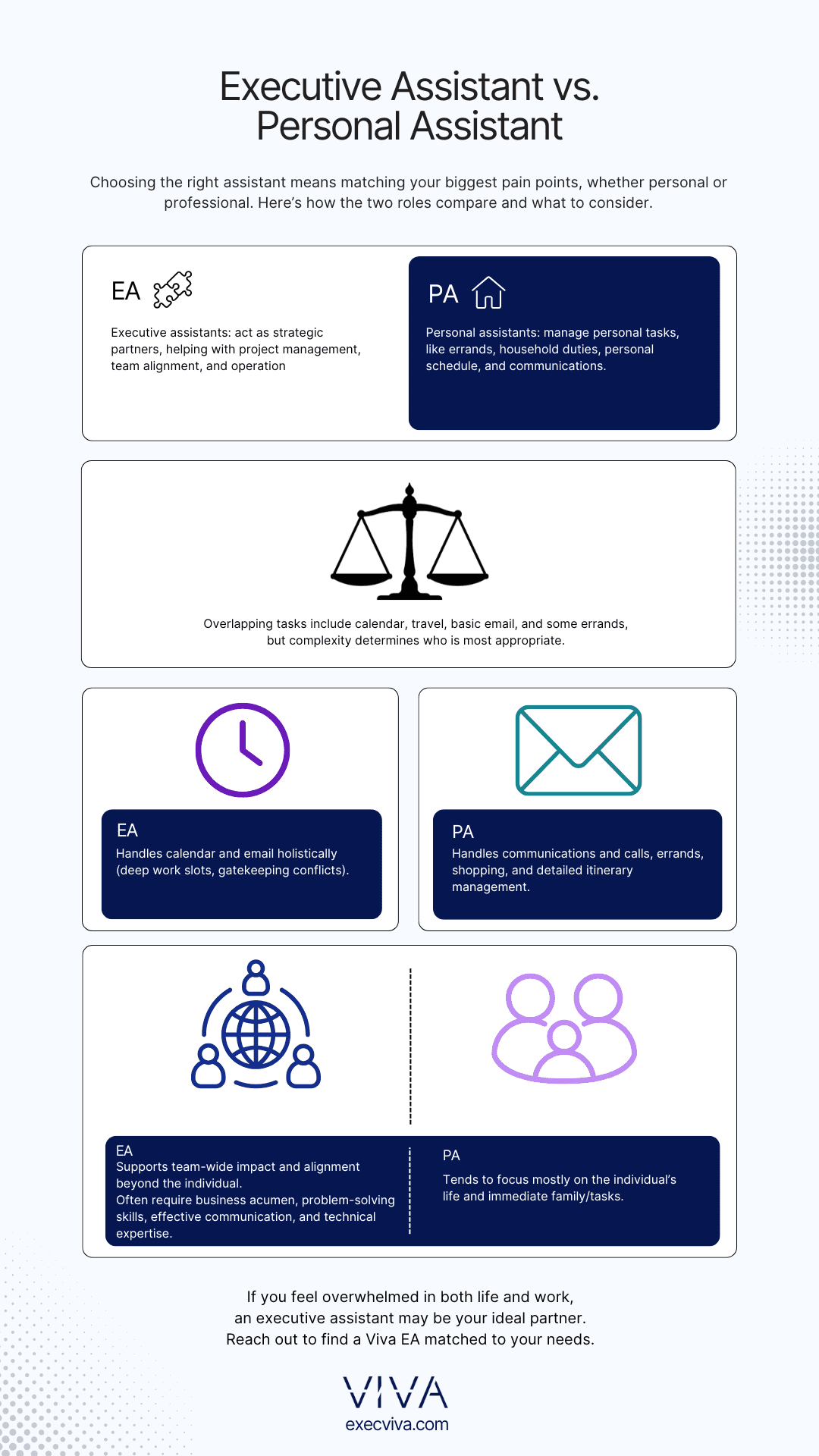
Table of contents
- Why is it important for a leader to decide between an executive assistant and a personal assistant?
- What does an executive assistant do?
- What does a personal assistant handle?
- Executive assistant vs personal assistant: How are they different?
- How do you choose an assistant based on your time and role?
- What do hybrid personal executive assistants do?
1. Why is it important for a leader to decide between an executive assistant and a personal assistant?
Time is one of the few truly finite resources for CEOs. According to Deloitte’s 2025 Global Human Capital Trends survey, 41% of respondents’ time each day is spent on work that doesn’t contribute to the value their organization creates.
That’s why in 2026, understanding the differences between EA and PA are more important than ever. Executives at U.S. startups and scale-ups operate in high-pressure environments, balancing stakeholder demands with rapid hiring and shifting team priorities and no time to waste.
Choosing between an executive assistant vs personal assistant isn’t just about job titles; it’s a decision that impacts your time, leadership, and team outcomes. Understanding how a personal executive assistant differs from role-dedicated support is the first step in making the right hire.
“I am incredibly pleased with the quality of Özlem’s work, and she has become a trusted member of our team. I am a more effective executive with Özlem on my team.” — CEO & Co-Founder, AyarLabs
This blog breaks down the differences in scope, responsibilities, salary expectations, and strategic value to help you make the right call.
Read how two leaders from AKASA decided to leverage the same assistant in completely different ways: she acts as a personal assistant to one, and as an executive assistant to the other.

2. What does an executive assistant do?
An executive assistant is a high-trust partner who supports business leaders by managing priorities, protecting time, and improving outcomes.
They’re experts at giving time back to their executives. According to Forbes, executive assistants can save leaders up to 8 hours per week, or 32 hours per month. We asked all the executives we support, and we found that every month, executives win back an entire week, not by working longer hours, but by handing off the right operational levers.
We asked our end users, and across hundreds of data points, one pattern is clear: when leaders delegate ownership of their calendar and other high-effort logistics to their executive assistant, they consistently reclaim nearly 10 hours per week. That time compounds into a full week each month for deep, strategic work without adding to their cognitive load.
“Vanessa has been a trusted partner, and we’ve established an effective working relationship. She is going above and beyond to protect my calendar and give me leverage by assisting me in various tasks ranging from calendar and mail management, meeting organization and prep, and travel planning.” — Head of Enterprise, Notion
Typical executive assistant responsibilities include:
- Inbox triage and message drafting: Filtering, flagging, and drafting high-priority communications so the executive focuses only on what matters most.
- Calendar design based on strategic goals: Building time blocks around deep work, high-leverage meetings, and leadership priorities.
- Meeting prep, follow-ups, and materials: Prepping decks or agendas, capturing notes, and ensuring action items are completed post-meeting.
- Recruiting candidates and managing hiring logistics: Scheduling interviews, tracking stages, and prepping candidate briefs.
- Travel and expense planning: Booking flights, hotels, and transportation, as well as managing expense reports and tracking budgets.
- Team comms and internal operations: Drafting updates, running weekly team syncs, and keeping everyone informed and aligned.
- Project coordination and internal workflow optimization: Helping manage OKRs, project deadlines, and cross-functional dependencies.
- Board meeting prep and stakeholder briefings: Organizing briefing documents, updating decks, and ensuring executive readiness.
- Automation and AI enablement: In Q3 2025, 70.6% of our end users reported that their EA implemented automations or AI tools that directly reduced workload and removed recurring bottlenecks.
What does this mean in real life?
- A CEO’s EA blocks focus time each week, filters non-urgent Slack pings, and coordinates investor updates.
- A People Ops VP delegates recruiting debriefs, scheduling, and offer letter coordination to their EA.
- A CRO hands off CRM updates, event planning, and pipeline reporting to a trusted EA.
This level of coordination, foresight, and strategic support clearly separates the executive assistant from the personal assistant.
“Karla has consistently been able to take on more ownership and more responsibility – with core logistics and especially recruiting. It’s been a huge help to the team.” — Head of Talent and People Operations, Luminai
Salary expectations (U.S.): Executive assistant salaries range widely in the U.S., with the national average hovering between $70,000 and $85,000. EAs supporting C-level leaders in high-growth tech companies routinely earn six figures, especially when they’re handling tools, systems, and workflows critical to scale. Tech executives should expect to pay close to $100,000 annually for top-tier support.

3. What does a personal assistant handle?
Personal assistants often support individuals with out-of-office tasks, from scheduling family commitments to handling errands.
Typical personal assistant responsibilities include:
- Household or family scheduling: Coordinating family calendars, kids activities, appointments, and home events.
- Personal errands and shopping: Running daily errands, gift shopping, doing in-store pick-ups, and handling returns.
- Travel planning and concierge tasks: Booking personal travel, managing restaurant reservations, and coordinating special occasion logistics.
- Bill payments, staff coordination, and home maintenance: Handling utilities, paying household staff, managing service vendors like cleaners or handymen.
- Inbox and phone communication management: Answering calls, responding to personal emails, and organizing correspondence.
- Grocery restocks, returns, and holiday planning: Managing pantry restocks, returns for online purchases, and handling logistics for holiday travel or events.
PA support in real life:
- A solopreneur delegates accommodation bookings, dinner reservations, and birthday gift shopping to their PA.
- A busy parent gets help with coordinating nannies, vet visits, and kids’ extracurriculars.
- A public speaker uses a PA to manage bookings, wardrobe logistics, and household repairs.
These are important differences to weigh in the executive assistant vs personal assistant decision.
Salary expectations (U.S.): $45,000–$80,000, depending on location and scope.

4. Executive assistant vs personal assistant: Key differences
The titles may sound interchangeable, but the roles of executive assistants and personal assistants diverge significantly in terms of scope, impact, and expectations. Understanding these distinctions helps leaders make the right hire for their stage, workload, and priorities.
Here’s a side-by-side breakdown to compare the core aspects of each role:
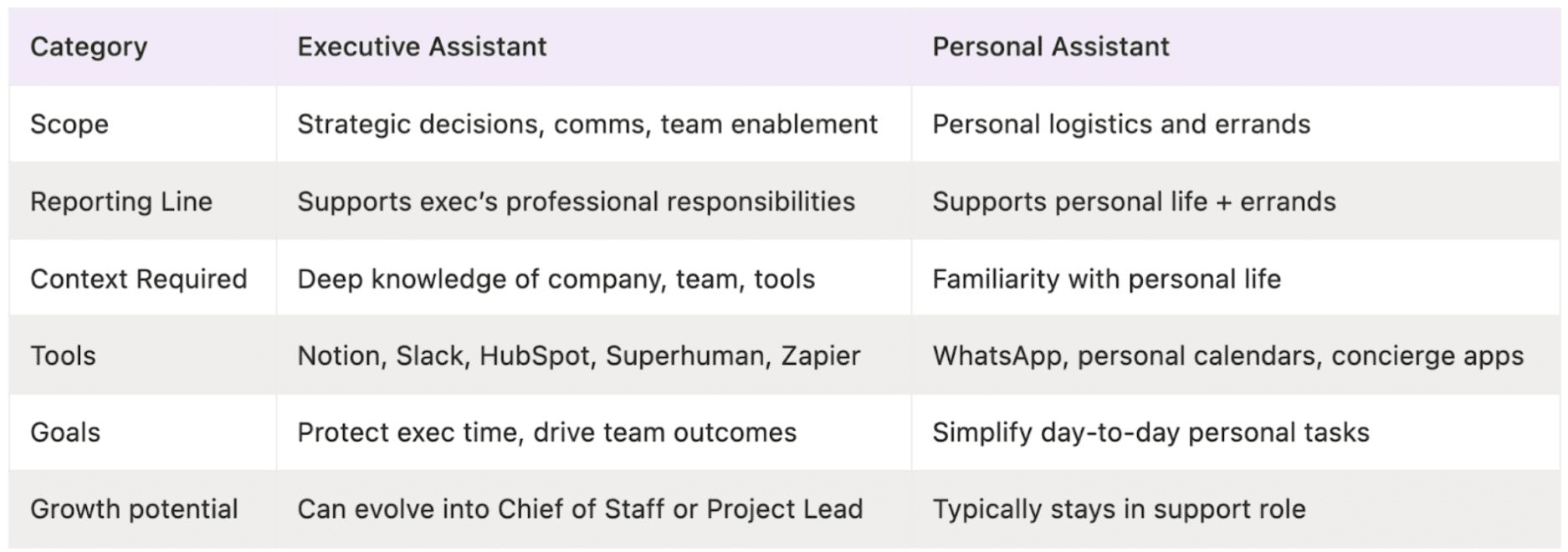
This table provides a visual summary of a comparison between the executive assistant vs personal assistant roles.
5. How to choose based on your time and role
Not sure which kind of assistant to hire? Start by reflecting on your daily struggles. These are common pain points for executives:
Personal pain points:
- I feel tired all the time
- I don’t have time to pick up the kids
- I’m rarely home in time for dinner
- I keep postponing the family vacation
- I want to start exercising again
Professional pain points:
- My calendar is constantly double-booked
- My inbox is a black hole
- I waste too much time coordinating meetings
- We’re behind on hiring
- My team feels disconnected and disengaged
The right path becomes clearer once you’ve identified what’s most urgent.
Choose a personal assistant if:
- You need help with family logistics, errands, or personal travel
- Your biggest blockers are home-related, not work-related
- You live independently and want lifestyle support
Choose an executive assistant if:
- You spend too much time on email, scheduling, or hiring ops
- You lead a team and need someone to help you be a better manager
- You want someone to coordinate internal stakeholders and external meetings
Understanding the respective roles of an executive assistant vs personal assistant will help you get the right support to meet your needs.
6. What do hybrid personal executive assistants do?
Some execs opt for a hybrid model: the personal executive assistant. Someone in this role supports household logistics and professional operations.
This role works best when:
- Your life and work are tightly integrated
- You need discretion, judgment, and business acumen in one hire
Common hybrid tasks:
- Coordinating hiring debriefs and weekend travel
- Managing investor updates and family calendars
- Handling confidential correspondence and home staff
Executive assistants from Viva are trained for leadership workflows, not just logistics. Our assistants support executives at high-growth companies with deep context, proactive support, and strong judgment.
Book a call with our team to see how quickly your EA can start delivering results.
Or read how companies like Gridwise and Veho use Viva to scale executive leverage.
FAQs
What’s the difference between an executive assistant and a personal assistant?
An EA supports business workflows and team operations. A PA handles errands and personal tasks. The impact, salary, and scope of each role differ significantly.
Can one person handle both executive and personal assistant tasks?
Yes—some execs hire a personal executive assistant to combine support areas. Start with an EA if you mainly need strategic support.
How much do an executive and personal assistant earn?
In the U.S., EAs earn $70k–$120k+, while PAs range from $45k–$80k. Hybrids fall in between, depending on their experience and the scope of what their client needs from them.
Who should hire a personal assistant?
PAs are ideal for public figures, solopreneurs, or anyone with high personal admin needs but limited team management responsibilities.
Who benefits more from an EA?
Founders, VPs, and leaders managing OKRs, hiring loops, and cross-functional teams see greater ROI from executive assistants.
.