Executive Assistants
Executive assistant interview questions: Test for skills and fit
Aug 4, 2025
5 min read


Hiring an executive assistant has a direct impact on executive productivity and operational focus. The right hire reduces friction, keeps initiatives on track, and strengthens decision-making at the leadership level. A poor fit adds complexity, often resulting in slower execution, communication gaps, and pulling time away from high-value work.
Strong interviews require questions and assessments that reveal how a candidate thinks and whether they can manage complexity and support leadership without needing constant direction.
This guide outlines how to evaluate those factors using strategic executive assistant interview questions, structured assessments, and observable traits that align with the realities of executive support. The insights here are designed to help you make the right hiring decision whether you’re hiring for the first time or refining an existing process.
“A good question to ask yourself as the interviewer is, ‘If I were the executive, could I see this person making my job easier and making me more efficient?’’ If the answer is no, it probably won’t be a good hire.” – Grace Castro, Recruitment Manager at Viva
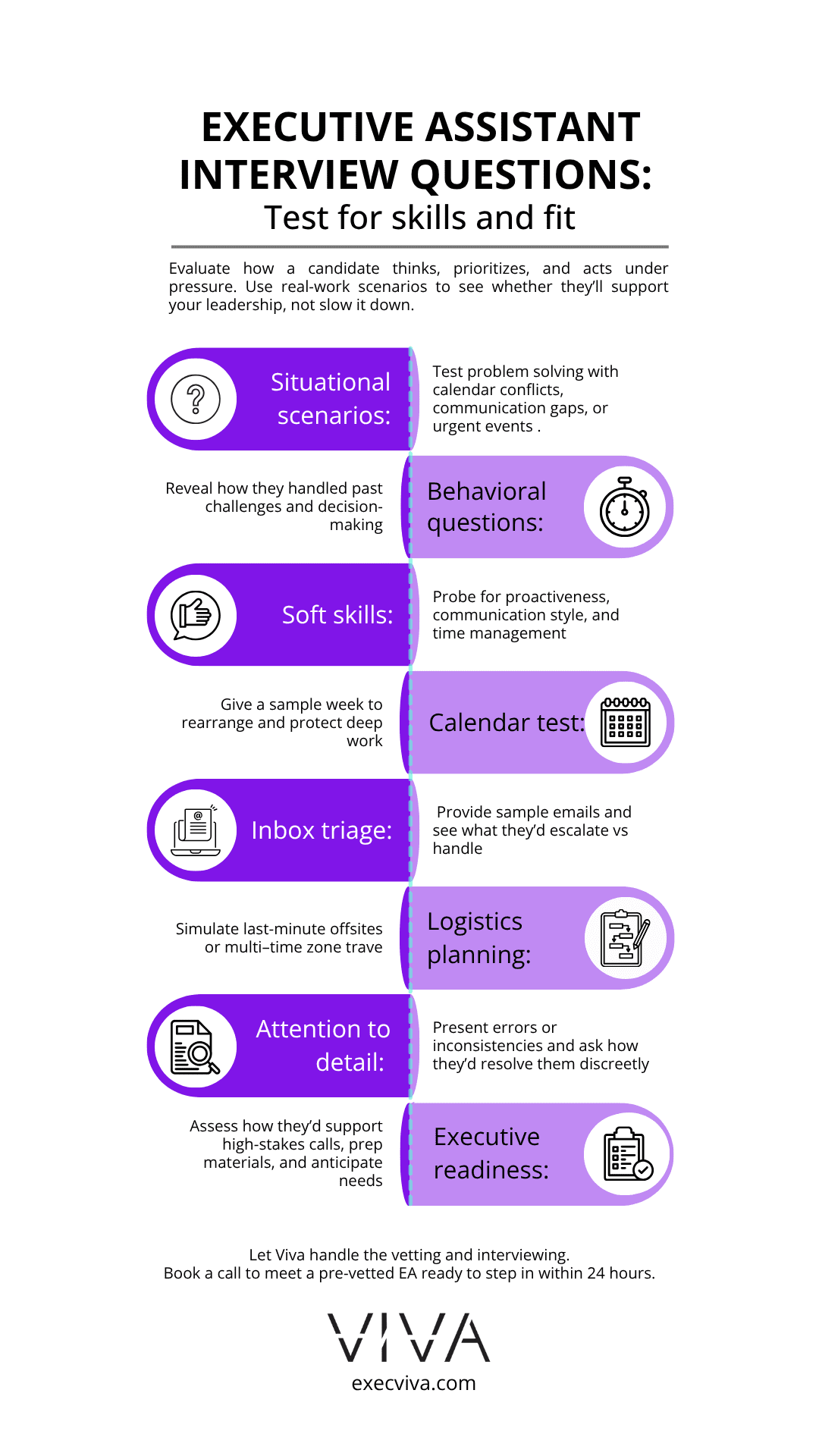
Table of contents
- Executive assistant interview questions (and the answers to listen for)
- Situational questions
- Behavioral questions
- Questions to evaluate soft skills
- Simple assessments that show how a candidate works
- Calendar coordination and prioritization
- Inbox management and communication
- Logistics and time-sensitive planning
- Spotting issues and using discretion
- Executive readiness and self-management
- How Viva helps startups hire the right executive assistant, without delays
- FAQ: Executive assistant interview questions
Executive assistant interview questions (and the answers to listen for)
When interviewing an executive assistant, you’re responsible for evaluating how a candidate handles complexity, supports decision-making, and contributes to a high-functioning team, especially in fast-moving environments.
Prepare a brief summary of the candidate’s experience and standout work before the interview. This will help you ask informed questions and guide the conversation toward relevant signals of fit. Structure questions into two categories when you’re building your interview plan:
- Personalized questions tailored to the candidate’s background and your executive’s working style
- Repeatable questions used consistently across candidates for reliable comparisons
Use the examples below to structure your conversation — and listen closely for how candidates reason through their decisions and communicate under pressure.
Situational questions
Executive administrative assistant interview questions, particularly situational ones, are a great way to learn how the candidate might react to hypothetical situations in the future. These questions test a candidate’s problem-solving skills, helping you understand how they might respond when faced with shifting priorities, tight timelines, or interpersonal complexity. Here are some situational questions to ask EA candidates in interviews:
- You’re managing two executives’ calendars, and both submit urgent requests. How do you prioritize?
Look for a clear process and communication strategy. - You notice a communication breakdown between your executive and a strategic partner. What do you do?
Strong candidates can spot gaps, navigate relationships, and take initiative. - You’re asked to coordinate a multi-day offsite with limited notice. Walk me through your process.
This helps assess planning, time sensitivity, and resourcefulness.
Behavioral questions
Behavioral questions aim to uncover how candidates have handled previous challenges and how they translate that experience into future roles. This can give you an indication of the candidate’s ability to speak openly about difficult situations. If your company has a fast-paced environment and working with a sense of urgency is important for the company culture, you can ask questions like:
- Tell me about a time you had to reprioritize tasks when expectations shifted.
Listen for how they made trade-offs and aligned efforts with broader goals. - Describe a situation where a scheduling error impacted your team. How did you respond?
Watch for accountability, communication, and follow-through. - Share an example of how you’ve used your organizational skills to bring clarity to a complex project.
This highlights their ability to create structure and drive momentum across moving parts of complicated projects.
Questions to evaluate soft skills
An EA’s soft skills often differentiate a capable assistant from a true strategic partner. These traits are critical to the executive assistant position, and the right interview questions can help you assess each one in context:
Proactiveness: Look for candidates who anticipate needs, take initiative, and operate independently in changing environments. Questions to ask include:
- Tell me about a time you identified a problem before it became urgent. What did you do?
- How do you typically stay ahead of your executive’s needs?
Effective communication: Strong executive assistants adapt their communication style to match the audience, whether aligning with internal teams or external stakeholders. Be sure to ask questions like:
- Describe a time you had to communicate something complex across different teams or stakeholders. How did you approach it?
- How do you ensure clarity in fast-moving or high-pressure situations?
Time management: Managing multiple tasks, deadlines, and competing priorities requires structure and focus. To gauge a candidate’s time management skills, include prompts and questions like:
- Walk me through how you organize your day when everything feels urgent.
- How do you prioritize when you’re supporting multiple projects or executives at once?

Simple assessments that show how a candidate works
Once you’ve surfaced how a candidate thinks, it’s just as important to assess core EA hard skills to see how they operate. Even the best responses can fall flat in practice if they don’t reflect real working habits. The right interview questions will help you determine whether a candidate can apply sound judgment in real-world situations.
When assessing an EA’s working style and habits, focus on how they prioritize tasks, communicate under pressure, and manage shifting needs without constant direction. Here are a few specific areas to evaluate:
Calendar coordination and prioritization
If they’ve supported multiple executives or teams before, ask how they managed competing calendar requests or restructured a packed week for better flow. Look for signs they protect executive focus, reduce context switching, and consider meeting intent rather than just filling open calendar slots.
- What to ask: Imagine you’re supporting two executives with overlapping priorities. If their calendars become packed and conflicting, how would you decide what stays, what shifts, and how to communicate changes?
- Sample task to assess: Share a hypothetical week filled with conflicting meetings, holds, and overlapping priorities. Ask the candidate to restructure the calendar and explain how they protected deep work time, reduced context switching, and accounted for meeting intent.
Inbox management and communication
Quick replies alone won’t move the needle for execs with high-volume inboxes. Executive assistants need to read between the lines, understand context, and take ownership of follow-through without adding backload to the executive.
- What to ask: Let’s say you’re managing a high-volume inbox. How would you decide which emails to escalate versus handle independently?
- Sample task to assess: Share a set of sample messages with varying urgency and tone. Ask the candidate to draft responses or explain their triage strategy based on context, priorities, and sender relationship.
Logistics and time-sensitive planning
In fast-moving environments, you want someone who can organize details with minimal input. Ask how they’ve handled a last-minute offsite, coordinated across time zones, or planned complex travel. Their response should reflect structure, proactivity, and cost-awareness without losing sight of executive preferences.
- What to ask: You’ve just been asked to plan a last-minute offsite for five stakeholders across three time zones. How would you begin organizing the travel, workspace, and communication?
- Sample task to assess: Present a basic offsite scenario with location, timing, and budget parameters. Ask for a proposed itinerary that includes travel, hotel, workspace, and stakeholder prep.
Issue spotting and discretion
Ask how they’ve handled inconsistencies like errors in an expense report, a scheduling error with a strategic partner, or unclear deliverables. Do they ask the right questions, act with discretion, and take initiative to close the loop?
- What to ask: If you noticed a possible error in a report or saw a calendar mistake involving a strategic stakeholder, what would be your next steps?
- Sample task to assess: Share a small sample of expense reports or scheduling data with one or two planted inconsistencies. Ask them to walk through their review process and what they’d flag.
Executive readiness and self-management
Urgency isn’t always set by the executive. Board members, legal teams, or strategic partners often introduce last-minute asks, and a strong EA knows how to filter, escalate, or absorb the request without creating more noise. Ask how they’ve supported leaders through critical moments, like board prep, investor meetings, or off-cycle reviews. Great candidates step in early, guide prep timelines, and manage around what’s unspoken — not just what’s assigned.
- What to ask: Imagine your executive has an investor meeting in two days and limited prep time. How would you help them feel confident and prepared?
- Sample task to assess: Ask the candidate to outline a prep plan for a last-minute board deck or off-cycle executive review. Look for signs of initiative, clarity, and an ability to prioritize unspoken needs.
Each of these scenarios reveals key information about how an executive assistant candidate thinks, prioritizes, and follows through. If they can talk you through how they’ve worked under pressure before (and the reasoning behind their decisions), you’ll gain a much clearer picture of whether their instincts align with your executive team’s needs.
How Viva helps startups hire the right executive assistant, without delays
There’s often no time for drawn-out interview cycles or second-guessing a candidate’s fit when you’re hiring executive assistants. You need someone who can add value fast without adding more to your plate.
That’s where Viva comes in.
Every EA we place has already been vetted through multi-stage interviews, scenario-based tasks, and skill assessments aligned with real executive workflows. We evaluate what actually drives performance: calendar optimization, communication, problem-solving, and decision support.
Instead of building your own list of executive assistant interview questions with answers, we’ll introduce you to a candidate who’s already proven they can operate at your pace and standard. Our EA agency hiring model is designed for speed and precision so you get fully vetted, startup-ready support without the guesswork.
Book a call with Viva and meet your next EA in less than 24 hours.

FAQ: Executive assistant interview questions
What questions should I ask in an executive assistant interview?
Focus on real-world scenarios that reveal how a candidate thinks and works. Ask questions like:
- How do you manage shifting priorities among multiple stakeholders?
- Describe a time you had to flag a scheduling conflict or potential risk to your executive.
These types of executive assistant interview questions surface critical thinking, ownership, and communication style.
What are good questions and answers for executive assistant interviews?
Look for open-ended questions paired with thoughtful, structured responses. For example:
- Tell me about a time you managed a high-volume inbox.
A strong answer should reflect prioritization logic, stakeholder awareness, and follow-through. The right pairing of executive assistant interview questions and answers can show how the candidate applies skills in real situations.
How should I evaluate responses during the interview?
Listen for clarity, context, and decision-making. Strong candidates explain their reasoning, connect actions to outcomes, and reference past roles without relying solely on titles or job descriptions. Follow-up questions like “What would you do differently next time?” can reveal depth.
How do I prepare for an executive assistant interview as a hiring manager?
Start by identifying the executive’s top priorities, such as calendar management, travel, inbox, and project work. Build your questions and sample tasks around those areas. Reviewing the candidate’s resume in context of what the role demands is critical for spotting alignment.
What should I look for when hiring an executive assistant?
Beyond resume points, assess for core skills like time management, written communication, confidentiality, and problem-solving. Ask targeted executive assistant job interview questions, and use a short task or scenario to validate how they actually work. Explore our guide on the key strengths of an executive assistant to get a deeper look at the top executive assistant qualities that drive real impact.
.