Executive Assistants
10 Executive Assistant Strengths (and the Skills Behind Them)
Aug 18, 2025
9 min read


Executives in fast-growth companies are expected to move fast, make high-stakes decisions, and manage constantly shifting priorities. But even experienced leaders can become bottlenecks without high-level support. That’s where a skilled virtual executive assistant becomes essential as a strategic partner who brings clarity, structure, and the capacity to drive execution without constant oversight.
In this guide, we break down the virtual executive assistant strengths that matter most in high-growth companies. Whether you’re thinking about hiring for the first time or leveling up your current support, this list will help you recognize the best executive assistant qualities that truly drive value.
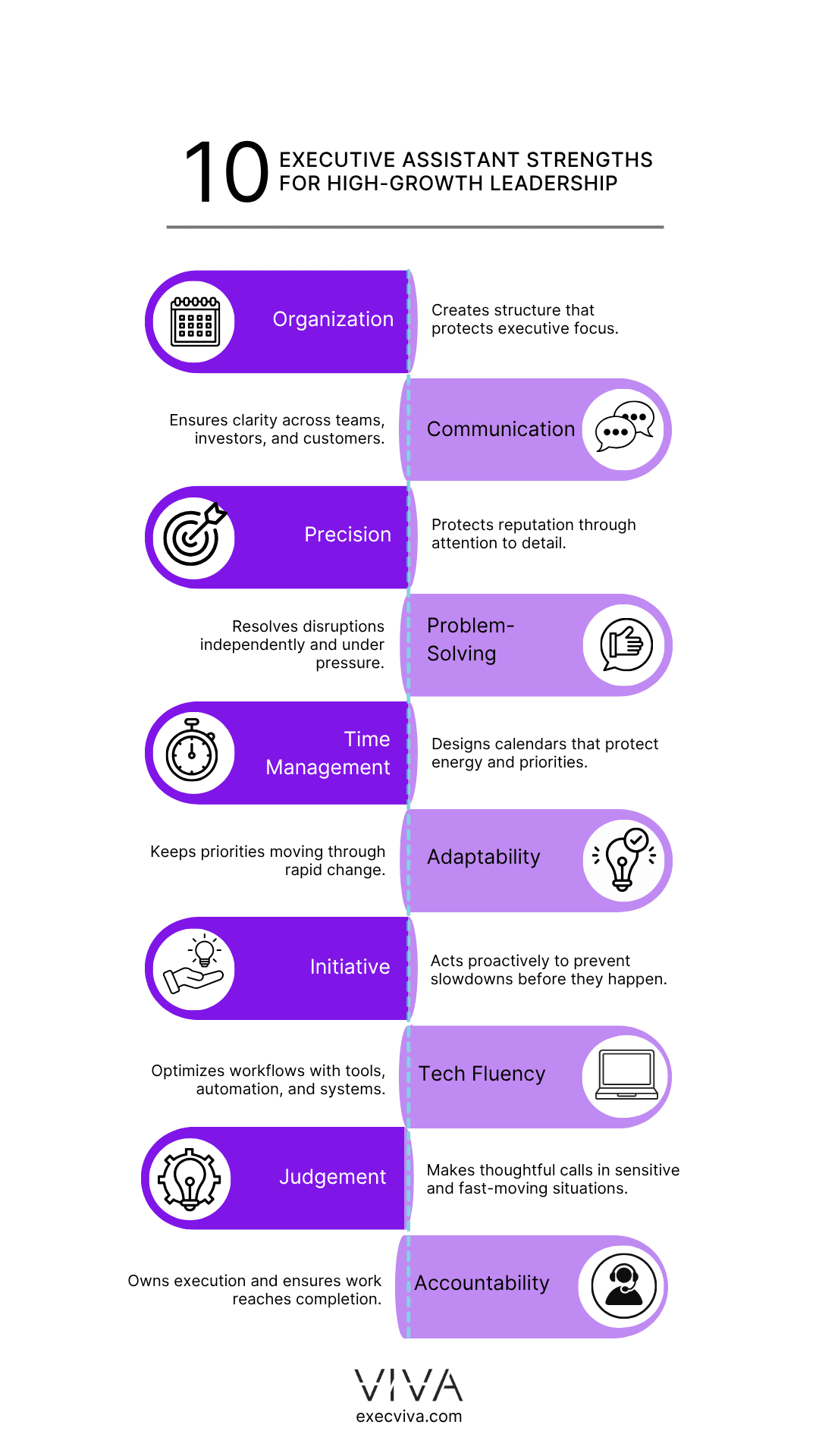
Table of contents
- Top 10 executive assistant strengths that drive performance
- From strength to impact: what Viva makes possible
- Frequently asked questions
Top 10 executive assistant strengths that drive performance
The role of an executive assistant has expanded well beyond calendar management. In fast-moving orgs, great assistants are expected to think critically, adapt quickly, and operate with a high level of trust. The following ten strengths represent core attributes of an executive assistant that enable effective leadership and keep high-priority work moving forward.
| Think you’re spending too much time on work someone else could own?
Book a call to explore how a dedicated executive assistant can support your leadership priorities. |
Organizational structure that unlocks executive focus
Competing priorities often overwhelm a founder’s calendar as early-stage companies scale. Without a clear structure, it becomes difficult to focus on the highest-value work.
Strong organizational systems allow executive assistants to protect focus time, build predictability into chaotic weeks, and manage complexity without constant oversight.
Viva in practice:
One executive at a Series A SaaS company was struggling to maintain focus while managing investor conversations and preparing for a launch. Their Viva assistant redesigned the weekly calendar around decision-making blocks and implemented a system to triage communication by source and urgency. The structure enabled the executive to handle key conversations and deliverables more efficiently, with less context-switching and missed follow-ups.

Executive-level communication that drives clarity across teams
As companies scale, the volume and velocity of communication increases across departments, investors, and customers. When communication breaks down, it creates rework, delays, and confusion that often fall back on the executive to resolve.
An executive assistant with refined written and verbal communication skills can act as a reliable intermediary to translate requests, draft responses, and maintain tone and clarity across channels.
Viva in practice:
At a growth-stage fintech company, a Viva assistant took over external updates, investor correspondence, and internal team communication on behalf of the CEO and CTO. Her ability to communicate clearly and confidently reduced back-and-forth, maintained alignment across product and engineering, and freed up time for the executive team to focus on strategic planning.
Precision that protects reputation and decision-making
Tech companies often move quickly, which can be at the expense of quality control. Yet small oversights can lead to lost credibility, especially in high-stakes investor, hiring, or customer-facing scenarios.
Executive assistants with strong attention to detail serve as a final layer of review and accuracy to support overall material quality and consistency.
Viva in practice:
One executive assistant flagged a discrepancy in a set of board slides for a CEO the day before an investor update. She didn’t just highlight the error—she rewrote the slide copy, sourced the correct data from the finance team, and ensured everything matched prior disclosures. According to the CEO, “She saved us from sharing the wrong numbers with our board.”
Independent problem-solving that keeps operations moving
Unexpected blocks occur frequently in high-growth environments, from travel shifts and scheduling changes to system and communication issues. Executive time is easily lost navigating these disruptions.
Executive assistants who bring a problem-solving mindset resolve issues without creating new work for the executive. They assess quickly, communicate clearly, and manage outcomes under pressure.
Viva in practice:
A founder at a healthtech company faced a last-minute disruption in travel plans ahead of a critical investor meeting. The Viva EA had already anticipated backup options. Within an hour, she arranged new travel, coordinated timing, and confirmed logistics. The exec’s meeting remained on schedule, and they were able to stay focused on preparation instead of scrambling for solutions.
Strategic time management that protects executive energy
Executives are left without bandwidth for long-term initiatives when calendars are overrun by unprioritized meetings and scattered responsibilities. Time becomes fragmented and reactive.
Executive assistants skilled in time management don’t just schedule—they design the executive’s week with intent, incorporating prep time, recovery time, and priorities based on leadership rhythms.
Viva in practice:
One Viva EA noticed that a CEO was losing time to disorganized hiring processes and back-to-back interviews. She introduced a Notion-based candidate tracking system, created reusable templates, and adjusted the calendar to allow for context-switching and debriefing. As a result, the executive reduced hiring friction, filled a leadership role faster, and regained hours for investor planning.
| It might be time for support if your calendar is full but nothing feels finished.
Book a call with Viva to match with an executive assistant trained to manage the pressures of business execution. |
Adaptability that keeps priorities moving
For companies that evolve quickly: goals shift, teams change, and tools are replaced. Progress stalls every time the environment does when there’s no flexibility.
An executive assistant who can adapt without losing momentum adds real value. They keep things running when everything else is shifting, whether managing changing schedules, new leadership dynamics, or sudden operational pivots.
Viva in practice:
Two Viva assistants supported seven onboardings and offboardings within 60 days at a New York company that was navigating multiple executive transitions. They managed calendars, communication, and internal updates across functions, helping to maintain clarity and continuity during a period of major internal change. Their ability to adjust quickly enabled their executives to stay focused on leadership, not logistics.
Initiative that prevents slowdowns before they happen
Executive assistants who wait to be told what to do become a bottleneck. But they extend executive capacity when they take initiative — solving problems before they land and acting on unspoken needs.
Proactive assistants add value by identifying inefficiencies, spotting missing context, and stepping in without being asked.
Viva in practice:
One executive assistant supporting the CTO and SVP of People at a Series E company flagged misalignment between team goals and quarterly planning timelines. She initiated prep sessions, built agendas, and coordinated calendars to keep key meetings on track. Her initiative helped avoid weeks of delays and reduced pressure during the quarter’s close.
Tech fluency that improves systems
Executive leaders rely on tools to work quickly — AI, CRMs, project management platforms, communication apps, and AI automations for recurring tasks. But when assistants lack fluency in these tools, the executive ends up doing the technical work themselves.
Tech-savvy assistants are trained to understand how to slot into your existing systems to, automate manual steps, scale day-to-day operations, and make your systems work better and more efficiently.
Viva in practice:
One Viva EA at a fintech company rebuilt the internal meeting prep process using Slack integrations and Google Docs automation. The new system cut meeting coordination time in half and ensured that every attendee had the right prep materials in advance. The executive was able to redirect that regained time toward fundraising strategy and partner outreach.
Judgment that guides day-to-day decisions
Executive leaders can’t afford to oversee every small decision. They need an assistant who can operate with good judgment, read the room, and make thoughtful calls without hand-holding.
Executive assistants who lead with sound intuition and clear communication reduce friction and increase trust, especially in fast-moving or sensitive situations.
Viva in practice:
When a customer renewal prep session clashed with a critical leadership offsite, one assistant made the call to rework the executive’s calendar and realign key internal stakeholders. She didn’t just reschedule—she prioritized the right follow-ups and ensured both priorities were addressed without disruption. As the COO later shared, “She protected revenue and momentum without missing a beat.”
Accountability that protects execution under pressure
Deadlines slip. Meetings change. Key assets get lost. In those moments, accountability means the assistant doesn’t wait for a fix. Instead, they own the next step and communicate the path forward.
An accountable EA absorbs complexity, follows through without reminders, and ensures that the work reaches completion — not just handoff.
Viva in practice:
Ahead of a last-minute investor meeting, one Viva EA supporting a founder rescheduled an entire day of back-to-back calls, coordinated with legal to finalize investor materials, and ensured details were correct across the board deck. All of this was done within 90 minutes of the opportunity surfacing, allowing the CEO to step into the meeting fully prepared.
Strengths vs skills: what is the difference?
These strengths show up as concrete skills on the job: calendar and inbox management, meeting prep, project coordination, and clear written communication. If you are searching for executive assistant skills, these are the strengths behind them. For the many titles this role can take, see executive assistant titles explained, and for goal-setting, see SMART goals for executive assistants.
From strength to impact: What Viva makes possible
Each strength outlined above is reinforced through Viva’s hiring, onboarding, and support model. We look for operational judgment, train for fast-growth environments, and stay involved to ensure consistency and follow-through. Viva’s executive assistants are part of a selective virtual assistant agency model designed to meet the pace and complexity of executive leadership.
Book a call to see how our executive assistants can support your priorities with the consistency your role demands.
FAQ: Executive assistant strengths
- What are the most important strengths of an executive assistant?
The most important strengths of an executive assistant include organizational skills, proactive communication, sound judgment, attention to detail, and adaptability. These executive assistant traits empower them to manage shifting priorities, protect leadership time, and support execution without needing constant direction.
- How do executive assistant strengths impact leadership effectiveness?
An executive assistant’s strengths directly affect how effectively a leader can operate. Strong EAs remove friction by anticipating needs, keeping timelines on track, and creating clarity in fast-moving environments. This all makes it easier for executives to focus on decision-making, not coordination.
- Can strengths like judgment or proactiveness be trained?
To an extent. At Viva, we select for foundational traits like judgment, initiative, and accountability. These skills can be strengthened through context, coaching, and exposure to business operations, but they can’t be forced. That’s why selection matters as much as training.
- How does Viva evaluate executive assistant strengths over time?
We assess strengths through regular feedback loops with the executive, coaching conversations with the assistant, and review of real work. This ensures the assistant’s strengths show up consistently, not just at onboarding.