Executive Assistants
What Is a Virtual Assistant? Benefits, Tasks, and When to Hire One
Aug 4, 2025
9 min read


Last updated on December 11, 2025
TL;DR
- What is a virtual assistant? A remote admin professional who supports multiple clients with scheduling, research, or document tasks.
- Virtual assistant advantages include speed, cost, and flexible support models, but are often limited in context and scope.
- What can a VA do? Inbox triage, CRM updates, content formatting, and more, though not usually strategic work.
- Most VAs work across clients with minimal onboarding; executive assistants (like those from Viva) embed in workflows and act proactively.
- VAs are helpful for repeatable admin tasks; EAs are best for decision-making, stakeholder prep, and hiring support.

Executives searching for ways to offload tasks or regain focus often land on one term: virtual assistant. But what is a virtual assistant? The answer varies depending on the business model.
Some VAs are task-level freelancers; others are agency-based admin partners. Most work with limited context, multiple clients, and minimal onboarding. Few are trained for executive-level workflows.
According to the U.S. Bureau of Labor Statistics, “According to the U.S. Bureau of Labor Statistics, there were approximately 3.5 million secretaries and administrative assistants, including virtual assistants, working in the U.S. in 2024.” The takeaway? Leaders across every sector continue to rely on this category of support to operate efficiently and stay focused on high-value work.

Table of contents
- What is a virtual assistant?
- What can a VA do for your team?
- What are the biggest virtual assistant advantages?
- How do virtual assistants compare to executive assistants?
- How do you know whether you need a VA or EA?
- FAQs
1. What is a virtual assistant?
To define it clearly, we went straight to the source. According to Adnan Khan, co-CEO at Viva:
“A virtual assistant is a remote professional who provides administrative and operational support to individuals or businesses. Common responsibilities include scheduling, travel booking, data entry, basic bookkeeping, social media management, and research. They work online from anywhere in the world instead of in a physical office. The largest global hubs for virtual assistants include the Philippines, India, Eastern Europe, Latin America, and South Africa.” – Adnan Khan, Co-CEO at Viva
2. What can a VA do for your team?
What a VA can do depends heavily on their training, the platform you hire from, and your expectations.
Another important aspect is not what they can do but what they get to do. As Adi Ignatius from Harvard Buiness Review puts it: “Managers sometimes hold onto things too tightly for too long, which makes it hard for them to focus on what really matters.” Ignatius’s observation reminds us of the importance of delegating.
What can you delegate to a VA? These are some tasks most virtual assistants can help with:
- Inbox triage, simple replies, or follow-ups
- Meeting scheduling, reschedules, and confirmations
- Formatting slide decks, spreadsheets, or internal docs
- Updating CRMs like HubSpot, Salesforce, or Pipedrive
- Coordinating travel and submitting expenses
- Posting pre-written content to social media tools
- Creating templated reports or updating internal trackers
- Light event coordination or booking meeting rooms via platforms like Google Workspace
Some virtual assistants also support light invoicing or help maintain team-wide documentation. However, because most VAs work across multiple clients and have limited business context, they’re rarely able to own systems or workflows fully.
VAs often need clear direction and narrowly scoped tasks. They’re not expected to decide priorities, escalate blockers, or serve as a proxy for their manager. A virtual assistant may struggle to keep up if your workflow depends on delegation without step-by-step instructions.
Explore our list of 81 tasks you can delegate to an executive assistant to see what’s beyond a VA’s scope.
“My EA is one or two steps ahead of me, makes my job easier, calling attention to things to ensure that no ball is dropped. Involves folks from the team to ensure deliverables are on time. She is resourceful, proactive, and patient.” – Sales Leader at Notion

3. What are the biggest virtual assistant advantages?
There are several virtual assistant advantages that make them appealing to small teams or cost-conscious companies:
- Lower cost: Offshore VAs can cost as little as $6–$12/hour
- Fast hiring: Onboarding can take as little as 1–2 days
- Fractional models: Great for teams who only need a few hours of support
- Specialization: Some platforms offer VAs skilled in bookkeeping, marketing ops, or data entry
Let’s say you’re a founder juggling 10–12 hours of repetitive admin a week. You might not need full-time support yet, but that time is still costing you strategic momentum. A virtual assistant can step in quickly and take over those recurring items, giving you breathing room to focus. When comparing providers, see our roundup of the top virtual assistant services for US executives.
That said, it’s important to know a VA’s limits. High turnover is common among VAs, especially among freelancers, and quality can vary widely. Because most VAs work with minimal onboarding, there’s a risk of misalignment or context gaps that lead to rework.
4. How do virtual assistants compare to executive assistants?
Both roles can technically operate remotely, but they differ in impact. Here’s how the two compare:
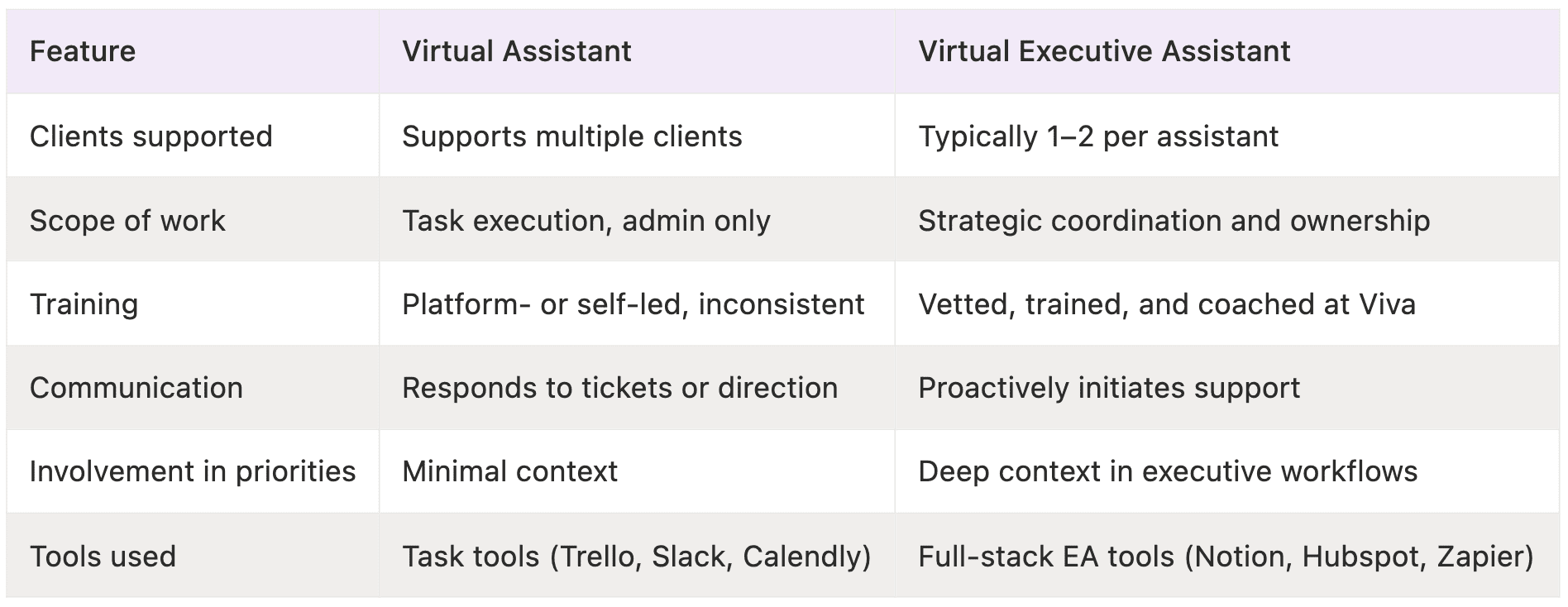
On the surface, hiring a virtual assistant can feel like a no-brainer, since they offer fractional support, but having no full-time commitment often results in lower outcomes. Turnover is also a risk factor. Many VA services operate without a strong accountability model or coaching framework. That can mean VAs disappear mid-project or fail to improve over time.
Hiring a virtual executive assistant from Viva, on the other hand, means that you can have a team member completely embedded in your team in less than 24 hours and see the impact in the first week.
“I am incredibly pleased with the quality of Özlem’s work, and she has become a trusted member of our team. I am a more effective executive with Özlem on my team.” – CEO & Co-Founder at AyarLabs
Curious about what a virtual executive assistant can do for you in just 24 hours? Read Placemakr’s success story on how one EA delivers impact for two co-founders in one day.
5. How do you know whether you need a VA or EA?
Choosing between a virtual assistant and an executive assistant isn’t about job titles; it’s about your organization’s needs and the results you want to see.
Virtual assistants offer affordability, fast access, and task-based support. They work well for teams that need predictable, process-driven help. But they rarely provide strategic leverage or anticipate needs.
Executive assistants, like those trained at Viva, are embedded team members. They own projects, coordinate with cross-functional stakeholders, prep founders for meetings, and help navigate hiring or investor workflows.
“Elizabeth has been able to do a lot without me. Instead of creating work for me, she takes it off my plate.” – Head of Research, Notion
To find out what you need, ask yourself:
How often do I want my assistant involved in decision-making?
- Rarely: I prefer to give clear direction → Virtual Assistant
- Frequently: I need someone who can make informed choices → Executive Assistant
“My EA has consistently been able to take on more ownership and more responsibility with core logistics and especially recruiting. It’s been a huge help to the team.” – Head of People Operations, Luminai
How important is deep context?
- Low: Tasks are consistent and process-driven → Virtual Assistant
- High: My schedule and responsibilities shift often → Executive Assistant
“My EA has done a great job both being proactive about helping manage my calendar and email, but also taking on other responsibilities with IT management.” – SVP of Software and Data Engineering
Do you need someone full-time and dedicated to you?
- Not necessarily → Virtual Assistant
- Yes, I am looking for a long-term partnership → Executive Assistant
“My EA has been a serious leverage. She picks things up pretty quickly and has made my life easier. It would be a major challenge for my team to lose her.” – Sr. Director, Strategy, Real Estate Partnerships, at Placemakr
Executives at high-growth U.S. companies often realize that cost per hour isn’t the metric that matters; it’s time saved and focus protected. Viva’s executive assistants are based in Latin America, work U.S. hours, and are onboarded in less than a week.
“You changed my mind about virtual EAs, and I truly hope that the positive experience continues in the future as well. The Viva team has been great in making this a smooth process and providing support. The match with my EA was spot on.” – CEO at Sequel.io
Finding the best fit for your company is not something you need to do alone. Book a call with us to find out how our team of executive assistants can help you and your business reach its goals faster.
See what a virtual assistant costs, compare Viva plans and pricing, or learn how matching works.
FAQs
What is a virtual assistant?
A virtual assistant is a remote professional who provides administrative and operational support, typically task-based, to multiple clients. Common responsibilities include scheduling, inbox triage, and CRM updates.
What can a VA do?
They can manage scheduling, document formatting, research, CRM hygiene, and other admin tasks, but usually don’t own projects or lead workflows.
What are the virtual assistant advantages?
Affordability, fast onboarding, and fractional support make them a good fit for light admin needs.
What’s the difference between a VA and EA?
VAs execute; EAs coordinate. VAs need direction; EAs think ahead. VAs manage tasks; EAs manage outcomes.
Is Viva a virtual assistant company?
No, Viva provides trained executive assistants who go far beyond traditional virtual assistant capabilities.
.