Productivity
Should you hire a remote executive assistant?
Dec 20, 2023
7 min read


If you’re thinking about hiring an EA, but can’t choose between an in-person or remote executive assistant, find out what these 5 startup executives were looking for when deciding on support.
What to look for in a remote executive assistant?
We are a fully remote company that hires and trains executive assistants from Latin America, and that has made us experts in finding the best talent in the region. However, the fact that our EAs are not US natives raises many questions among our prospects.
Let’s take a look at the five most common hesitations we get in our sales process – and how we turn hesitant prospects into happy, raving customers.
Table of contents
- The quality of talent
- Culture alignment
- Contractor vs in-house EA
- Onboarding process
- Status-quo
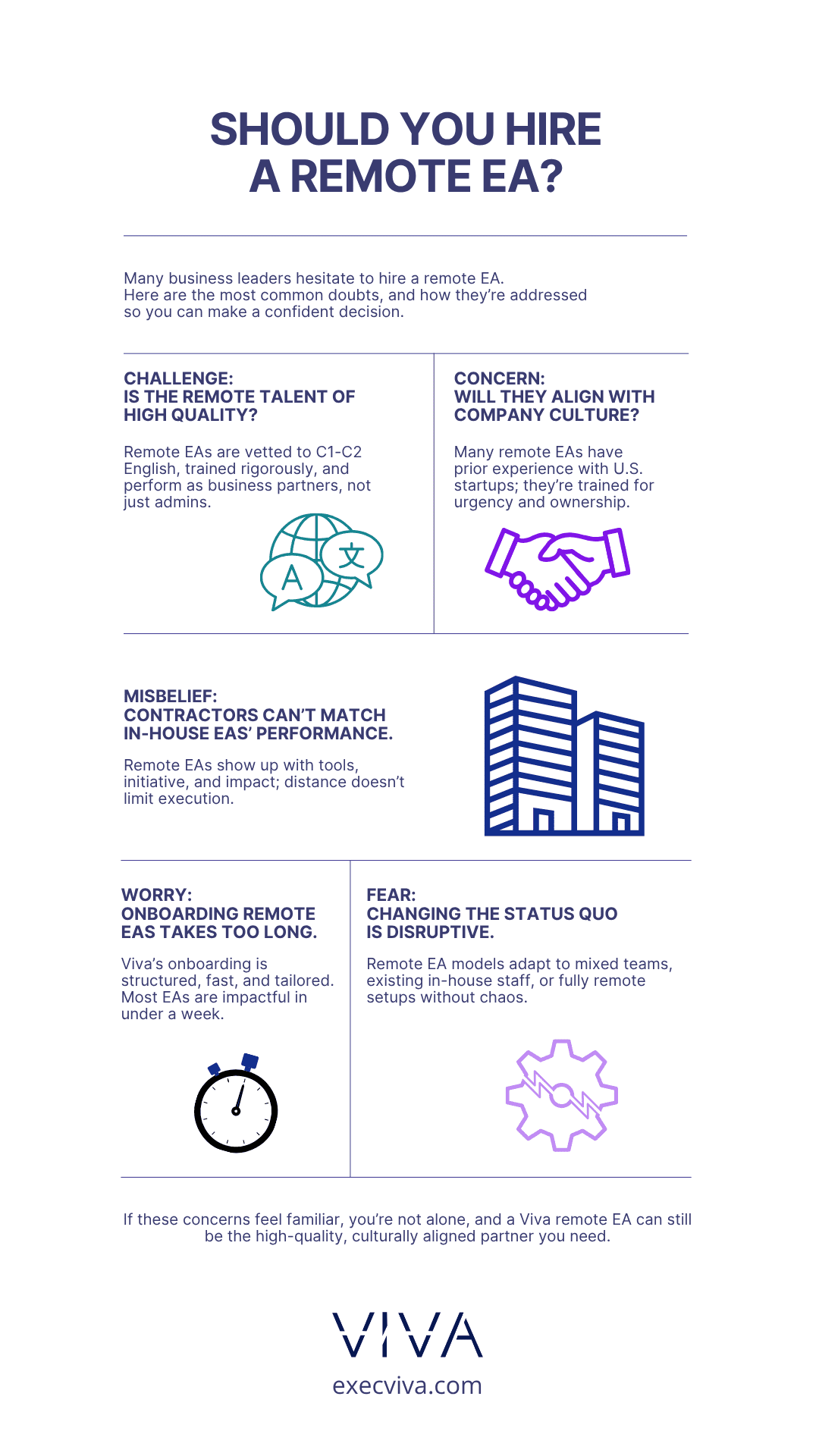
How’s the quality of the talent of a remote executive assistant?
Getting an executive assistant is like having an extension of yourself. An EA is a business partner who is not just there to follow orders and arrange your calendar but to fill in for you. Whether it’s to facilitate a meeting you cannot attend, answer emails on your behalf, or even conduct preliminary interviews with new hires.
Having an executive assistant with impeccable communication skills is not just nice to have; it’s a must-have. If they’re going to host a meeting or answer emails with your signature at the bottom, they better be flawless.
That’s why, when a prospect shares their concern about our EAs’ English skills, we completely understand where they’re coming from. For us that is also one of the biggest limitations when hiring for new roles. We often come across a candidate who would be incredible in their country of origin, but unfortunately doesn’t meet Viva’s high standards due to their English proficiency.
How do we ensure our EAs’ English proficiency?
We don’t settle for intermediate; we strive for greatness. That’s why all our EAs have a C1 or C2 English level, which we evaluate using a standard exam at the very beginning of the recruitment process. A C1 level of English proficiency is considered advanced, and it indicates a high level of language competency. At this level, an EA can understand complex texts, express ideas fluently and spontaneously, and communicate with native speakers with ease. However, a C2 level of English proficiency indicates that the EA has mastered the language at the highest level.
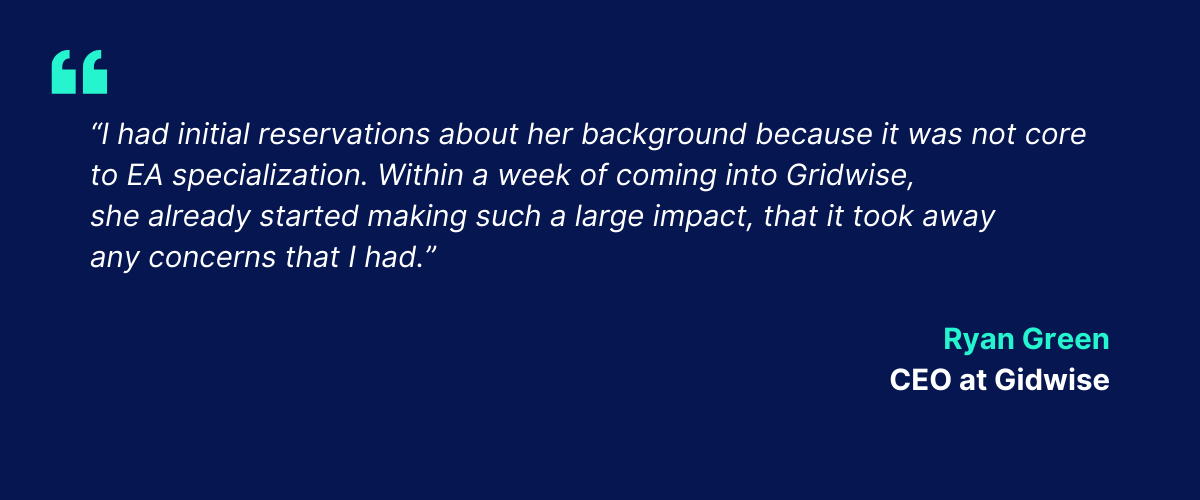
Despite our rigorous screening, we understand some executives might still be on the fence, so we just have them see for themselves. That was the case for one of our customers, but when he met his Viva EA, all his doubts vanished. He saw how articulate and proficient she was, and noted that her level of English was near-native. If you have similar concerns, rest assured, you can meet your Viva EA before signing up and making up your mind.
Are you being productive? We’ve built this fast quiz to find out (and what to do about it).
Would a remote executive assistant adapt to our culture?
The work environment of an American startup is not for everyone. It moves fast and it requires all parties to get involved, take ownership, and help the company grow. If even some Americans would find it to be too big of a challenge, it’s no surprise that startup executives worry about bringing in someone from outside of the US.
What they don’t know is that over the past ten years, Latin America has emerged as a prime hub for the BPO and Customer Service sectors globally. Major North American brands like Google, Ford, and Nike have already established their customer service and call centers across various countries in this region.
That’s why most of our executive assistants have previously worked for American startups and enterprises, both remotely from their home countries and on-site. Despite their previous experience, during our two-month training, all our EAs learn to move fast and act with a sense of urgency, so when they’re staffed with a new customer, their ramp-up time is a fraction of what you’d expect from a new hire.
Can contractors perform at the same level as an in-house EA?
Some companies are forcing their employees to go back to the office because there’s a belief that they will perform better in the workplace than if they do it from home. Some executives prefer an executive assistant on site for the same reason. But the truth is, a truly outstanding EA can do their job from anywhere in the world. How? They are tech-savvy, can arrange deliveries online, automate supply orders, plan offsites, have swag delivered, and much more.
One of our EAs identified a gap at a customer’s headquarters in New York: They were operating without an office manager, and even though this EA is based in Guatemala, she volunteered to be the office manager. Despite being 3,000 miles away, she successfully took charge, ensuring the office had everything it needed, from essential supplies like paper, to coffee and water.
What’s even more impressive? She didn’t stop there. Over time, she understood the office’s supply needs, established a cadence, and then automated the process. This meant that the office in New York consistently had its necessities without missing a beat, all thanks to the support of an executive assistant miles away. This anecdote is a testament to the immense value remote EAs can bring to the table. It’s proof that physical distance doesn’t hinder an A-player from making a significant impact.
Don’t settle for an EA just because they can commute to the office. Get the best EA there is, no matter where they are.

Does it take too long to onboard a remote executive assistant?
When hiring a new employee, some companies set up a corporate email, wish them luck, and hope for the best. At Viva, we drive the entire onboarding process, from executive to executive assistant.
Some executives see onboarding processes as a waste of time. Even though they know this learning phase is necessary, they often refrain from delegating something just to avoid teaching that specific skill to a member of their team. But they don’t need to overthink this: We handle the logistics, and our process is as fast as it gets:
We start with a 30-minute call with the executive who needs EA support, diving into the specifics of what’s valuable for them (from tools to corporate data and software skills). Then, we train our EAs, so that by the time they step in to support their executives, they’re already armed with everything essential.
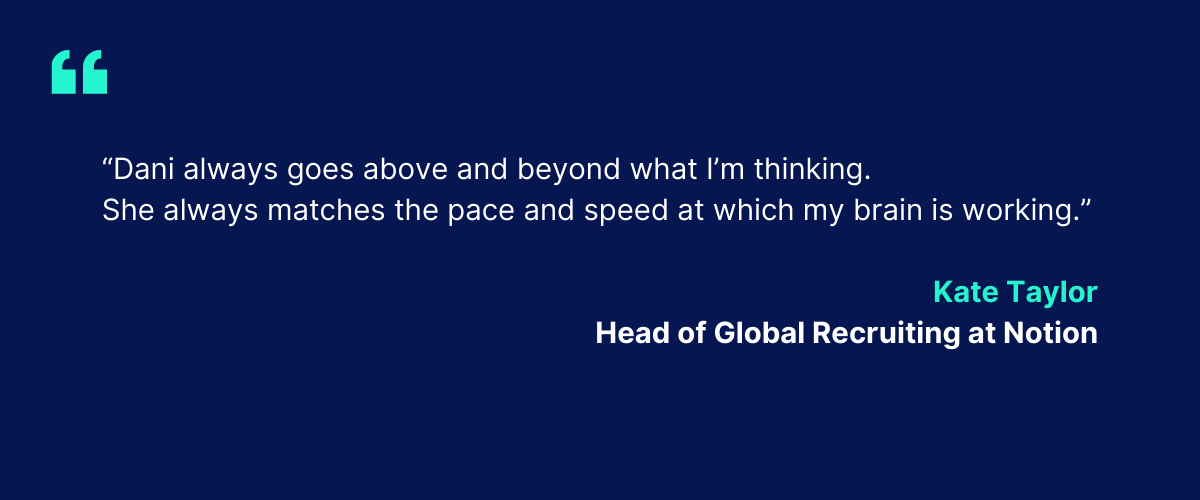
Over the past three years, we’ve created an unmatched EA onboarding system. Our process is tailored specifically for EAs, ensuring they provide value in under a week. Our goal is to get an EA fully ramped up and impactful in the shortest time possible. We go through the onboarding process slowly so you can hire fast.

Will I mess with the status quo?
Building the EA function for a leadership team is a big job, and there is no need for you to go either 100% in-house or 100% contractor. Finding partners who can match the pace of your startup is essential, no matter if you see them every day at the office or exclusively through video calls.
We’re skilled at handling all sorts of situations. Not long ago, one of our EAs was supporting two executives, and suddenly, their in-house EA resigned. They were left in a tight spot, but we decided to step in. Within 24 hours, we redeployed our Viva EA into that vacant role and swiftly brought in another EA for their remaining needs. The disruption that could have occurred was almost entirely mitigated because of Viva’s readiness.
Our remote executive assistant can work seamlessly with your in-house EAs
We were not aiming to replace their in-house EAs; we are happy to work in different ways with each of our customers. Some of our bigger customers already have a pool of in-house EAs and our Viva EAs work seamlessly with them.
If you’re still hesitant about getting a contractor instead of going in-house, consider evaluating needs and fit on a case-by-case basis. Maybe your CEO needs in-house support because they need someone to travel with them but your VP levels are open to remote support. It’s a matter of evaluating everyone’s needs and having them met in the best possible way. We’ll be happy to help you build the EA function for your leadership team.
You’re not the first to voice these concerns. We get it: trusting our vetting system and going with a remote EA can feel like a big leap of faith. More than 100 startup executives had those same doubts, but they trusted the process, were paired with our Viva EAs, and now see value every day.
The good thing about getting a remote EA subscription service is that, if you don’t like it, all you have to do is cancel. Want to see if we can help? Chat with our team.
FAQs of hiring a remote executive assistant
- What is the cost comparison between hiring a remote executive assistant through Viva and an in-house executive assistant?The cost of hiring an in-house EA can vary depending on factors such as the location, experience, and specific services required. At Viva, on the other hand, we have a flat fee to guarantee you pay a fixed price no matter where you are. Hiring a remote Viva EA is more cost-effective since you don’t need to account for office space, equipment, or other in-house expenses. Plus, at Viva, we take care of benefits, and bonuses and even provide you with a replacement if your EA takes time off.
- How do remote executive assistants handle tasks that require physical presence, such as managing in-office events or emergencies?Remote executive assistants handle tasks requiring physical presence by either coordinating with local service providers or working in tandem with on-site team members who can manage such tasks. One of our EAs actually managed to step up as office manager for her company’s headquarters in NYC, even though she is located in Central America.
- What specific tools and technologies do remote executive assistants use to ensure seamless communication and task management with their executives?Remote executive assistants are tech-savvy professionals who become power users in project management softwares like Notion, Monday and Trello, communication platforms like Slack, Zoom, or Microsoft Teams, and other cloud-based tools like Google Workspace or Microsoft 365. Plus, they’re quick learners, which means they can become experts in any tool your company uses.