Executive Assistants
How to set up a remote executive assistant for success in 90 days?
Feb 3, 2025
5 min read


If you recently hired or just started looking for a remote executive assistant, it’s probably because you’re already swamped and need an extra hand– not in a month or two, but right now. That’s why you should know which steps to take, so your assistant can be fully ramped up as soon as possible.
Table of contents
- What should you focus on in the first 30 days?
- What should you focus on between days 30 and 60?
- What should you focus on between days 60 and 90?
- What’s the outcome of a successful 90-day onboarding?
What should you focus on in the first 30 days?
A well-executed onboarding process can shape an employee’s entire experience. This introduction to the company is crucial; it can lay the foundation for a lasting professional relationship or set the stage for an early departure. That’s why we’ve put together a 30-60-90 day plan for executive assistants, so you know how to guide them from the very beginning and start seeing value in less than a week.
You must be strategic about what you focus on in the first month if you want to set your remote executive assistant up for success. We recommend paying special attention to these three determining aspects: setting expectations, establishing communication, and building trust.
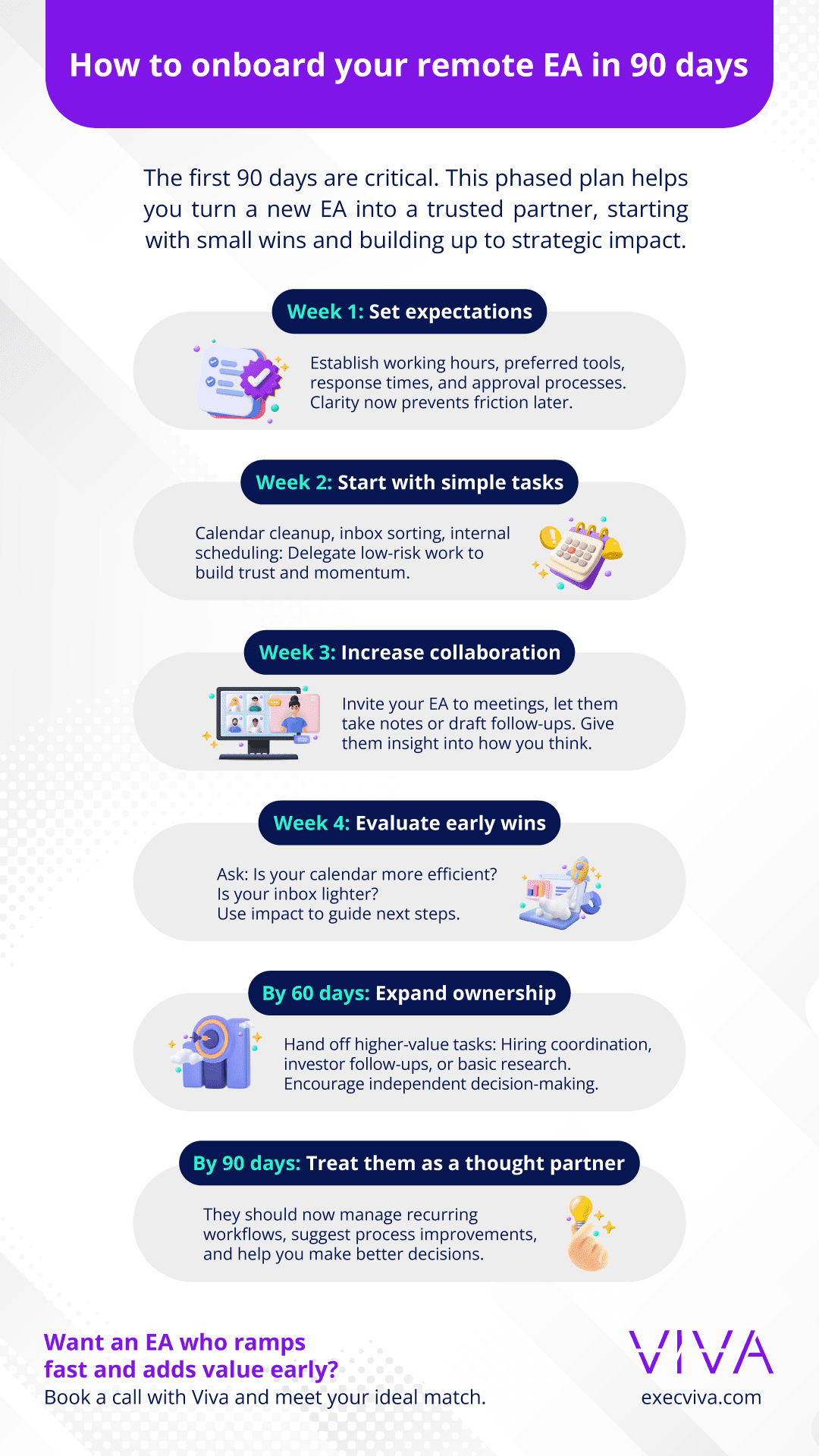
Week 1: How do you set clear expectations from day one?
The key to setting expectations from the start is to be open and specific about them. Everybody has their own way of getting things done, and that’s perfectly fine, but onboarding an executive assistant is not the same as onboarding any other team member. In order for your EA to deliver real value, they must learn how to think like you, write in your own voice, and deliver work of the same quality as what you would produce yourself.
A remote executive assistant is an extension of you, a second brain if you will. That’s why we recommend that in the first week, you:
- Set up daily check-ins (sync or async) to review priorities.
- Explain how decisions are made and what requires your approval.
- Share your calendar, work style, and preferred communication methods.
- Start with low-risk tasks like scheduling and inbox organization.
- Introduce your EA to key team members and tools they’ll need.
Week 2: How do you delegate effectively?
Some executives struggle with delegation. This is because they think they can do a task better than anyone else, because they’re afraid to let go of control, or because they might feel like they’re asking too much of their EA. But the reality is that startup execs have too much on their plate – so much so, that getting everything done is a rare occurrence. Don’t see delegation as another chore; instead, see it as what it is: trusting your team to take care of certain chores that require your involvement to be done well. This is how you can start doing so:
- Identify 3–5 most time-consuming tasks and ask your EA for support (e.g., creating pre-meeting briefings, doing research, putting decks together).
- Provide clear instructions but allow room for initiative.
- Set up a system for tracking progress (e.g., Trello, Asana, Notion).
- Encourage proactive problem-solving—your EA should start making decisions, not just follow instructions.
Week 3: How do you build trust and improve collaboration?
The best way to build trust with your executive assistant is by believing you made the right hire. That means trusting they are capable of doing the work you hired them to do. Here are some good practices you can start implementing:
- Let your EA join key meetings to take notes and flag follow-ups.
- Ask them to draft emails and reports for your review.
- Assign a project (e.g., event coordination, investor meeting prep) and assess their approach. This is a great example of how to plan an offsite step by step.
- Provide feedback regularly to refine their workflow.
Week 4: How do you measure early success?
You should start seeing the impact of your executive assistant’s support by week 4. This is the time to assess their contributions, refine their responsibilities, and expand their role. If they’ve done a good job of keeping your inbox and calendar in check, it might be time to delegate bigger responsibilities. This is how:
- Review what tasks they’ve taken off your plate.
- Identify new areas where they can provide support.
- Allow them to take ownership of specific workflows (e.g., travel planning, team coordination).
- Reduce check-in frequency as trust builds.
What should you focus on between days 30 and 60?
Most of the executives we work with start seeing value in the first week of onboarding a remote executive assistant, so by the end of the first month your EA shouldn’t only be fully ramped, they should already be doing much more than admin and ops work. Remember that EAs are not order-takers; they’re strategic business partners who are qualified to take on big responsibilities.
How do you hand off bigger tasks to your remote executive assistant?
Handing off bigger tasks to your remote executive assistant starts with trust and clear expectations. Instead of assigning only small, well-defined tasks, gradually delegate higher-level responsibilities that require judgment and initiative. Begin by outlining the desired outcome, then give them the context and resources they need to succeed. Encourage independent decision-making by allowing them to take ownership of recurring tasks and proactively manage your schedule. Here’s how:
- Delegate high-level responsibilities, like investor follow-ups or hiring coordination.
- Let them handle recurring tasks without your approval.
- Encourage them to anticipate your needs instead of waiting for direction.
- Provide more autonomy in scheduling and workflow decisions.
How do you create a system for long-term success?
Creating a system for long-term success with your remote executive assistant means building a framework that ensures consistency, accountability, and efficiency. Instead of relying on constant oversight, put systems in place that track progress and encourage proactive problem-solving. The goal is to shift from managing tasks to managing outcomes, giving your assistant the tools and autonomy to drive results. Here’s how to make that happen:
- Implement a structured way to track delegated work.
- Streamline communication—fewer check-ins, more ownership.
- Trust them to manage relationships with external stakeholders (e.g., vendors, partners).
- Allow them to refine processes to increase efficiency.
What should you focus on between days 60 and 90?
Many people assume that executive assistants simply handle emails, schedule meetings, and organize travel. But that’s just the beginning. In reality, a great EA can be a valuable thought partner, challenging your ideas, refining your perspective, and pushing you to grow as a leader. By now, your EA should be proactively managing tasks and making your life easier in ways you didn’t anticipate.
How do you transition your EA into a strategic partner?
- Have them prepare decision-making summaries instead of just gathering data.
- Assign ownership of entire projects, such as event planning or executive reporting.
- Let them manage cross-functional coordination with other teams.
- Include them in strategic planning discussions.
How do you ensure long-term success?
- Identify skills they can develop to bring more value.
- Document processes for easier onboarding in the future.
- Set new goals for the next 90 days based on evolving business needs.
What’s the outcome of a successful 90-day onboarding?
A well-structured 90-day onboarding process sets the stage for a seamless and highly effective working relationship with your executive assistant. By this point, they should be fully integrated into your workflow, operating with minimal direction while adding strategic value. Here are six questions you should ask yourself.
- Does your EA own and manage your schedule with minimal input?
- Do they handle emails, meetings, and follow-ups without reminders?
- Does your executive assistant proactively solve problems and anticipate your needs?
- Do they take on strategic work, freeing you to focus on growth?
- Is your EA a true extension of you, not just a task-doer?
- Do they own entire processes like vendor relations, or facilitate all-hands meetings?
If most of your answers are a clear “yes,” your EA is fully onboarded and adding value. But if “no” is the dominant response, it might be time to reassess whether they’re the right fit. If that’s the case, let us connect you with the ideal EA to support your startup’s growth. Book a call today to find the right match.