Executive Assistants
5 ways to empower your virtual assistant to manage up
Mar 1, 2025
5 min read



There are many ways to empower your virtual assistant to manage up and push back effectively, but our experience has confirmed that these five approaches are proven to be the most effective for our customers: encourage them to speak up, present yourself as a trusted partner for them to push back, communicate clearly, make them feel included, and avoid micromanaging them.
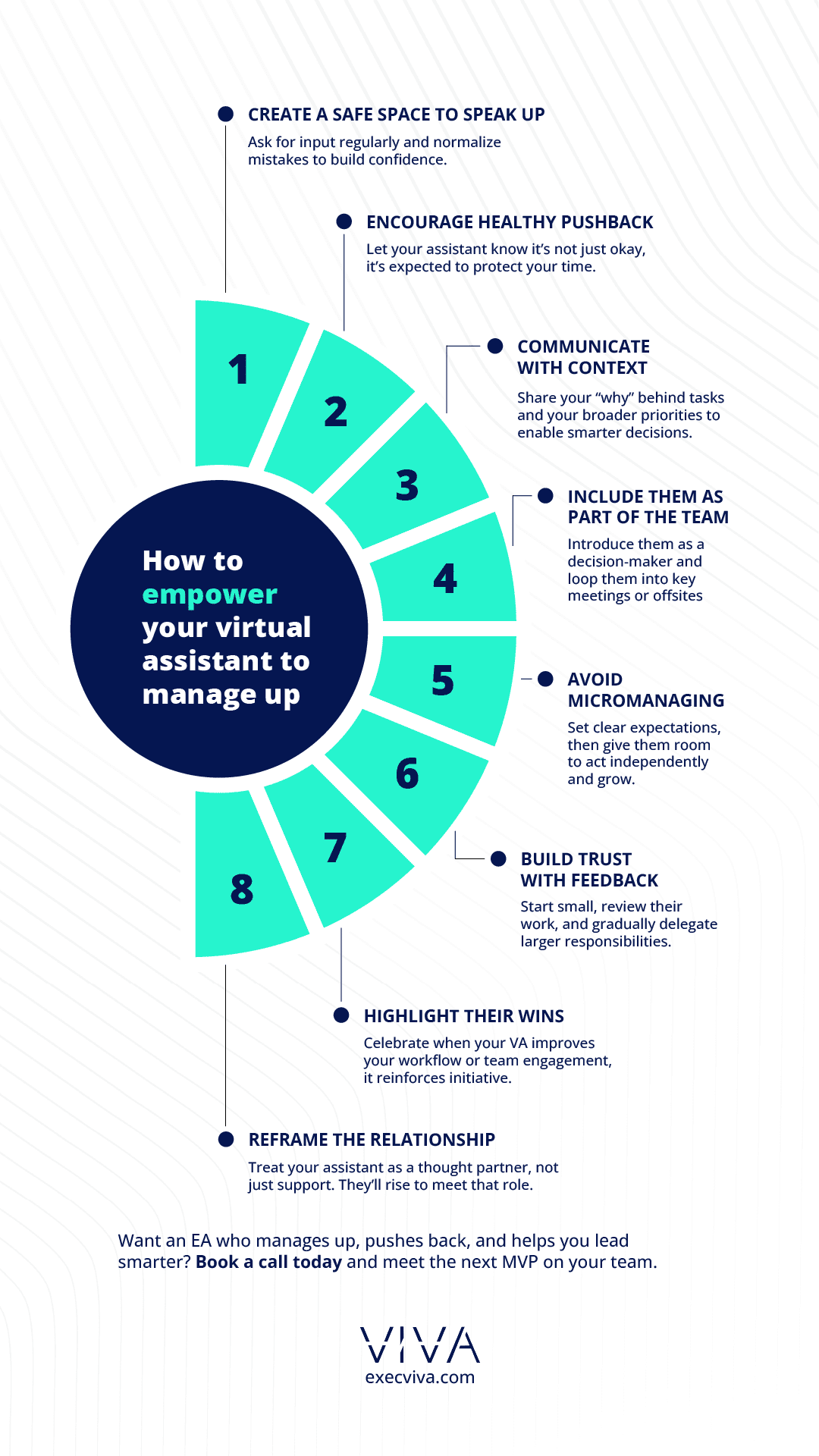
Table of contents
- Encourage your virtual assistant to speak up
- Help your executive assistant push back effectively
- Establish clear communication with your EA
- Make your virtual assistant feel included
- Avoid micromanaging your virtual assistant
What does “managing up” really mean for a virtual assistant?
Managing up means to work in a way that makes your manager able to do their work effectively. That’s why knowing how to manage up is especially important for your virtual assistant. After all, your assistant’s ultimate primary objective is to help you be better at your job.
As a company that specializes in helping executives be more productive, we have seen how hundreds of partnerships between execs and their assistants are born. In that journey, we’ve witnessed how some of those relationships are set up for success from the start, and how others need some support to be stronger.
One of the biggest challenges for executives is that they expect their EAs to manage up, speak up, and push back, but they don’t know how to empower them to do so. If the EAs themselves don’t have the initiative to be strong business partners, they might sit comfortably in the position of the order taker instead of acting proactively and helping their executives do their job better.
If you’re in a situation like this, you might want to know how some of our customers– all of whom are startup executives in the US– have empowered their EAs to manage up and become the business partner they need.
Encourage your virtual assistant to speak up
Allowing your virtual assistant to express themselves freely is one of the best ways to encourage them to manage up. Why? Because they feel more secure and start being more proactive when they feel heard, when they see you value their opinion, and when you actually pay attention to what they can bring to the table. For that to happen, you should create a safe space for input. Ask for your EA’s thoughts during meetings and on specific tasks. If they get it wrong, don’t snap on them. Instead, offer guidance and show it’s ok to make mistakes. Ask your EA for their perspective when discussing projects. Simple prompts like: “What do you think?” or “Do you see any issues with this plan?” can make a big difference.
One of our customers, the CEO of a ride-sharing app, turned to his executive assistant, Sara, for her opinion. Their partnership grew and she quickly became what he called his “thought partner”.

Help your executive assistant push back effectively
The higher you are in the company, the more meeting invites you’ll receive. Your knee-jerk reaction will probably be to accept them all and see when you can find time to actually get work done, but deep down you know you probably should say no to some of those meetings or requests. Eventually, you’ll have to start saying no.
That’s one of the main benefits of having a virtual assistant: Their job is to remove all distractions and keep you focused on the most impactful work you can produce. Let your EA know that pushing back is not just allowed but encouraged when necessary. You may be their leader, but they know what’s best for you.
One of our customers, the CHRO at a Series E startup, had a weekly People team meeting that she organized and facilitated, but her virtual assistant noticed that low engagement was a problem. Team members struggled to share their opinions, and the meeting wasn’t the best use of anyone’s time.
Her virtual assistant suggested shifting the meeting from a weekly to bi-weekly cadence and proposed rotating facilitators. By pushing back, she freed a lot of her executive’s time and, on top of that, increased team engagement during company meetings.
Establish clear communication
Establish clear communication from the start to get the most out of your virtual assistant. Instead of simply assigning tasks, share the broader context of your goals and priorities—this empowers your EA to offer more strategic support.
A good way to start is by sharing as much context as possible. One of our customers, the CEO at a Series C startup, asked her EA to meet with him and his direct reports and understand everyone’s personal and professional priorities. This allowed her to plan for the entire quarter, making sure everyone was focused on their tasks and objectives.
Explain the “why” behind tasks when delegating. Instead of “Schedule this meeting,” try “Schedule this meeting because we need alignment before the product launch.” This enhances clarity and helps your EA make better decisions on your behalf. By fostering open communication and sharing your strategic vision, you create a proactive partnership that drives efficiency and supports your long-term goals.

Make your virtual assistant feel included
Working remotely has many benefits, but one setback is that some team members might feel like outsiders, especially if they’re one of the few collaborators who aren’t in the office.
Most of our executives are located in big cities across the US but their virtual assistants are scattered around Latin America and even Europe. Many of them have found ways to make their EAs feel included, either by introducing them to the team as a decision-maker in specific areas, or by including them in company events, such as team offsites. There’s no one better at planning offsites than executive assistants, so why not have them fly over to oversee the whole thing? It will make them feel included and guarantee that your event runs smoothly.
If traveling is not an option, include your EA in relevant meetings and conversations, and encourage the rest of the team to have 15´Slack donuts with them and get to know them on a deeper level. This will make them feel like they are a part of something bigger and improve their motivation.
Avoid micromanaging your virtual assistant
Avoid micromanaging your virtual assistant—it’s a lose-lose situation. It keeps you tied up with unnecessary oversight while preventing your assistant from being truly productive. Why would they bring fresh ideas to the table if they’re constantly second-guessing every step? Instead, set clear guidelines and grant your EA the autonomy to execute.
One of our customers empowered her assistant, Janice, to take initiative without needing constant direction. Rather than asking, “Is there anything I can do?” Janice identified her executive’s needs independently and tackled ad hoc initiatives that turned out to be incredibly valuable. Her early deliverables weren’t perfect, but her executive provided constructive feedback, and now, Janice leads entire processes and even runs team meetings on her own.
The key is to start small—delegate simple tasks, offer feedback, and gradually hand over bigger responsibilities. As your EA gains confidence and experience, they’ll take on entire projects and deliver outstanding results. This all depends on your willingness to trust them.
When you empower your executive assistant to manage up, speak up, and push back, you’re not just improving productivity—you’re building a stronger, more agile startup. By providing the right environment, setting clear expectations, and genuinely valuing their input, you transform your EA into a strategic partner who actively contributes to the success of your business.
If you’re ready to onboard a virtual executive assistant who can manage up, speak up, and push back effectively, let’s chat! All our EAs undergo a business boot camp that teaches them how to manage up, speak up, and push back effectively so you can be even better at your job.