Executive Assistants
Executive assistant qualifications of a successful EA
Jul 30, 2024
6 min read


What are the most important executive assistant qualifications? While an EA’s role and skills can be customized to fit the executive’s unique needs and role, there are core skills and qualifications that are needed in every EA role.
Check out the profiles of some of our EAs. All of our executive assistants are fully equipped to support you in <24 hours.
If you’re the SVP of People at a Series D startup, one of your biggest needs is probably squeezing all those candidates’ interviews into your calendar. If you are the CTO at a Series B startup, for example, you probably need to make sure your entire team is proficient in all the software the company uses. Your EA’s role and their qualifications will vary based on those needs. In this post, we’ll help you understand how to find a top-tier EA regardless of role.
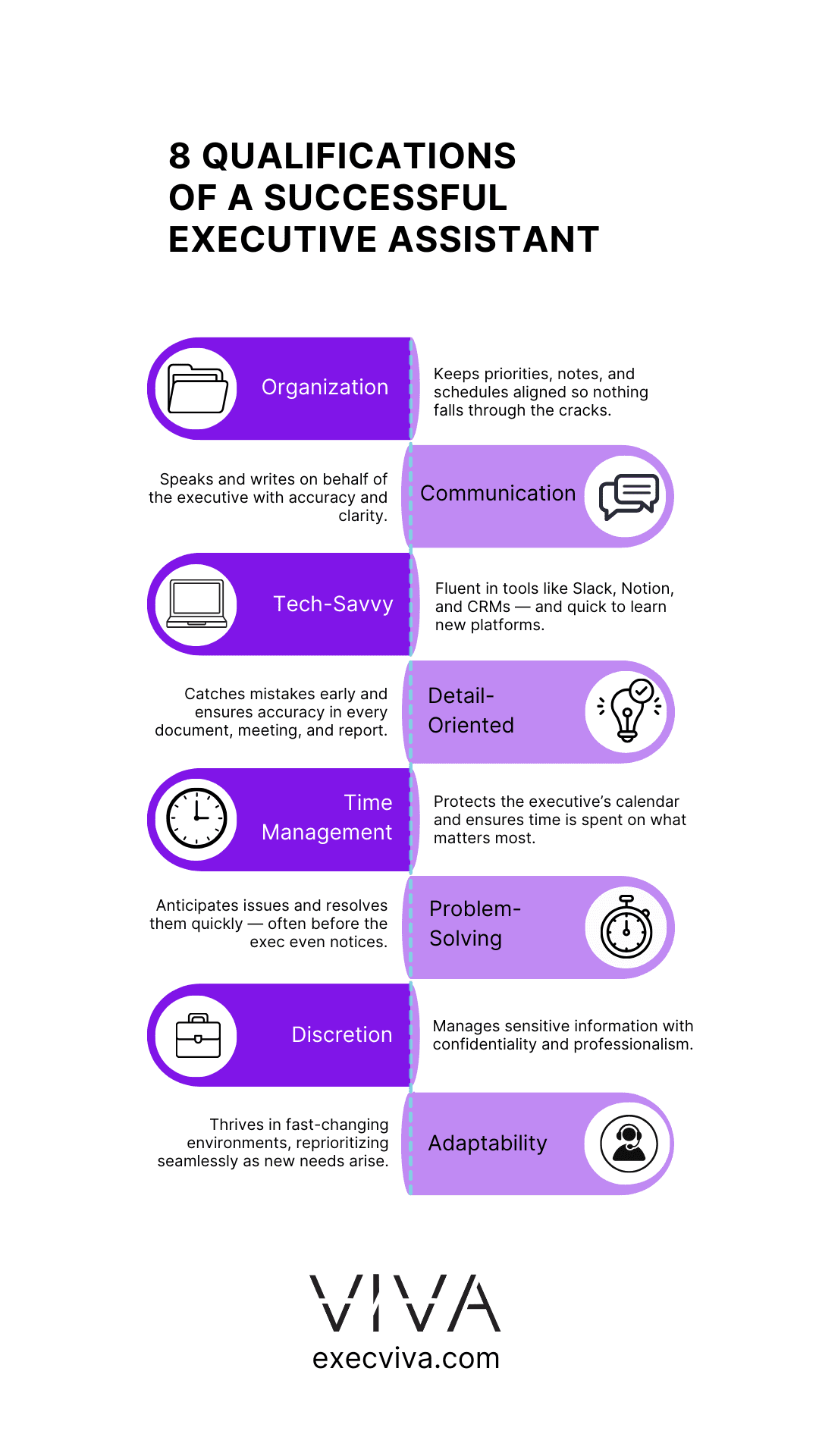
Table of contents
- Strong organizational skills
- Excellent communication abilities
- Technological proficiency
- Attention to detail
- Time management skills
- Problem-solving skills
- Discretion and confidentiality
- Adaptability and flexibility
Top 8 executive assistant qualifications
An EA will be more valuable to you depending on the specific needs of your role, but what’s a good starting point? Which executive assistant qualifications are a must-have? We’ve put together a list we believe marks the difference between good EAs and truly outstanding executive assistants.
-
Strong organizational skills
Startup executives have a lot on their plate — sometimes even too much. If you need to prep for a board meeting, plan a trip, hire a new team member, and take care of all the other responsibilities of your own workload, chances are that at least one of them is going to be demoted from your priorities and moved to the back burner. If this sounds familiar, rest assured, you’re not alone.
Executives are not meant to operate solo. To deliver the best work they’re capable of, they should have executive support. That’s why organization is one of the most important qualifications of an executive assistant.
Your EA will take notes about absolutely everything, allocate time for you to work on what’s important, take over anything you can delegate, and ensure nothing ever falls through the cracks.
One of our EAs, for instance, noticed her executive struggled to keep up with Slack messages. That’s when she decided to take over and remind the exec every time she left a message unanswered. If the EA was familiar with the topic, she even answered herself. Having an EA guarantees a more organized way of working.
-
Excellent communication abilities
One of the best ways an executive can leverage their executive assistant is to allow them to fill in for them. As much as you’d like to maintain a close relationship with your entire team, attend every relevant meeting, or nurture an external connection, you probably don’t have the time to do all that.
That’s where your executive assistant comes along. Since they work so closely with you, they quickly learn to talk, think, and even make decisions in the same way you would. Don’t hesitate to ask your EA to facilitate a meeting or draft emails on your behalf, create your own operating manual, and share it with your EA so you feel comfortable with that.
In doing so, they’ll free up so much time, you will finally get the chance to do some deep work or catch up on projects that were once a priority and they’re now long overdue.
-
Technological proficiency
If you’ve never had an executive assistant, you may not know how tech-savvy they are, especially EAs who have a background in tech startups.
Executive assistants are power users of some of the most popular tools in the startup world: from Salesforce to Notion, to Superhuman and Slack. Don’t be surprised if your EA ends up teaching you a thing or two about your preferred tools.
The speed at which executive assistants operate also makes them fast learners, so if there’s any tool you want your EA to learn, just ask. They will dive in head first and quickly become fully proficient.
-
Attention to detail
Even though most job candidates would swear to pay attention to detail, this is an absolute non-negotiable for executive assistants. After all, paying attention to the smallest details can make you look great or seriously harm your professional reputation.
Receiving an email with typos, adding the wrong number to an expense report, or providing an outdated stat in a meeting deck will make others doubt everything you say. If you’re going to delegate any of those tasks to your executive assistant (we strongly suggest you delegate them all), they better pay attention to every single project they put together.
Viva executive assistants, for instance, undergo extensive training the moment they join the company – no matter how many years of experience they have in the role. We test their attention to detail in many ways, and you can too: assess their typing skills or see if they take different time zones into consideration before scheduling a meeting. The highest standards of quality hide in the little details.
-
Time management skills
Time is the most important resource we have: Companies cannot afford to move slowly. Executives have workloads that take much more than eight hours a day, and executive assistants need to know how to manage their time in the most effective ways.
When you become a leader in your organization, everyone wants to get time on your calendar, but there are not enough hours in the day for you to complete your work and have day after day of back-to-back meetings.
Luckily for you, executive assistants are experts in knowing what truly deserves your time and what can be deflected or canceled. Their time management skills don’t only affect their work, but will have a big impact on yours.
-
Problem-solving skills
Startup executives spend a considerable amount of time solving issues that arise out of the blue. For that reason, they end up not having enough time to focus on big projects or completing deep work.
Executive assistants are a great asset when a fire starts burning somewhere. An EA who has already ramped up to their full capacity and knows how you think and operate, becomes an extension of you, someone who can make executive decisions and solve a problem. They won’t even bother you with the details.
Problem-solving is also a great skill for EAs to have when their executive is traveling. One of our own Viva executive assistants told us how her executive received a text during a board meeting informing him that his flight was delayed. Before his meeting ended, the EA had bought him a new train ticket, arranged a new flight with the airline, and texted the details so he could still focus on the meeting without unnecessary stress from an itinerary change.
-
Discretion and confidentiality
Executive assistants work so closely with executives, that being discreet is not a nice-to-have; it is a must-have. We understand not all execs are so willing to trust a new team member, but our experience has shown us that trust is nurtured easily when you have security protocols in place. How do we do that and how can you build trust with your executive assistant?
At Viva, we place a high priority on hiring individuals we can trust. We integrate ethics into every stage of our process, from initial recruitment and screening, to training and customer interactions.
We urge our team to remain vigilant about potential threats to confidentiality and to handle data and information according to our protocols, which are designed to protect our customers’ needs. It’s not merely about having these protocols in place; it’s about continuously striving to maintain 100% compliance.
-
Adaptability and flexibility
How often do you find yourself planning the week, only to see a new priority pop up mid-week? Being able to switch gears and re-prioritize your day based on new needs is key for any startup executive. That’s why their EAs need to be even better at adapting to those needs.
One of our EAs support two executives who are always on the move. The execs travel multiple times per week, and sometimes, that involves a lot of schedule juggling. When trip plans change, the EA quickly reprioritizes tasks and operates with such urgency that, before the executives even have a chance to ask for updates, everything is already arranged—from rebooking flights to informing their hotel’s front desk of the delayed arrival.
You need an EA who moves even faster than you do, so if you’re looking for executive support, make sure the candidate ticks this critical box.
Hiring the right executive assistant can change the way you work, but that will only happen if you find a candidate with all these qualities, someone who can have a real impact on every front.
If you’re looking for someone who checks all the boxes but you don’t have the time to look for them yourself, chat with our team. Our executive assistants are fully trained and ready to start when you are.