Productivity
Executive Time Management Techniques For Busy Leaders
Mar 16, 2024
7 min read


Are you familiar with the concept of executive time management? A day at the office may look completely different from person to person depending on the type of job they do. For CEOs and other high-profile executives, one thing is certain: tasks never stop piling up. On any given day, your team members look for guidance and you’re meeting with investors, evaluating new projects, checking in with mentors and mentees, keeping an eye on deadlines, and always trying to keep your email inbox from overflowing.
Leading a successful company depends on many factors, including your time management skills and willingness to delegate.
Are you being productive? We’ve built this fast quiz to find out (and what to do about it).
What is executive time management?
Everyone can benefit from managing time wisely, but it’s especially crucial for executives because they oversee entire companies. They often work long hours and have lots of responsibilities. Executive time management is how executives ensure their work is done in the most efficient ways. For maximum efficiency, executives must organize, delegate, and prioritize tasks. By being good at time management, executives can organize their work, feel less stressed, model leadership skills for their team, and strike a better balance between work and life, preventing overwhelm and burnout.
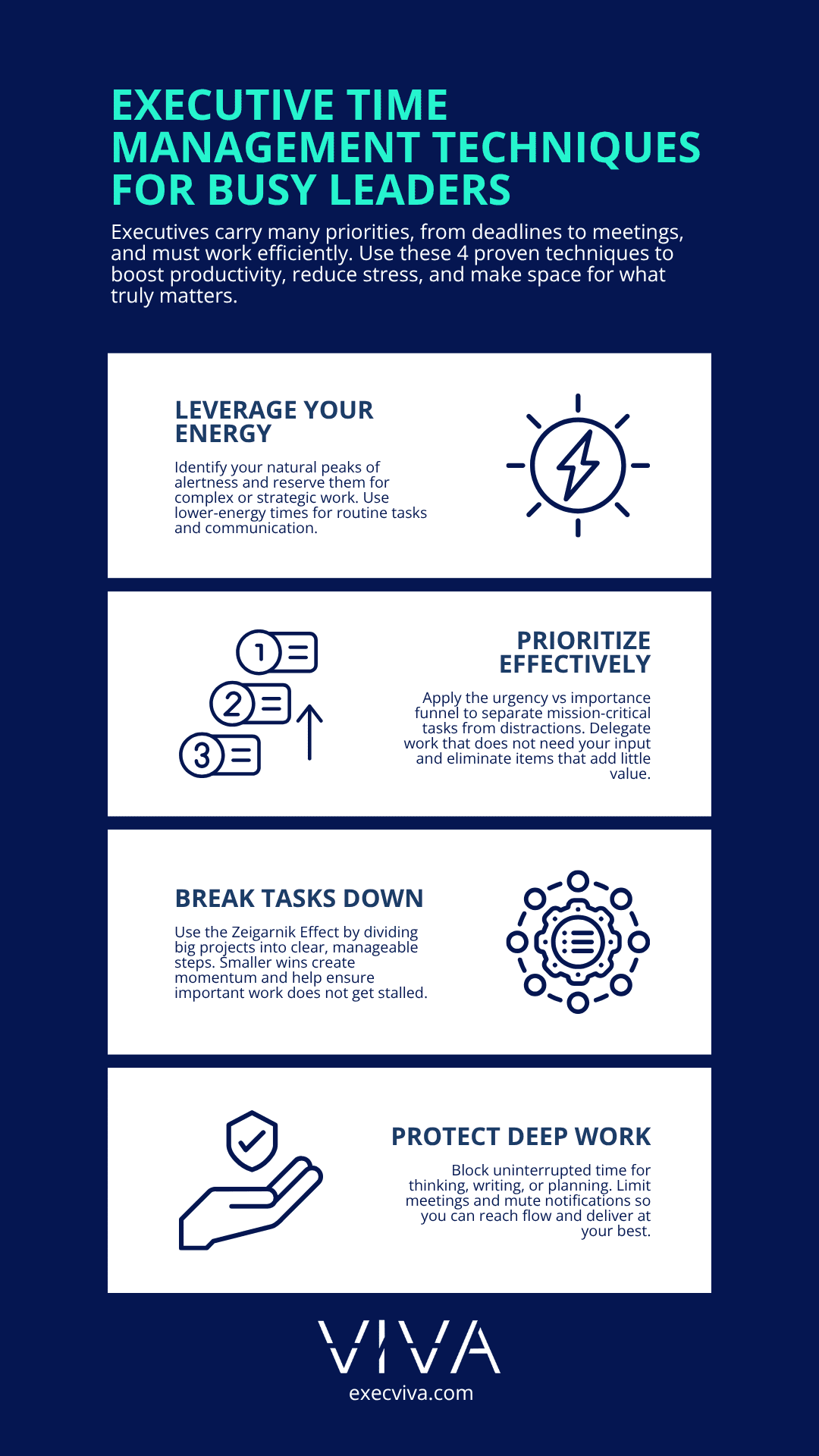
Getting organized for maximum time management seems difficult, which is exactly why we developed this list of the top 4 executive time management techniques leaders can put into practice.
Top 4 executive time management techniques
1. Understanding your circadian rhythm
The circadian rhythm is our natural clock, an internal mechanism that regulates our sleep-wake cycle and other physiological processes. It’s a 24-hour cycle that is influenced by external factors such as sunlight, temperature, and activity levels.
Knowing your circadian rhythm can help you in many aspects of your personal and professional life. Aligning your daily activities with your circadian rhythm will help you move more smoothly through the day, helping you manage your time more effectively, and resulting in enhanced productivity.
The first thing you need to do is identify your chronotype. Everyone has a different circadian rhythm, which is why some people prefer starting the day with an early morning run and others would rather stay up late to finish their work.
There are four chronotypes, each of which is modeled after animals that have the same behavior: bears, lions, wolves, and dolphins.
- Bear chronotype: Bears are the most common chronotype, representing the average population. They typically follow a regular sleep-wake cycle, feeling most alert during the day and needing a consistent amount of sleep each night to function optimally.
- Lion chronotype: Lions are early risers, waking up naturally before dawn and feeling most productive and alert in the morning hours. They tend to adhere to a strict schedule and may experience a dip in energy levels during the evening.
- Wolf chronotype: Wolves are characterized by their preference for staying up late and sleeping in. They often feel most creative and productive during the evening and night hours, finding it challenging to wake up early in the morning and feeling sluggish during the early part of the day.
- Dolphin chronotype: Dolphins have an irregular sleep pattern, often experiencing difficulty falling asleep and waking up frequently during the night. They are typically more alert in the morning after a night of fragmented sleep but may struggle to maintain energy levels throughout the day.
Understanding your chronotype can help you plan your day according to your natural energy levels.
How can you hack your circadian rhythm?
There are five highly useful tips that can help maximize your productivity and well-being by aligning your daily activities with your circadian rhythm.
- Create a consistent sleep schedule
Maintaining a consistent sleep schedule is essential for regulating your circadian rhythm. Go to bed and wake up at the same time every day, even on weekends. Tools like Apple Health track your sleep patterns. If you have it in your phone, go take a look and see what’s reasonable given your current sleeping cycle.
- Plan your day around your energy levels
Your circadian rhythm affects your energy levels throughout the day. Plan your most important tasks for when you have the most energy. For example, if you realize you fit in the bear chronotype, you may want to focus on deep work between 10:00 a.m. and 2:00 p.m.
- Take breaks
Our circadian rhythm follows a pattern of energy and rest. It’s important to take breaks throughout the day to recharge your energy levels. Take small breaks every hour, or an hour and a half, and longer breaks after three to four hours of intense work. Use that time to recharge by either going for a walk, stretching, grabbing a bite to eat, or connecting with someone near you.
- Get natural sunlight
Exposure to natural sunlight can help regulate your circadian rhythm. Try to spend time outside during the day, or, if your schedule keeps you from being outside during the day, at least try to sit by a window while you work. During the fall and winter, you can take vitamin D supplements or use a sun lamp to imitate sunlight. *Ask your doctor before doing so.
2. The importance of prioritization
Prioritization is a crucial aspect of time management because it helps individuals allocate their time and resources effectively to the tasks that matter most. In other words, prioritization allows you to identify which tasks are most important and urgent, so you can focus your energy and time on them, rather than spending your entire day dealing with less important activities.
The Viva productivity funnel
Whether you’ve heard of it by name or not, there’s a chance you have already made this a part of your thought process without even knowing it, at least some of it. This tool helps you see the importance versus the urgency of doing something. It is as simple as creating a funnel with four sections: urgent, not urgent, important, and not important.

Use the productivity funnel to place tasks and projects in whichever section you see fit.
This approach will help you see what needs to be done as soon as possible, what can wait, what can be delegated, and what can be deleted.
- The items you place at the top of the funnel can be deleted or, at least, muted for the time being. If you’re the CEO, you might need to stop having too many 1:1s, so you can simply remove them from your calendar.
- Then, there are tasks you can automate. If you’re the VP of people, scheduling meetings with candidates will take too long. Use scheduling software like Calendly instead to automatically arrange meetings.
- Delegate urgent tasks that don’t necessarily require your presence or action to be finalized. If you want to strengthen your social media presence, delegate that to your EA. They can make a list of relevant companies, identify potential leads, draft a blurb to DM them directly, create a social media strategy, and write, post, and monitor your content.
- Finally, take on the tasks that are genuinely urgent and important instead of handling the entire funnel by yourself, such as focusing on raising the next funding round or putting a strategy together for a new expansion.
Don’t be afraid to delegate urgent and less important tasks to an efficient team member. Find someone who can be trusted to tackle big responsibilities, and, most importantly, can prioritize them. An executive assistant (EA) is skilled in taking on delegated tasks. Having an EA can change the way you work.
3. Put the Zeigarnik Effect to work
Whenever we have a bad experience, we retell the story of what went wrong multiple times, way more than good experiences. We are most likely to hold onto the memory of a clerk who was rude to us rather than the flight attendant who remembered our dietary restrictions.
Something similar happens inside our brains when we are working on a project but reach the end of the day with that deck still open and halfway done. That unfinished task keeps coming back to us in an endless loop throughout the rest of the day and night until we finally have the time to open it again and finish it.
Why do we focus on the negative rather than the positive, or the one unfinished task rather than the 10 we completed? The answer can be found in something called the Zeigarnik Effect: a psychological phenomenon that refers to the tendency human beings have to remember incomplete tasks better than finished ones.
This phenomenon was first identified by Bluma Zeigarnik, a psychologist who discovered that waiters remember orders from tabs that are still open more precisely than those that have already been paid for.
As long as a task remains unfinished, that endless loop will stay active until we manage to finish it, closing the loop and allowing our brains to, finally, move on to the next thing.
How can insights of the Zeigarnik Effect make us more productive?
- It motivates us to complete tasks because the open loop creates a sense of tension and discomfort that is relieved when the task is finished.
- It helps us motivate our team members by giving them incomplete tasks that need to be finished.
- Breaking up larger tasks into smaller, incomplete ones, can trigger our brains into getting more things done.
4. Maximizing focus and reach flow
Focusing on one type of task for a period of time rather than tackling everything as it comes, stimulates your brain and makes it more likely to reach flow. This refers to a psychological phenomenon first studied by psychologist Mihály Csikszentmihályi, and is technically defined as:
“Optimal state of consciousness where we feel our best and perform our best”.
This might be the first time you hear about flow state, but you have probably heard or even used the expression “being in the zone”. Whatever term appeals to you most, flow is a very powerful state of mind where you are giving your undivided attention to one thing and one thing only. Most people plan their day around their meetings, when in reality what you should be doing is planning your meetings around your day.
During flow state, you will feel more productive because when you are hyper-focused on something you think faster, move faster, make better decisions, and can see more clearly what might be ahead.
Tools to get into flow state
- Focus on positive emotions: Think of the impact the completion of this task will have on your business.
- Set challenging tasks for yourself: This will motivate you and keep you going.
- Get rid of distractions: Let your mind focus on the task at hand, nothing else.
- Choose music that stimulates your ability to focus.
- According to a recent study, there are three elements that impact an executive’s ability to reach a flow state. The first one is intellectual quotient (IQ) which happens when they have clarity over their role, a clear understanding of the objectives, and access to relevant knowledge and resources.
- The second element is emotional quotient (EQ), which includes having an environment of trust and respect, having fun, and a general feeling that everything they do is a collaborative effort and that they’re not alone.
- The third one is the meaning quotient (MQ): This one describes the peak-performance experience as feeling excitement, tackling a new challenge; and something that matters, will make a difference, and hasn’t been done before.
- Employees working in a high-IQ, high-EQ, and high-MQ environment are five times more productive at their peak than they are on average. If your company doesn’t provide all three, ask your head of culture to start working on it.
In summary, time management is not a trend; it is a mindset in which you prioritize your time and resources efficiently because you know how valuable they are. If you’re looking for new ways to be more productive, consider hiring an executive assistant, the ultimate productivity booster.
- Your EA can manage your calendar based on your chronotype, so you are more productive during your peak hours.
- Your virtual executive assistant can use the Viva productivity funnel to eliminate the unnecessary items from your to-do list, automate repetitive processes, take on what you need to delegate or assign it to another team member, and finally, ensure you’re focused on the most impactful work you could be doing.
- Your EA can use the Zeigarnik effect to break big projects into smaller tasks, so you stay productive without getting overwhelmed.
- Your EA can help you reach the flow state by creating blocks of deep work, removing distractions, and staying on top of your email, calendar and Slack, so you’re not tempted to go check your notifications.
Sounds like something you’d like to explore? Chat with our team and see if getting an EA is the right choice for you.