Executive Assistants
Executive administrator vs. executive assistant: Which one should you hire?
Apr 26, 2024
9 min read


TL;DR
- Executive administrators handle broad office support; executive assistants offer deep, strategic support to 1–3 execs
- Executive assistants save their executives 10+ hours/week through calendar control, inbox triage, and team coordination
- Executive assistants often evolve into chief of staff or ops roles
- Viva’s executive assistants are based in Latin America, are aligned to U.S. time zones, and are available to onboard within 24 hours
- Viva customers consistently cite trust, leverage, and time savings as top outcomes

Executives scaling fast-growth teams need more than general administrative help. According to the Work Trend Index Annual Report, nearly 2 in 3 people (64%) say they struggle with having the time and energy to do their job, and 60% of leaders say that a lack of innovation or breakthrough ideas on their teams is a concern.
That’s why it’s time for you to start looking for support if you’re in a leadership position and you’re handling nearly everything on your own. Your productivity and your team will thank you for it.
This blog compares the roles of an executive administrator, an executive assistant, and the nuances of admin vs. EA to help you decide which one you should hire.
Table of contents
- What is an executive administrator?
- What is an executive assistant?
- Key differences at a glance
- How they handle real-life executive problems
- How to decide what your team needs
- Final thoughts
- FAQ
1. What is an executive administrator?
An executive administrator handles company-wide administrative tasks, often supporting multiple teams, departments, or a general leadership group. They’re foundational to workplace operations. This role is best suited for companies that need steady support for logistical and clerical functions rather than deep, executive-level enablement.
While this person may interface with department heads or leadership teams, their work is often broad in scope and lower in strategic impact. The executive administrator is also more likely to follow structured processes rather than drive decision-making.
Typical responsibilities include:
- Scheduling meetings and managing office calendars
- Coordinating team events and cross-functional logistics
- Ordering supplies and managing vendors
- Editing internal communications and formatting reports
- Filling in for other admins or support roles
Because the role is more task-based, executive administrators are often shared across multiple leaders or departments. They are typically hired full-time for in-office work, though hybrid and remote options are increasingly viable for this position.
2. What is an executive assistant?
An executive assistant or executive administrative assistant is embedded directly with one, two, or three executives, acting as a true partner in their day-to-day execution. The best EAs own outcomes, not just tasks, and make decisions proactively. They’re not reactive task managers; they’re force multipliers.
“I’m thrilled with how quickly my EA has picked things up. She was able to jump right in and has done a phenomenal job. On day 2 of working together she was already transforming my whole calendar and managing my email.” – CEO at Ayar Labs
This role often requires a higher level of professional maturity, discretion, and communication skills than the executive administrator role. Executive assistants serve as the front line for an executive’s time, information, and relationships. Many also support special projects and play a critical role in shaping the executive’s rhythm of work.
Key areas of executive assistant support include:
- Managing inboxes using triage systems like Superhuman or Gmail filters
- Handling calendar control, real-time meeting moves, and strategic time blocking
- Being responsible for travel bookings, expense reports, and credit card reconciliation
- Meeting prep: pre-reads, agendas, briefings, and post-meeting summaries
- Handling team communications, offsite coordination, stakeholder engagement
- Hiring coordination, research, and project execution
The ability of anEA to “think like their exec” is what separates good from great. EAs are often empowered to act independently, especially after trust is developed.
“[My EA] is more of a thought partner and contributor for my day and my team. I have been thrilled; she’s been wonderful. Exceeding my expectations for sure.” – VP of strategy and development at Veho
Many executives discover that once their EA understands their preferences and priorities, they’re not just scheduling; they’re shaping what gets done and when.
3. Key differences at a glance
The admin vs. EA conversation often boils down to one core question: Are you looking for coverage or are you looking for leverage? This comparison table breaks down some of the most important differences between the two roles, so you can choose which one you actually need:

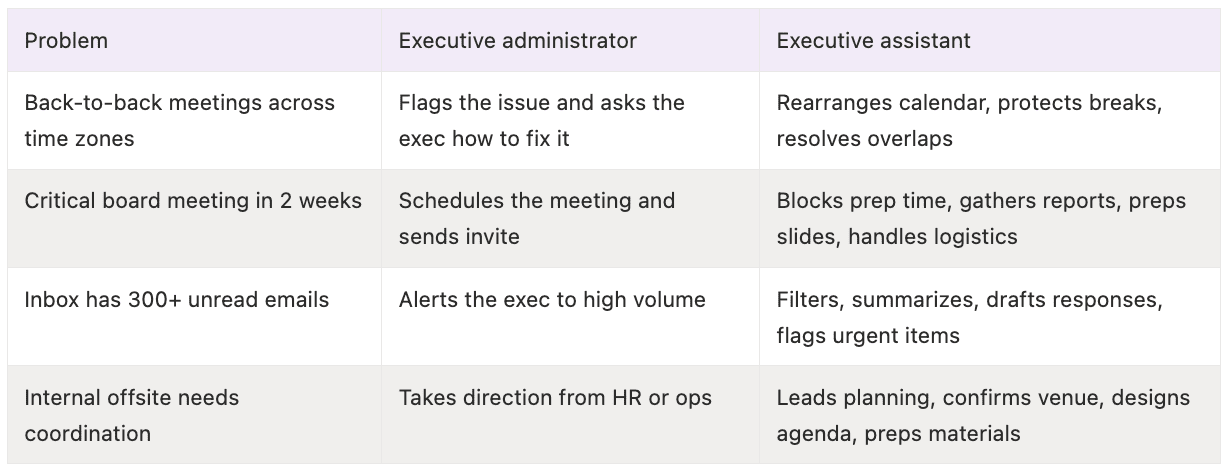
4. How they handle real-life executive problems
This table reflects how the admin vs. EA distinction shows up in day-to-day leadership challenges. An admin helps complete tasks when directed. An EA actively solves problems and removes blockers.
5. How to decide what your team needs
According to Deloitte’s 2025 Global Human Capital Trends survey report, 41% of respondents feel that their time every day is spent on work that doesn’t contribute to the value their organization creates. That’s why hiring the right support is more important than ever.
In order to do that, you need to understand which role is best for you and your company’s needs. To find the answer, ask yourself these three questions:
What kind of support are you looking for?
If your top need is for someone who can keep the broader business organized – ordering supplies, planning company events, and editing documents – then an executive administrator is likely sufficient. This role helps keep the wheels turning, especially in larger organizations that require centralized administrative coverage.
But if your calendar constantly shifts, your inbox is overflowing, and your team lacks visibility into what’s important, then an executive assistant is a smarter investment. EAs shine in moments of chaos. They bring structure and focus where both are lacking.
“My EA goes even beyond my individual productivity and actively seeks ways to increase operational efficiency within the business, which has been really impactful.” – CEO at Gridwise
How much autonomy do you want this person to have?
The level of autonomy you’re comfortable granting should heavily influence your decision.
An executive administrator is generally task-oriented and will wait for direction before acting. They’re perfect for companies that prefer to define workflows in detail.
In contrast, an executive assistant thrives on autonomy. They’re comfortable making judgment calls, drafting communications, or negotiating with vendors. When you’re unavailable, you need someone who can still move the ball forward. That’s what EAs do best.
“My EA’s proactive approach surprised me. She’s taken on responsibilities I never expected from an EA. She’s been helping with our Finance townhalls, and she’s starting to take over the entire meeting. I honestly wasn’t aware of all the tasks a high-quality EA can help you with.” – CFO at Veho
This is a key distinction in the admin vs. EA debate: Are you hiring someone to follow instructions or to anticipate and act?
Are you hiring for now or for scale?
Consider how this role might evolve. If you’re looking for someone who can grow with your business, step into special projects, or even become a chief of staff down the line, prioritize hiring an executive assistant.
Many of Viva’s customers have watched their EA expand from calendar and inbox management into operations, culture, hiring, and even investor relations. They start as support and become a strategic player within the org.
In high-growth environments, the admin vs. EA decision has compounding effects over time. To compare providers, see the best executive assistant services in 2026. A great EA will deliver ROI far beyond task management.

6. Final thoughts
Choosing between an executive administrator and an executive administrative assistant isn’t just a semantic exercise. It’s a decision about how you want to spend your time and how much support you want.
If you’re a founder, VP, or C-suite leader managing investor relations, hiring, customer escalations, and product strategy, you need leverage.
You need someone who protects your calendar, owns your inbox, and helps move priorities forward without your constant input.
We surveyed hundreds of executives in tech, and found out that by delegating calendar management, inbox control, and meeting orchestration, executives reclaim roughly 1.9 hours per workday, unlocking a full week of deep work each month without added time or cognitive strain.
That’s what an executive assistant delivers. And with access to experienced professionals across Latin America, you can get started in less than 24 hours.
Are you looking for an executive assistant to support you and/or your leadership team?
Discover how a highly skilled EA can optimize operations, enhance productivity, and free your time for high-impact work. Book a call today to explore how the right executive assistant can transform your team’s efficiency.
Related reading
- Office manager vs. executive assistant: key differences
- Executive assistant titles explained
- Compare Viva vs. the alternatives
7. FAQ
What is the difference between an admin and an EA? An admin handles broad tasks across an office; an EA gives tailored support to execs. EAs are more strategic and autonomous. This is the essence of the admin vs. EA role.
What does an executive administrative assistant do? They support 1–3 executives with calendars, inboxes, meetings, projects, hiring, and comms, functioning like a junior chief of staff.
How do I choose between an EA and an executive administrator? Start by identifying whether you need high-level support for a specific exec, or general admin help across your org.
Are executive assistants worth the cost? Yes, especially when hired through Viva. Customers recover 10+ hours weekly and report better team visibility and follow-through.
Can I hire an EA part-time? No. Executive assistants from Viva are fully dedicated to one customer and support 1 to 3 executives in the same org.
Discover how a highly skilled EA can help optimize operations, enhance productivity, and free up time for high-impact work. Book a call today to explore how the right executive assistant can transform your team’s efficiency.
.