Executive Assistants
The Guide to Virtual Assistant Pricing Packages: Find What Works for You
Mar 19, 2025
7 min read


Hiring a virtual assistant can be a game-changer for productivity and business growth. But with so many virtual assistant pricing packages, choosing the right pricing option for your business can feel overwhelming. Understanding pricing structures will ensure you get the best value, whether you need basic administrative help or a strategic virtual executive assistant.
This virtual assistant packages guide will help you learn exactly what to look for as you evaluate your options.
Table of contents
- What’s included in virtual assistant pricing packages?
- How much should I pay for a virtual assistant package?
- General virtual assistants
- Virtual executive assistants
- What factors should I consider when hiring a virtual assistant?
- How to choose the right virtual assistant package
- How to calculate the ROI of an EA?
- Ready to find your perfect executive support match?
What’s included in virtual assistant pricing packages?
It’s important to understand what’s included in each pricing tier when evaluating virtual assistant packages. Virtual assistant pricing typically falls into 3 main structures:
- Hourly rates – Pay only for time used. Great for small businesses with fluctuating needs.
- Part-time packages – Set number of monthly hours at a discounted rate compared to hourly pricing. Great for business professionals who are looking for partial support in ocassional tasks but don’t expect to delegate anything confidential or long-term.
- Full-time/retainer packages – Dedicated support with a fixed monthly fee. This rate often includes training and management oversight. This is ideal for executives seeking an assistant who is a strategic thinker, can manage confidential information, and serves as a long-term solution aligned with their business growth plans.
Basic plans cover administrative tasks like email management and scheduling. More comprehensive packages may include CRM management, executive reporting, and strategic business support—resulting in greater business value.
How much should I pay for a virtual assistant package?
The cost of virtual assistant pricing packages varies depending on the level of support you require. Basic administrative assistants (who will support with appointment setting or office correspondence) cost less than virtual executive assistants, who manage projects and make strategic decisions, and are more empowered to find solutions.
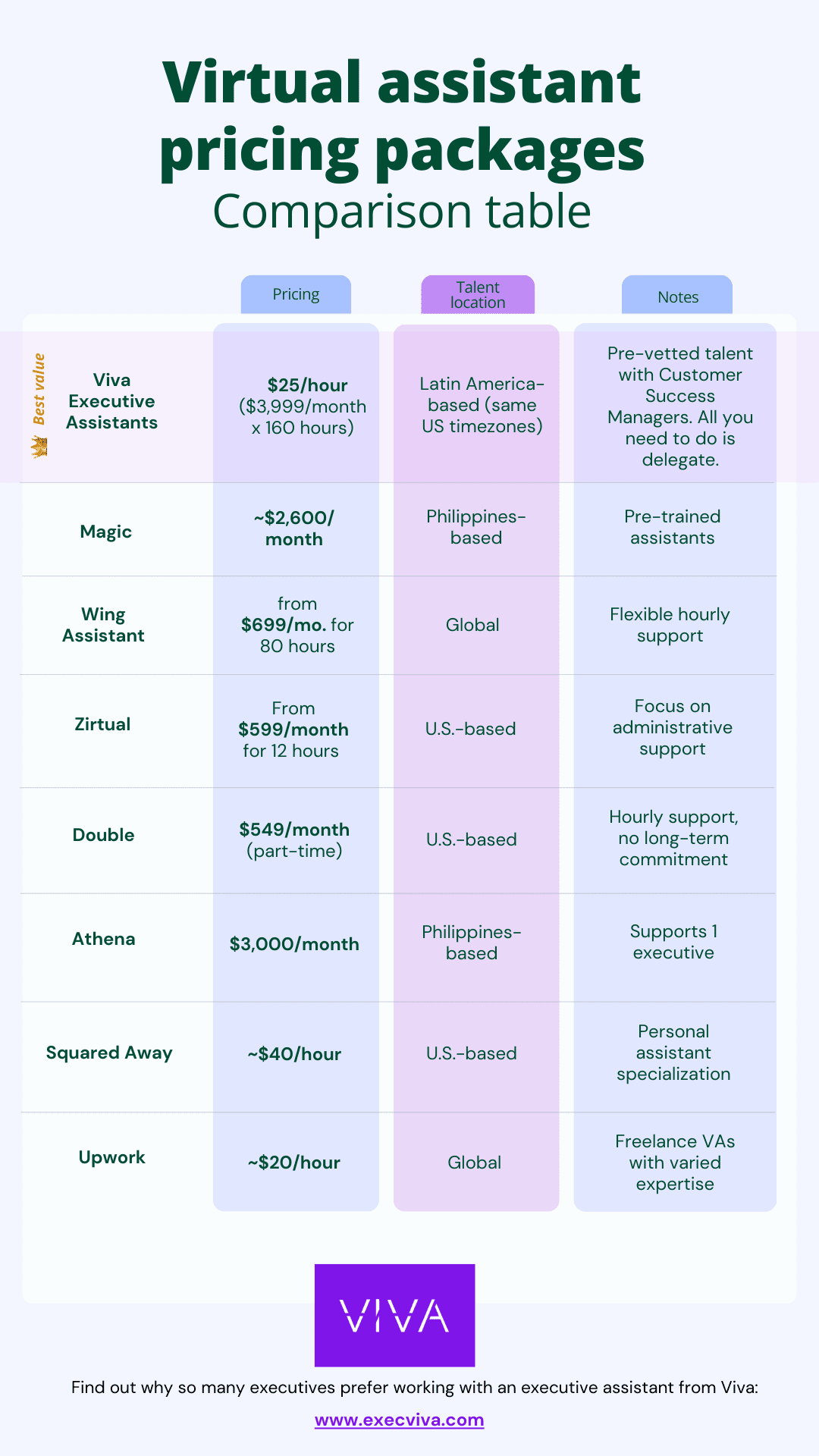
View a PDF version of the virtual assistant pricing packages table.
General virtual assistants
Ideal for routine admin tasks like scheduling, email management, and data entry.
Virtual executive assistants
Best for executives needing high-level support with meetings, project management, and confidential tasks. A virtual executive assistant supporting an HR executive (like the VP of People) can handle confidential HR matters, coordinate leadership meetings, and manage hiring pipelines—allowing People leaders to focus on company culture and scaling the team.
Now, if the virtual executive assistant supports the CEO, they can oversee investor relations scheduling, track key strategic initiatives, and manage high-priority emails—freeing up the CEO to drive business growth and make critical decisions.

What factors should I consider when hiring a virtual assistant?
1. Location
Time zone compatibility directly impacts collaboration. A virtual assistant working in a vastly different time zone may take longer to respond to urgent requests, making real-time coordination difficult. U.S.-based assistants typically charge more ($30-50/hour) than international assistants ($15-25/hour). Instead of thinking about specific countries or locations, we recommend you focus on having someone in your same time zone support you.
Athena’s assistants are based in the Philippines, which means they either work asynchronously or follow a graveyard schedule to align with their executive’s time zone. Neither option is sustainable in the long run, making them less suitable for executives seeking a long-term, committed solution.
Viva Executive Assistants provides pre-vetted talent located in Latin America, working within US timezones. While both companies offer similar pricing, Viva ensures assistants are immediately available during executive work hours without requiring late-night shifts or schedule adjustments making a positive impact on collaboration.
2. Experience and education
For basic administrative tasks, a general virtual assistant with standard experience may be sufficient. They handle tasks like:
- Social media management (responding to comments, scheduling publications, pulling reports)
- Scheduling meetings with predefined guidelines
- Data entry and CRM updates
However, executives often require virtual executive assistants with specialized expertise and startup coaching. A startup CFO, for example, might need an EA to:
- Provide meeting support, creating meeting decks, distributing and following up on action items, and managing sophisticated scheduling with multiple stakeholders
- Manage investor communications, drafting professional updates and creating and updating an investor contact list
- Support fundraising due diligence, compiling term sheets and cap tables
These tasks demand a university education or specialized training to ensure accuracy and strategic decision-making support.
3. Training and development
An untrained virtual assistant requires extensive onboarding, which can slow down workflows. Some services, like Viva Executive Assistants, offer business boot camps and ongoing coaching, reducing ramp-up time and improving effectiveness.
For startup executives, this means:
- A product manager at a tech startup can assign a Viva-trained EA to automate workflows in Zapier, ensuring repetitive tasks—like pulling sales data into Notion—are handled without manual effort.
- A CEO scaling operations can rely on an EA with pre-existing knowledge of project management tools like Asana or Notion, allowing them to jump into process optimization right away instead of spending weeks learning the platform.
4. Management support
Do you want to directly manage your assistant or would you prefer a service with Customer Success Managers (CSMs) who handle quality assurance, performance tracking, and continuous training?
A CSM acts as a layer of oversight, ensuring that:
- Productivity is continuous and remains aligned with your evolving needs
- Performance issues are addressed promptly and a solution is found for you
- Best practices are reinforced consistently
For example, a busy startup founder juggling multiple priorities might struggle to track their EA’s workload. With a CSM, monthly check-ins ensure task execution is on track, any bottlenecks are resolved, and additional training is provided when needed—all without adding another managerial burden to the executive.
5. Technology and security
Not all virtual assistant services provide equipment or security measures. Some include hardware, software, and secure access protocols, while others require executives to handle these themselves. Before committing, ask whether the assistant will come fully equipped with the necessary tools or if you’ll need to set up access, security, and compliance measures on your own.
For example, an executive assistant handling sensitive financial data for a startup CFO needs secure access management—something a fully managed EA service may provide through VPNs and encrypted communication tools. Hiring a freelance VA, on the other hand, may require the executive to set up and monitor access independently, increasing security risks.
How to choose the right virtual assistant package
Do I need basic administrative support for my business? If you’re a solopreneur or part of a small startup (fewer than 20 employees), consider hourly or part-time packages for cost efficiency. These options work well for handling routine tasks that don’t require ongoing visibility into your schedule, priorities, or decision-making.
Examples:
-
- A seed-stage startup founder handling investor outreach and customer emails might need a VA for 10-15 hours/week to schedule meetings, format pitch decks, and manage inbox overload.
- A bootstrapped e-commerce startup can use a part-time VA to process orders, update inventory, and handle customer support tickets without committing to a full-time hire.
Do I have project-based or part-time needs that require flexibility? If your business is growing and needs help with specific projects, look for retainer packages that offer flexibility without the commitment of full-time support. These packages are great if you’re okay with a VA supporting multiple clients at once, similar to a freelancer.
Examples:
-
- A startup launching a product might need a VA to coordinate beta tester outreach, track feedback in a shared document, and schedule product demo calls for a few months.
- A founder running a fundraising round could use a VA to organize investor follow-ups, maintain a deal tracker, and draft email responses.
- A remote-first startup expanding internationally might hire a VA to research local regulations, compile hiring options, and book international business travel as needed.
Do I need a dedicated virtual executive assistant to act as my second-in-command? If you’re a high-growth startup executive (CEO, founder, or leadership team), invest in a dedicated virtual executive assistant who can provide strategic support and significantly boost productivity.
Examples:
-
- A CEO preparing for Series B needs an EA to manage investor relations, track fundraising follow-ups, and coordinate due diligence requests.
- A COO scaling operations could delegate onboarding logistics, financial reporting prep, and cross-functional meeting management to an EA.
When evaluating pricing, do I consider the full value of the service? Don’t focus solely on hourly rates—look at the total value. Over the course of a year, how much could the service save you if it includes management support, training, and security? How much value would the productivity of a full-time EA add?
How to calculate the ROI of an EA?
To calculate the ROI of an EA, we consider the executive’s salary, the company’s valuation, and the percentage of time savings. Read how to build a business case for a virtual executive assistant.
Ready to find your perfect executive support match?
Viva Executive Assistants offers a 1-month trial for $950 with no-strings cancellation. Experience how strategic support can transform your workflow before committing to a full-time virtual assistant package.
Viva hires, trains and coaches top-tier virtual executive assistants to support startup executives from fast-growing companies. Viva takes care of all the details from recruitment to coaching and upskilling, so all you have to do is delegate.
Book a call today to find the right executive assistant for your business.