Executive Assistants
How your assistant can help secure your next fundraise
Jan 24, 2025
5 min read


Executive assistants can help you go through a fundraise in a more effective way. They can take dozens of tasks off your plate before, during, and after you’ve secured your funds. From creating profiles of potential VCs to managing the logistics of investor meetings and proofreading term sheets, see what some Viva EAs have done to help their executives during fundraising and learn what you can delegate to yours right now.
Table of contents
- What are the challenges of preparing for a fundraiser?
- How do you get started with your executive assistant for fundraiser support?
- What can EAs do before, during, and after your fundraiser?
- Real-life examples of Viva EAs who’ve supported startups during fundraising
- Which fundraising tasks should you delegate to your executive assistant?
What are the challenges of preparing for a fundraiser?
Life at a startup is already demanding, but when it’s time to raise another fundraiser, the pressure can become overwhelming. At Viva, we work with startup executives across the U.S., and we’ve seen firsthand how challenging it is to balance the demands of securing funding while keeping operations on track.
In these moments, we often recommend onboarding an executive assistant to help lighten the load. However, many overworked and exhausted executives push back, saying, “Right now isn’t the time.” What they don’t realize is that this is exactly when they need extra support the most.
Having an executive assistant during a raise round allows you to manage your time to focus on investor relations and delegate operational tasks, ensuring your company continues running smoothly. Plus, an EA will reduce your stress, as you’ll know you have a trusted, capable partner to help carry the workload.
If you’re going through something similar but can’t focus on onboarding a new team member right now, simply hire a remote executive assistant subscription service. In doing so, you get a team member who is fully trained, onboarded, and ready to get to work. All you have to do is delegate.
How do you get started with your executive assistant for fundraiser support?
If this is the first time your executive assistant will be involved in fundraising efforts, there’s one key principle to follow: Give them full visibility. Overcommunication is key—it minimizes errors and ensures your EA fully understands your needs. Ensure they have access to all the resources and information they need to succeed. Here’s how:
- Share past data: Provide access to data from previous funding rounds, including pitch decks, investor lists, CRM access, and any relevant documentation.
- Communicate frequently: Don’t just communicate—overcommunicate. Keep your EA informed about your priorities, timelines, and expectations.
- Loop them in: Include your EA in meetings, email threads, and discussions related to the funding process to give them a complete picture.
- Arrange 1:1 connections: If possible, set up a meeting between your EA and someone who played a significant role in past fundraising. This firsthand insight can help them understand the nuances of the process.
What can EAs do before, during, and after your fundraiser?
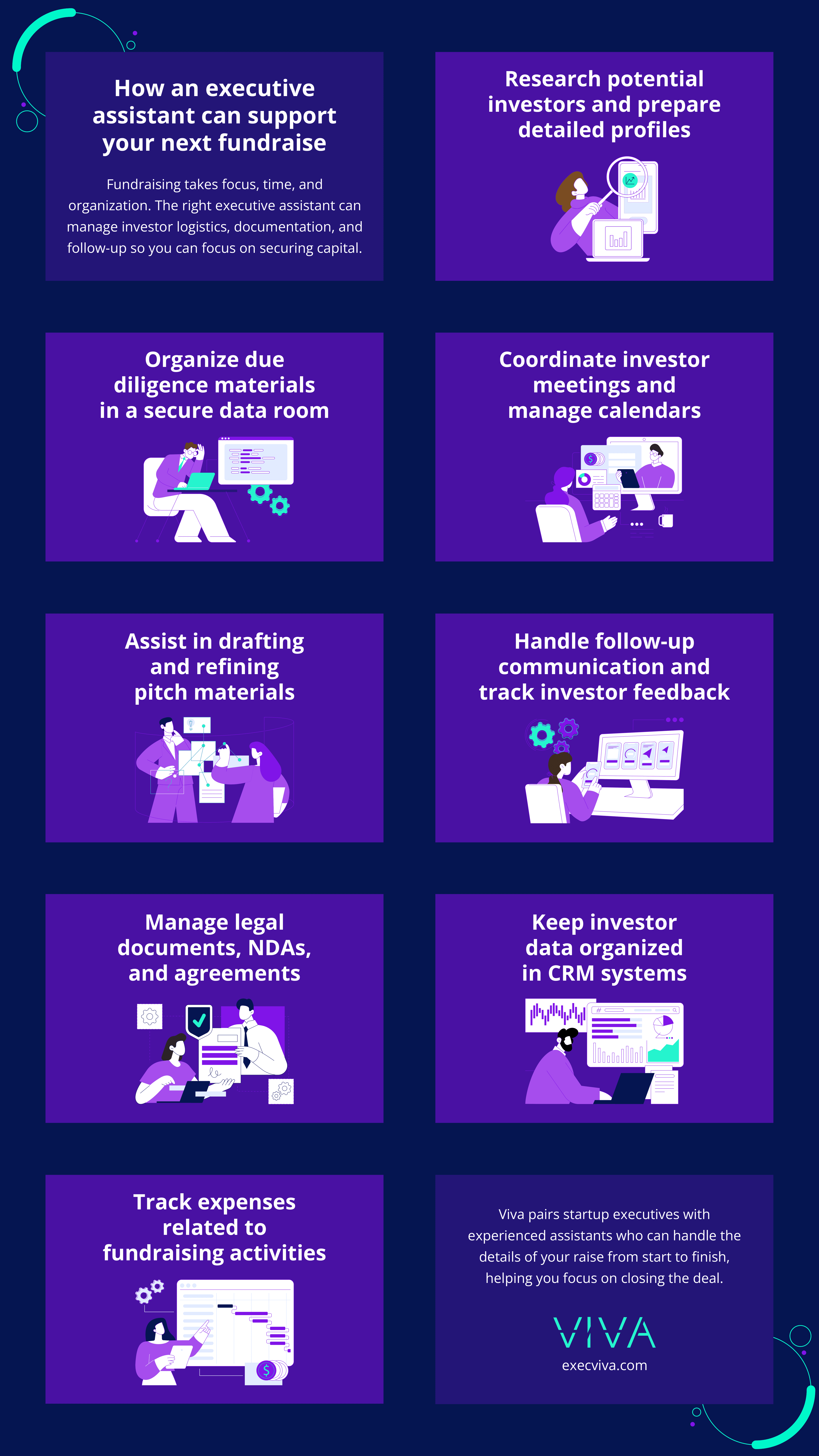
Executive assistants can help you before, during, and after a fundraising stage. We’ve put together a list of 14 different tasks you can delegate to them and get off your plate:
- Before the fundraise:
- Research potential investors and create detailed profiles.
- Organize and maintain a comprehensive due diligence data room.
- Schedule and confirm meetings with potential investors.
- Assist in drafting, editing, and polishing the pitch deck.
- Prepare briefing notes on investors’ backgrounds and interests.
- During the fundraise:
- Manage logistics of investor meetings, both virtual and in-person.
- Handle follow-ups and compose and send thank-you notes after meetings.
- Monitor investor feedback and compile summaries for post-meeting analysis.
- Keep track of critical deadlines and ensure all necessary documents are submitted.
- Act as a point of contact for team members to ensure operational continuity.
- After the fundraise:
- Coordinate final agreements and investor communications.
- Update internal stakeholders on outcomes and next steps.
- Archive and organize all documents for future reference.
- Reflect upon and document lessons learned for future funding rounds.
Real-life examples of Viva EAs who’ve supported startups during fundraising
If the previous examples sounded a bit too general, here are six real-life examples from Viva EAs. They’ve helped startups raise capital from seed stage all the way to Series D. Here’s how they’ve done it (anonymized names were used to protect the confidentiality of our customers):
- Camila, the executive assistant at a California-based startup, supported her team through their latest fundraising by:
- Researching and compiling a list of potential investors, which was shared with the leadership team for connections to initiate conversations.
- Managing investor outreach: Camila’s executive sent initial emails, after which she took over to schedule Zoom meetings and send follow-ups.
- Planning and organizing two multi-day trips (Las Vegas and San Francisco) for investor meetings, scheduling up to eight meetings daily.
- Coordinating remote playtests between the team and investors.
- Creating and maintaining a CRM in Airtable to centralize investor information, using HubSpot for contact data and ensuring daily updates.
- Participating in weekly strategy meetings to identify follow-up tasks and meet deadlines.
- Researching restaurants and making reservations for key meetings during the final stages of the process.
- Assisting with legal documentation to meet deadlines during the closing stage.
- Natalia, the EA to the CEO of a California-based biotech company, contributed to their latest raise by:
- Scheduling investor meetings, coordinating NDAs, and managing signatures and filing.
- Reviewing and comparing NDAs from the previous year to ensure consistency, saving the company legal review costs when no changes were found.
- Comparing and marking changes between two term sheets, a meticulous process that helped establish clear and lasting partnerships.
- Verónica, the executive assistant to a VP at an AI infrastructure startup, supported their Series D fundraising by:
- Taking ownership of investor follow-ups after her executive sent outreach emails.
- Coordinating schedules for introductory calls, managing calendar logistics across time zones, and ensuring meetings were efficiently arranged.
- Streamlining communication and scheduling, enabling her executive to focus on high-level investor discussions.
- Diana, the EA in the FinOps department of a ride-share assistant app, supported her team by:
- Creating and populating a shared data room in Google Drive, organized into areas of interest for potential investors, such as Business and Product Overview, Customer Partners, Technology, Leadership, Legal, and Financials.
- Migrating files to the designated data room as needed and performing quarterly updates.
- Sourcing inputs from tools like QuickBooks, organizational charts, pitch decks, and internal trackers, then submitting finalized materials with CEO approval.
- Engaging in strategic meetings and follow-up conversations with potential investors.
- Laura, the executive assistant to the CEO of a California-based tech startup that specializes in automating repetitive manual work, played a key role during their most recent raise round by:
- Tracking investor outreach using Notion, including details such as when outreach occurred, meeting schedules, and follow-ups.
- Scheduling back-to-back in-person meetings by coordinating with other assistants, leaving buffer time, and arranging transportation.
- Managing live tracking of outreach progress to keep the team updated in real-time.
- Ensuring one-pagers were sent to investors on time, critical for maintaining communication flow.
- Sara, the EA at a California-based data analysis startup, supported their Series B fundraising by:
- Reviewing the term sheet alongside her executive to identify and compile all required documentation.
- Preparing and organizing documents, including insurance paperwork, board composition records, client MSA’s (Master Service Agreement), employee contracts, and employee information.
- Using Google Drive to create a folder structure mirroring the term sheet’s order, simplifying investor review.
- Ensuring all materials were submitted within strict deadlines, leading to quick investor responses.
- Maintaining efficiency and accuracy throughout the process to meet the startup’s goals and secure $30 million in funding.
As you can see, there are countless ways executive assistants can provide invaluable support during fundraisings. Don’t hesitate to delegate significant responsibilities—chances are, your EA will approach these tasks with the same level of care and attention as you would yourself.
- Marcela, the executive assistant at a cyber startup, supported the company in securing their latest raise by:
- Keeping everything organized and on track using Monday.com.
- Building a database to track firms, stages, and important documents, making it easy to find the right information when needed.
- Assigning tasks, keeping team members informed with updates.
- Using tools like Kanban boards and automation to monitor progress.
Which fundraising tasks should you delegate to your executive assistant?
If you’re ready to start delegating but don’t know where to start, here’s a list of 11 tasks you can assign to your executive assistant right now:
- Scheduling and coordination: Have your EA coordinate meetings with potential investors, venture capitalists, and other stakeholders to ensure everything runs smoothly.
- Research and due diligence: Ask your EA to gather detailed information about potential investors, including their investment focus, portfolio companies, and contact details.
- Pitch preparation: Have your EA assist in creating and refining presentation materials, pitch decks, and other documents needed for investor meetings.
- Logistics management: Rely on your EA to handle travel arrangements, accommodations, and logistics for investor meetings.
- Follow-up and communication: Delegate follow-up communications, ensuring that all requested documents and information are promptly sent to potential investors.
- Data management: Assign the responsibility of managing and organizing investor data, contact information, and interaction history in a CRM system.
- Routine administrative support: Free up your time by entrusting routine administrative tasks to your EA, allowing you to focus on high-level strategic activities related to fundraising.
- Confidentiality management: Have your EA get a signed NDA before every meeting with potential investors.
- Event planning: If you’re hosting investor events, delegate the planning and management of invitations, RSVPs, and logistics to your EA.
- Document management: Have your EA assist with the preparation, organization, and filing of legal documents, contracts, and agreements.
- Financial tracking: Ask your EA to track expenses related to fundraising activities and manage reimbursement processes.
Are you going through a new fundraiser and need a fully trained executive assistant? Let us match you with the perfect EA to support your startup’s journey. Book a call today.