Executive Assistants
10 impactful executive assistant tasks for all funding stages
Dec 26, 2024
7 min read


What are 10 impactful executive assistant tasks? Executive assistants excel at tasks like managing complex calendars, overseeing email communication, coordinating high-stakes meetings, and preparing strategic briefing documents. They also streamline operations by tracking OKRs, organizing team activities, managing investor relations, facilitating onboarding, and handling travel logistics and expense reports. As a startup grows, these tasks fluctuate and evolve.
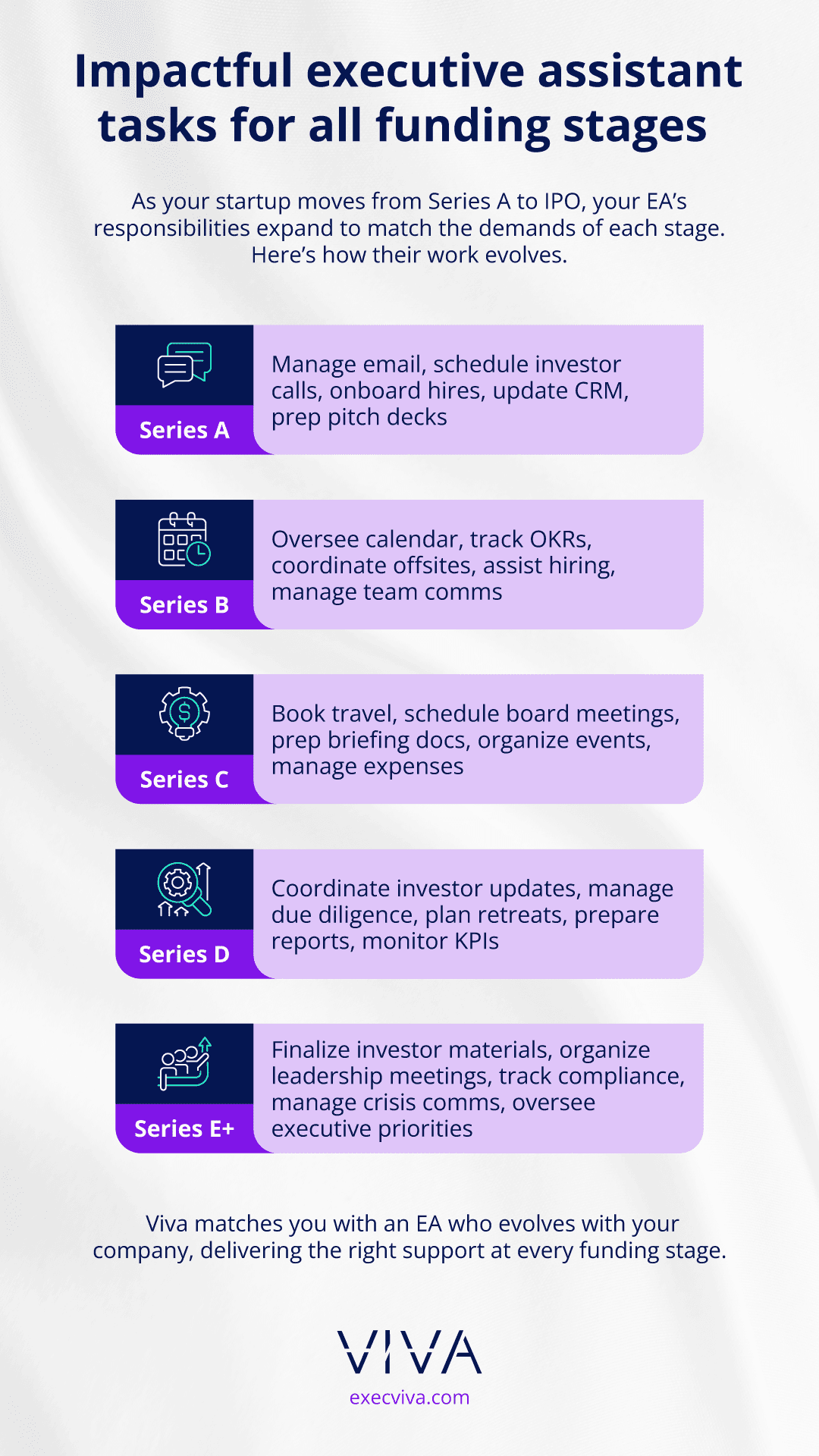
How do executive assistant tasks change in a startup? Executive assistant tasks evolve significantly across funding stages, adapting to a startup’s growing complexity. In our experience working with larger companies, we’ve seen that the scope of an EA’s role doesn’t change based just on the executive’s industry or specific responsibilities—it’s also shaped by the stage of the fundraise.
At earlier stages, like Series A, EAs focus on generalist tasks, supporting operational growth and helping executives manage day-to-day activities. As the company progresses into Series B and beyond, the EA’s role becomes more specialized as they take on more strategic responsibilities, such as managing investor relations, organizing board meetings, and driving high-stakes projects that align with the company’s expanded needs.
Table of contents
10 impactful executive assistant tasks for all funding stages
- What are the key traits of a successful startup executive assistant?
- What are 10 impactful executive assistant tasks in Series A?
- What are 10 impactful executive assistant tasks in Series B?
- What are 10 impactful executive assistant tasks in Series C?
- What are 10 impactful executive assistant tasks in Series D?
- What are 10 impactful executive assistant tasks in Series E, and beyond?
- Conclusion
What are the key traits of a successful startup executive assistant?
These are key traits of a successful executive assistant (EA):
- Adaptability: Shifting gears as the company scales
- Critical thinking: Making decisions without constant oversight
- Feedback-savvy: Quickly implementing suggestions and improving
- Proactivity: Anticipating and fulfilling needs before they arise
Every stage of your startup journey requires speed—but later stages demand even faster execution as the stakes and complexity rise. Learn more about what makes a great executive assistant at every stage of the startup journey.

What are 10 impactful executive assistant tasks in Series A?
You’re wearing multiple hats—fundraising, hiring, and meeting customers. An EA at this stage is your operational co-pilot, helping you stay organized amid the whirlwind.
EAs in Series A organizations focus on a mix of foundational administrative tasks and team support. Their goal is to simplify your day so you can focus on building your product and raising funds.
Top 10 executive assistant tasks for Series A:
- Manage your email inbox and prioritize critical communication
- Support with investor meetings: building decks, following up on action items, keeping an investor database, and scheduling investor meetings across multiple timezones and stakeholders
- Support hiring efforts with initial interviews and assessments
- Keep track of key project deadlines and follow-up
- Assist with onboarding new hires by organizing paperwork and equipment
- Set up office supplies and manage vendor contracts
- Organize company-wide team engagement activities
- Be the main point of contact for the executive team
- Maintain your CRM
- Handle personal tasks like booking appointments or managing reminders
How fast should your EA go in Series A?
At Series A, “fast” means creating systems that help the executive focus on growing the business, solving problems on the fly, and making quick decisions.
Discover how a dedicated executive assistant can help drive growth at every stage. Book a call with us today to learn more.
What are 10 impactful executive assistant tasks in Series B?
The pace picks up once you secure Series B funding. Your team grows, your responsibilities multiply, and every minute matters. An EA’s role expands to include more operational and project management support, helping your growing team stay on track.
Top 10 executive assistant tasks for Series B:
- Oversee your calendar, balancing meetings with focus time blocks
- Coordinate project timelines and ensure deadlines are met
- Manage your inbox with more refined prioritization techniques
- Support team leads by arranging cross-functional check-ins
- Create systems to track OKRs and progress across departments
- Facilitate onboarding for larger teams, including training schedules
- Organize events like company offsites or quarterly all-hands meetings
- Handle procurement of equipment and tools for the team
- Coordinate with external vendors, lawyers, or accountants for operational tasks
- Track hiring milestones and support HR with scheduling interviews
How fast should your EA go in Series B?:
At Series B, “faster” means not just executing tasks quickly, but also scaling workflows and anticipating what’s needed for the company to hit its next growth milestones.
What are 10 impactful executive assistant tasks in Series C?
Your startup matures once you have Series C funding secured. The need for a generalist EA shifts toward a specialist one, focusing more on your priorities as the executive, rather than the team at large. Your EA starts managing high-value tasks, such as coordinating your travel and overseeing investor relationships, while stepping back from office management and daily operations.
Some EAs are ready to move to a chief of staff position or a more operational role as exec ops or admin business partner. Read more about executive assistant titles explained here.
Top 10 executive assistant tasks for Series C:
- Plan and manage complex travel itineraries, including international trips.
- Schedule investor updates and board meetings
- Refine calendar management with more strategy (e.g., no-meeting days)
- Create briefing documents for investor or client meetings
- Track progress on strategic initiatives you oversee
- Coordinate your public appearances or speaking engagements
- Manage expense reports and budget reconciliation
- Help organize funding round data rooms and follow-ups
- Act as a liaison with key external stakeholders
- Prepare personalized communication or thank-you notes for investors
How fast should your EA go in Series C?:
At Series C, “even faster” means zeroing in on what moves the needle for the executive: time management, relationship-building, and staying one step ahead. Their proactiveness ensures that the executive doesn’t have to handhold projects – they only need to know when the tasks will be complete.
Looking for an executive assistant who can adapt to your company’s needs? Let us match you with the perfect EA to support your startup’s journey. Book a call today.
What are 10 impactful executive assistant tasks in Series D?
At Series D, your startup operates on a much larger scale, with global expansion, acquisitions, and market dominance becoming focal points. An executive assistant’s responsibilities become even more strategic, supporting the executive’s high-stakes decision-making and ensuring seamless operations across a larger organizational footprint.
Top 10 executive assistant tasks for Series D:
- Coordinate quarterly investor updates, prepare detailed financial performance reports, and schedule presentations to align with key investor schedules.
- Manage due diligence timelines, prepare materials for M&A discussions, and act as a liaison with legal and financial advisors.
- Facilitate strategy sessions among the C-suite by organizing agendas, capturing action points, and tracking progress on long-term goals.
- Oversee complex schedules that span multiple time zones, ensuring critical meetings are prioritized.
- Organize operational reviews with department heads, track deliverables, and follow up on cross-team projects.
- Coordinate travel and meetings for international market launches, including vendor selection and partnership engagements.
- Manage communication calendars for media appearances, arrange interviews, and ensure timely preparation of talking points.
- Plan executive team offsites and leadership retreats to align teams around company goals and reinforce culture.
- Track global regulatory deadlines, coordinate filings, and collaborate with legal and finance teams to ensure alignment.
- Organize emergency response workflows, including communication protocols and stakeholder updates during high-stakes situations.
How fast should your EA go in Series D?
At Series D, “strategic speed” is key—your EA ensures nothing slips through the cracks by anticipating challenges, simplifying processes, and enabling you to focus on driving growth and leadership in increasingly complex scenarios.
What are 10 impactful executive assistant tasks in Series E and beyond?
Your EA’s focus narrows to hyper-specific, high-impact tasks at the Series E level and beyond. By this stage, your schedule is packed with investor updates, board meetings, and travel commitments. A seasoned EA becomes your partner in strategic execution, allowing you to operate at peak efficiency.
The difference between executive assistant tasks in Series D and Series E lies in the level of operational maturity and the nature of executive assistant responsibilities. While both stages involve high complexity, Series E typically represents the final preparation for an IPO, acquisition, or global dominance, making the EA’s role even more strategic and high-stakes.
Top 10 executive assistant tasks for Series E and beyond:
- Prepare presentation decks, investor reports, and strategic briefing materials for internal and external communications
- Schedule board meetings, coordinate with board members, organize financial reports, and ensure all investor communications are timely and clear
- Organize leadership meetings, track team goals and OKRs, and maintain a calendar of follow-up actions and deadlines
- Maintain a record of compliance deadlines, track regulatory filings, and coordinate with legal teams for updates
- Arrange meetings with key partners, prepare due diligence materials, and organize travel for meetings and site visits
- Compile financial summaries, track revenue reports, and assist with preparing materials for financial board reviews
- Coordinate media interviews, manage speaking engagements, and prepare talking points or press kits
- Organize emergency meetings, track crisis communications, and maintain a log of action steps and deadlines
- Organize project timelines, track key operational KPIs, and ensure that team meetings and progress reviews are scheduled
- Manage communication and feedback channels within the executive team to ensure transparency and quick resolution of operational challenges
How fast should your EA go in Series E and beyond?:
Series E represents “peak speed,” requiring your EA to be laser-focused, strategic, and adept at managing complexity in a way that allows you to lead without distractions.
Conclusion
The role of an EA evolves from Series A to Series E. As your company grows, an EA’s tasks shift from foundational support to highly specialized, high-value responsibilities. Understanding these shifts ensures you can build trust, delegate effectively, and maximize your EA’s skills at every stage of growth.