Productivity
Productivity vs. efficiency: What executives need to know
Jul 2, 2025
5 min read


Understanding productivity vs. efficiency is key to how executives design their workflows, measure team performance, and allocate leadership attention. While these terms are often used interchangeably, they reflect different operating principles, and choosing the right one at the right time can dramatically improve business outcomes.
This guide explains the difference between productivity and efficiency and offers practical strategies for improving both.
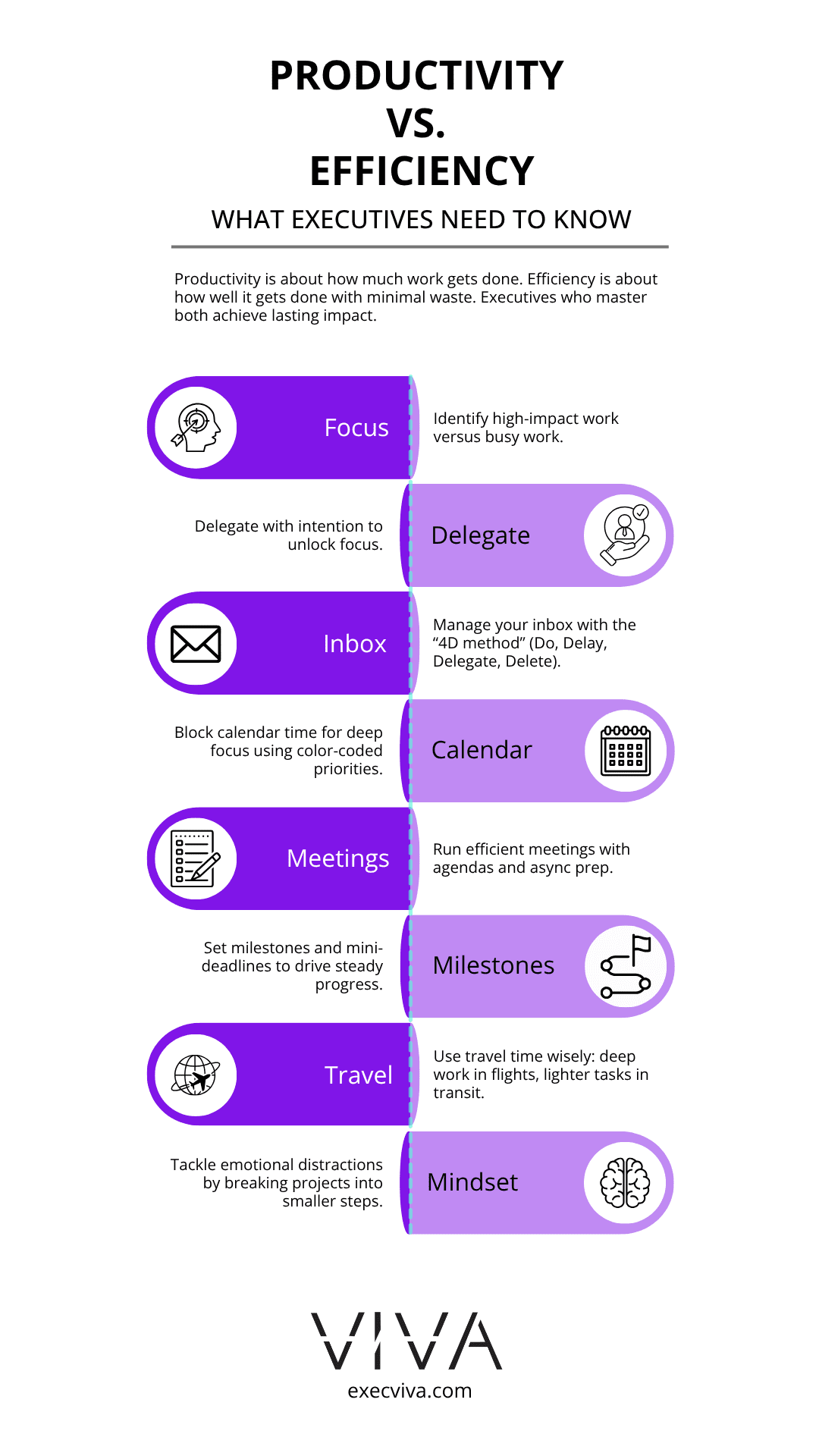
Table of contents:
- What’s the difference between productivity and efficiency?
- How productivity vs. efficiency plays out in leadership roles
- Five strategies to improve both productivity and efficiency
- Bonus: Turn emotional distractions into strategic focus
- What Viva brings to executive productivity
Productivity vs efficiency: what’s the difference?
At a high level:
- Productivity is about how much work gets done
- Efficiency is about how well that work is done using the fewest resources possible
When teams discuss efficiency vs. productivity, they’re weighing output against input. A person may be highly productive while completing a high volume of work but inefficient if it takes excessive time or oversight. On the flip side, someone may produce fewer deliverables but optimize work processes, tools, and time.
Both matter. The strongest operations identify where each metric adds the most value.
How productivity vs. efficiency plays out in leadership roles
For startup executives, productivity vs. efficiency isn’t just a personal goal, but sometimes acts as a leadership constraint. With limited hours and competing demands, the question becomes: are you using your time effectively, or just staying busy?
That’s why many executives turn to high-performing support to manage execution while protecting strategic focus. One of the clearest illustrations of this balance is through virtual executive assistants.
- A productive EA handles logistics, scheduling, and general administrative tasks at scale
- An efficient EA builds systems, removes bottlenecks, and improves visibility for better decisions
In practice, the best virtual EAs extend executive capacity by improving how work flows, not just how much gets done. Supporting both productivity and efficiency often begins by delegating with intention.
| Optimize how you lead with expert executive support.
Book a consultation to see how Viva’s virtual executive assistants maximize productivity and efficiency. |
5 strategies for CEOs to improve both productivity and efficiency
Executives balancing productivity vs. efficiency need focused tactics that can be applied personally or delegated effectively. These five strategies help leaders maximize output while optimizing work processes to save time and reduce friction—hallmarks of high-impact leadership.
1. Control your inbox to reclaim focus
Email management requires specific and continuous protocols and procedures that have been defined clearly and are applied consistently. Otherwise, the task of email management can be daunting and time-consuming.
- Productivity tip: Schedule specific times to manage email instead of constantly reacting. This reduces interruptions and preserves concentration.
- Efficiency tactic: Adopt the 4D method — Do, Delay, Delegate, Delete — to triage your inbox effectively. Delegating this process to a trained executive assistant can further reduce distractions, allowing you to spend time on strategic priorities.
- Do: Mark emails from key clients or board members as urgent and flag them for the executive’s immediate attention.
- Schedule: Organize emails that require the executive’s input but aren’t urgent into a ‘To Review’ folder. The executive will go through them during designated times.
- Delegate: Forward emails to the appropriate team members, adding a clarification note if needed, and track the follow-up.
- Eliminate: Filter out spam and irrelevant newsletters, unsubscribing where appropriate.
2. Structure your calendar for intentional focus
Being constantly busy does not necessarily equal productivity. To achieve productivity, you need to set dedicated time for focused work. This will always feel inconvenient, and you may feel the need to eliminate it from your schedule; however, if you keep it as a priority, it will improve your productivity.
- Productivity tip: Set daily blocks of uninterrupted time for focused work, treating them as priorities.
- Efficiency tactic: Use calendar compartmentalization: color-code and theme your schedule to align with priorities. Skilled executive assistants can manage this system, ensuring your calendar reflects your strategic needs and balances availability with focus.
3. Make meetings meaningful and concise
Meetings are often counterproductive due to their excessive frequency or lack of organization. At the same time, meetings can foster productivity by aligning go-to-market teams, setting priorities, and developing plans and strategies. Leaders must consider efficiency versus productivity when deciding which meetings to keep.
- Productivity tip: Attend only meetings with clear agendas and desired outcomes.
- Efficiency tactic: Share meeting materials in advance and encourage asynchronous review. This practice increases preparation and reduces unnecessary meeting time. Executive support can facilitate pre- and post-meeting coordination, keeping teams aligned.
4. Drive team accountability with clear milestones
Sometimes, the dread of not completing one’s projects can be detrimental to productivity. Other times, this is exactly the motivation that your team needs to succeed. This dynamic is called the Zeigarnik Effect, and leaders can use it in their team’s favor.
- Productivity tip: Use visible reminders of unfinished tasks to motivate closure and momentum.
- Efficiency tactic: Establish mini-deadlines and regular check-ins to maintain progress without micromanagement. Executive assistants can help track these milestones and facilitate communication.
5. Stay productive on the go: Optimize travel time for maximum output
Traveling for business can feel less than productive. Arriving to the airport hours before the actual flight plus flying and transportation time can feel like a waste of time. Nonetheless, traveling is an essential part of many businesses. How can it be more productive and efficient?
- Productivity tip: Plan tasks by segment — deep work during flights, lighter tasks during layovers.
- Efficiency tactic: Prioritize and schedule tasks to reduce switching costs and maintain productivity. Executive support can handle travel logistics and prepare customized task lists to maximize time.
Implementing these tactics is easier with reliable, proactive support. Virtual executive assistants trained to anticipate needs and manage workflows help transform these strategies from concepts into sustained results. By managing routine tasks and optimizing operational rhythms, they enable executives to focus on driving growth and making high-impact decisions.
Bonus: Turn emotional distractions into strategic focus
Emotional challenges like anxiety, frustration, or self-doubt can quietly undermine both productivity and efficiency. For executives, managing these internal barriers is as crucial as managing external tasks.
- Break complex projects into smaller, manageable steps. This reduces overwhelm and prevents procrastination, helping you maintain forward momentum.
- Reflect on recent wins and milestones. Building awareness of progress fosters confidence and counters feelings of impostor syndrome, often leading to hesitation or indecision.
- Prioritize team well-being. Encouraging wellness initiatives supports mental health and improves quality output by reducing burnout and distractions across your leadership team.
- Cultivate emotional self-awareness. Having a clear understanding of how your feelings impact work habits empowers you to adjust your approach proactively, enabling you to achieve true productivity, even in stressful situations.
While emotional resilience starts with leadership, executive assistants trained in proactive support can ease cognitive load by managing routine demands, freeing executives to focus on high-impact decisions with clarity and calm.
| Want personalized tactics that work for your unique leadership style?
Book a consultation to explore tailored executive assistant solutions. |
How to measure productivity and efficiency as an executive
Productivity and efficiency mean different things depending on role, industry, and goals. For executives, traditional volume metrics, like hours worked or tasks completed, are often insufficient.
Instead, measure success by asking:
- Don’t measure your week by hours worked, but by outcomes moved. Track progress against strategic initiatives, not just activity volume.
- Audit where your time and team are going. Look for misalignment between effort spent and business priorities, and then reallocate accordingly.
- Build systems that scale beyond you. If something relies on your direct involvement to succeed, it’s not yet efficient or scalable.
Regularly tracking these signals helps executives understand when to prioritize productivity (e.g., driving growth initiatives) versus efficiency (e.g., optimizing team workflows).
This approach not only improves your personal effectiveness but sets a powerful example for your teams. Many of the strategies in this guide apply to other roles as well, so sharing these principles can elevate organizational performance broadly.
How Viva empowers executive productivity and efficiency
At Viva, balancing productivity and efficiency is a practical priority, not just a concept.
Our executive assistants are highly skilled professionals, selected from the top 0.2% of applicants. They arrive fully trained and coached to do more than complete tasks, but develop systems and processes that maximize leadership time.
From managing general administrative work and data entry to overseeing projects and inbox strategy, they free executives to concentrate on growth.
Viva assistants integrate smoothly into teams, delivering operational leverage that drives both high output and efficient use of resources.
Ready to maximize your productivity and efficiency?
Book a consultation to see how Viva executive assistants help leaders reclaim time and accelerate results.
.