Executive Assistants
5 Good reasons to hire EAs (in the words of startup executives)
Nov 24, 2023
9 min read


Some executives may resist the idea of hiring an executive assistant, even when faced with overwhelming workloads, due to various reasons.
Executives might view being constantly busy as an inherent part of their role, believing they can manage all responsibilities independently.
Others may harbor skepticism about or simply be unfamiliar with executive assistant subscription services, perceiving them as risky or unreliable.
Concerns about the perception of peers could also play a role, with worries that hiring an assistant might be construed as a sign of inadequacy or arrogance by fellow executives.
Additionally, executives might have exceptionally high standards for an assistant, doubting that anyone could meet their expectations, and therefore choose to handle everything themselves.
Lastly, a strategic decision to delay hiring until the company reaches a specific growth stage, like Series B, might lead executives to perceive the current stage as too early or unnecessary for bringing an assistant on board.
If any of these questions resonate with you, you’re not alone. Many executives find themselves grappling with similar hesitations when it comes to hiring an executive assistant. The mere idea of entrusting tasks, delegating responsibilities, or investing in an EA might seem like a nice-to-have rather than a must-have.

Why you should reconsider hiring an executive assistant
In this article, we invite you to pause and reconsider. We’re here to challenge those doubts and reveal the transformative potential of an EA. As you navigate the ever-demanding landscape of executive leadership, the key to unlocking your true potential could be just one well-informed decision away.
Not every executive is certain that the best approach for their needs is getting someone to help them with admin and ops tasks. A good place to start is to understand the most common arguments against the decision – and the good reasons behind hiring an executive assistant.
In our experience supporting executives, we’ve heard these arguments time and time again. We’ve reached out with answers, propositions, and most importantly, with evidence of how executives can benefit from having a trusted partner who helps get things organized and done.
You’ll be able to read in their own words how valuable the support has been.
5 good reasons for hiring an executive assistant
Reason 1: The startup world is full of new and revolutionary ideas like an EA subscription service, even if you hadn’t heard of it before.
“I haven’t heard about this kind of subscription service before. It feels too risky to hire someone remotely instead of hiring in-house.” This is an actual concern from startup executives.
Most of the time, executives share their preference for hiring someone in-house instead of someone who’ll do the job remotely. Their fears are not unfounded. It can be more difficult to keep remote employees accountable. Also, the nationwide call to RTO or return to the office might interfere with hiring any new remote employees.
There is also a myth that in-house EAs will outperform remote EAs at all times, based on their location alone. Nevertheless, at Viva, we’ve proven time and time again that remote EAs are able to do almost anything that an in-house EA would, especially for administrative tasks.
Now, if a company is looking to hire someone who can also do operational tasks like planning offsites or meetings, remote EAs have standard, success-proven procedures to manage those remotely. We have a solid track record of satisfied customers who have had an offsite planned for them.
For this Series A company, it wasn’t their first rodeo. They hired someone before, an in-house EA who was also doubling as a receptionist. The biggest issue for them was inconsistency in managing expectations. At times, the results would be brilliant, and at other times, subpar. This inconsistency drove them to look for a more suitable candidate who could deliver great results with more regularity.
After careful consideration, they’ve decided to try a new approach to solve their prevalent pain points: focus on EA support for administrative tasks like calendar and email management and getting support for project management and special projects. The CEO said: “I’d like to organize the large contracts and streamline them in one process and place.” These are tasks that a skilled EA can do very well, regardless of location.
After a month of working with a Viva EA, this is what the CEO had to say:
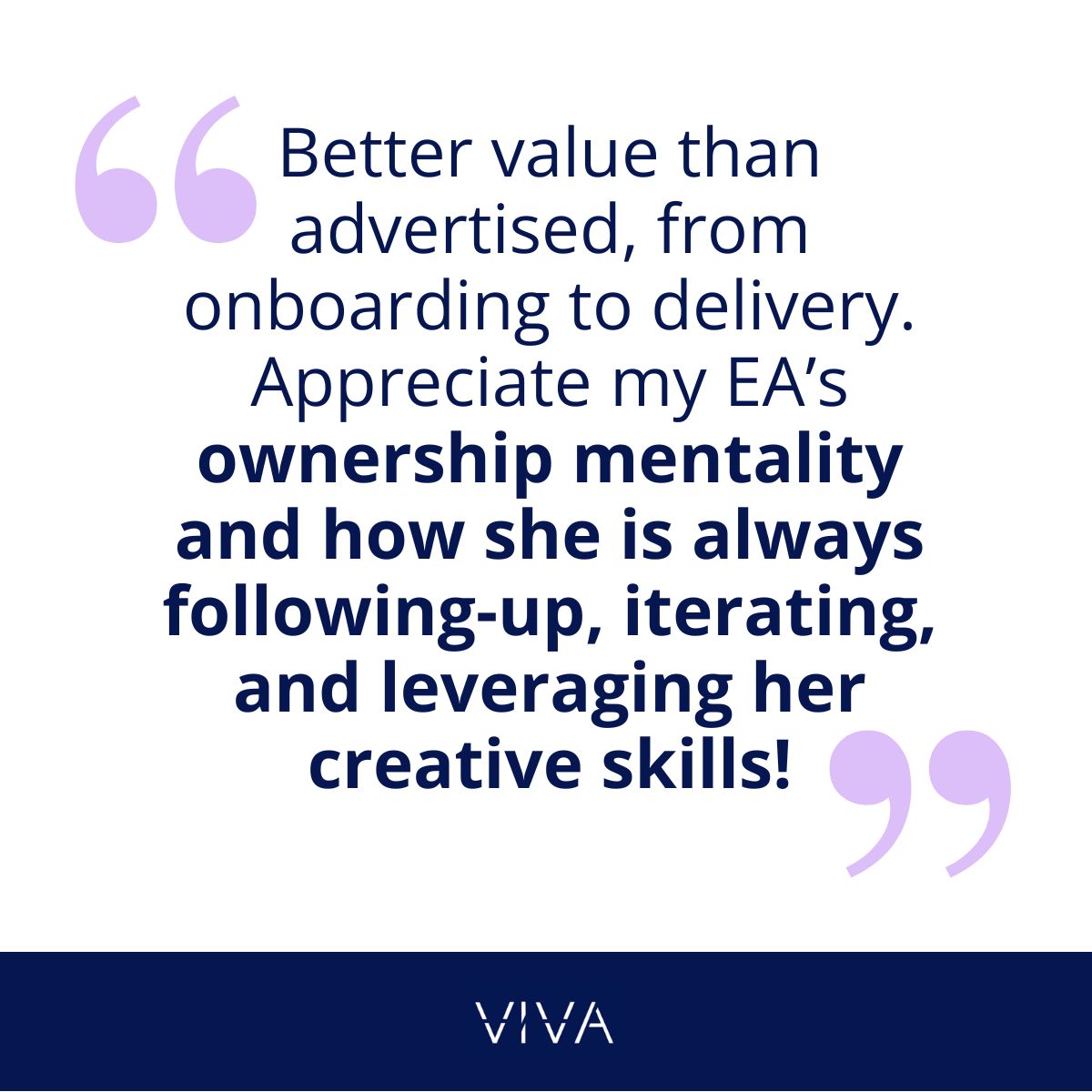
“Better value than advertised, from onboarding to delivery. Appreciate my EA’s ownership mentality, and how she is always following up, iterating, and leveraging her creative skills!”
Reason 2: Startup executives can be more productive once they’re not swamped with admin tasks.
Many startup executives question the need for an EA, assuming that their overstuffed schedules are the norm.
A hectic schedule looks like overflowing inboxes with thousands of unread and unanswered emails and wild calendars that satisfy no one due to many no-shows from the executives themselves, double or triple-booked time slots, and low accountability for pending items.
It’s important that executives know and understand that such schedules shouldn’t be the norm and that a different life is possible.
Countless executives are getting the support they need to avoid these pain points. As a result, they are being more focused – and even more sane (in their own words).
Take a look at this real-life story from one of our customers:
The CEO of a Series B company in the US found himself in need of more than just a calendar manager. He wanted someone to help prioritize tasks and ensure follow-through, holding him accountable for his to-do list. He and his team weren’t sure if this person actually existed.
This wasn’t just a solo quest; the CRO and CFO were also on the lookout for such support.
Interestingly, it wasn’t the executives themselves who flagged this need; their talent team did.
Initially, the execs hired someone for the job, but soon realized the person wasn’t quite fulfilling their expectations. This made their skepticism about hiring an EA grow.
Before bringing in a Viva EA, each executive was juggling their own admin tasks. The realization struck: “We need someone who’s detail-oriented and can keep things from slipping through the cracks.“
The call for help didn’t stop there. Now that he thought about it with a more open approach, the CEO expressed a desire for an EA who could handle board communications and schedule those crucial board meetings.
The catch? These execs are swamped, making coordination a potential nightmare. Imagine the relief of having an EA who could take charge of these critical yet time-consuming tasks, enabling the leaders to concentrate on guiding the company’s direction instead of getting caught up in administrative tasks.
After a month of working with a Viva EA, this is what they had to say:
“Working with our Viva EA has helped me better focus my time and communication so I’ve been able to do more productive and effective work.” After just one month of working together, two of their executives were already feeling more focused, with an open communication line with their peers, subordinates, and board members. This focus resulted in more productive and effective work.
Instead of spending yet another month battling a non-functional schedule and calendar, the executives decided to try bringing in support and were seeing results right away.

Reason 3: Hiring an EA is a smart move to save time and resources. It’s not about arrogance or inadequacy.
“Will other executives think I’m inadequate or too arrogant?”
In this real-life case, the executive is a high performer who gets bored when challenges are no longer hard, moving on to the next thing. This driver mentality might hinder the executive from asking for help or getting the support they need, because they thrive in a challenging environment. Nonetheless, executives’ talents are best used in specialized challenges pertaining to their role, instead of administrative tasks that an EA can do.
As a veteran, this executive is a tough person who knows how to work hard. This “drive hard” mindset might make them hesitate to get an EA, as there’s concern about potentially giving the impression that they are outsourcing tasks because of an inability to handle the workload themselves.
However, it’s crucial for this hardworking professional to recognize that having an EA isn’t a sign of weakness but rather a strategic move to enhance productivity, streamline operations, and enable them to focus on high-impact responsibilities. It’s about leveraging support to amplify effectiveness, not a concession of inadequacy.
When an executive is getting support in managing their calendar and email, it is not about them being inadequate or arrogant. It’s a smart move to save time and use it in strategic endeavors.
Arrogance is about low emotional intelligence rather than delegation techniques. Emotional intelligence is a soft skill of leaders who shine, and that skill tends to become even more exemplary when working with an EA.
After a month of working with a Viva EA, this is what they had to say:
One of the executive’s direct reports noticed that she had become more focused and productive lately. He complimented her on her efficiency and attributed it to her new executive assistant. The executive agreed and said that hiring an assistant was a great decision.
These are not the words of a direct report who feels their executive is arrogant or incapable. Rather, they are the words of someone who understands the benefits that an EA can bring to a leader and their entire team.

Reason #4: High-performing EAs are great for “picky” delegators.
“I’m too picky, I know what I like, and I’m certain that people won’t be able to fulfill my high expectations.”
Executives who have high standards might believe that no one can meet their expectations.
This is where proper delegation techniques come into play. Building processes that ensure specific outcomes, albeit demanding, helps executives make sure that their preferences are being met and the results are accountable and predictable.
Delegation tends to be tough for many startup leaders, who are skilled in multiple areas, want to move fast, and need to perform and generate impressive outcomes. Though delegation may not come naturally, it is a skill that can be learned. And like most skills, delegating gets easier the more you practice it.
Even for picky, hesitant executives, having someone who stays on top of their priorities, keeps them informed every day, and makes sure their team is organized while feeling it’s all flowing easily is a great motivator to them for at least having a first approach to the idea of bringing in support in the form of an executive assistant.
Executives who are picky, demanding, and need to move fast should find someone who is “always one or two steps ahead of me, creative, resourceful, proactive, and also very patient” so they can delegate tasks and trust the work will be done with quality and on time. And executives with Viva EAs have shared that this is exactly what they experience.
After a month of working with a Viva EA, this is what they had to say:
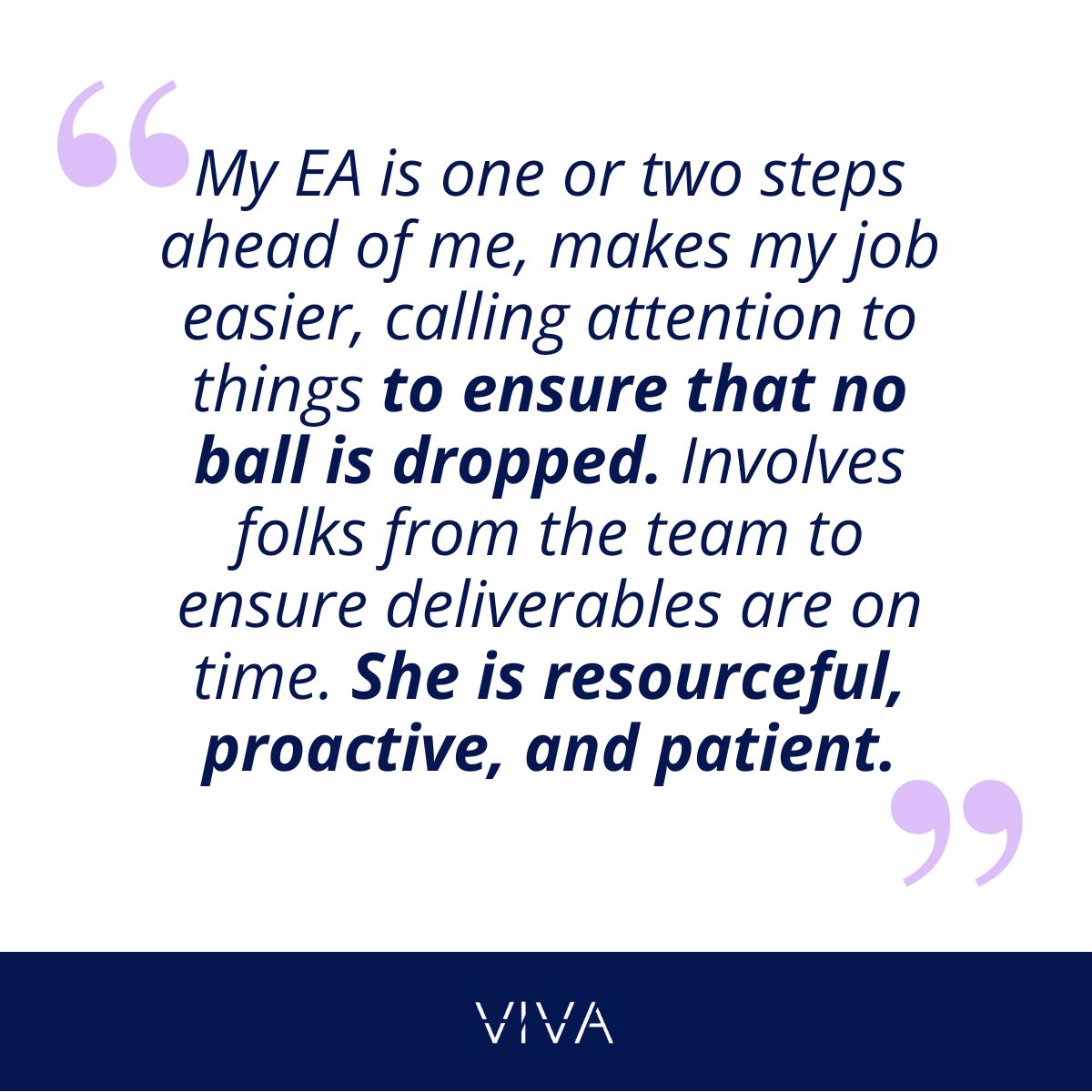
“My EA is one or two steps ahead of me, makes my job easier, calling attention to things to ensure that no ball is dropped. Involves folks from the team to ensure deliverables are on time. She is resourceful, proactive, and patient.”
Reason #5: Every company from Series A and beyond can find value in an EA.
“I want to wait until we are a bigger company – like Series B with 100+ people – to get an EA.”
Some executives postpone hiring an EA until their company reaches a certain size. This notion is not entirely wrong. Startups still looking to find product market fit might not need to hire an EA. Instead, their efforts should go solely toward the mission of finding PMF. Anything else is a distraction.
Our recommendation is that any executive from a Series A+ company with 20+ employees should get an EA to be more productive and help their companies grow. This is because executive assistants are trusted partners who can help organize, prioritize, and follow up on action items, keeping executives accountable for those priorities.
Recently, an executive from a Series B company reached out to us because someone from their Talent team was swamped. As they were growing, admin tasks and operational work in recruiting started to become a major bottleneck for a company that needed to grow fast, in a sustainable way.
They already had two executive assistants on their team. This could have given them doubts and fears of whether the best solution would be to onboard a third, given their sustainability mindset (something that has been a recurring theme as 2023 comes to an end). At the same time, they don’t want to slow down the acceleration of their recruiting needs and activities since those will propel growth in their company.
No matter if a Series A with 20 employees or a Series E with 1,000 engineers, an EA is a great fit because, in all of these scenarios, executives need to become increasingly productive and need to be levers of growth acceleration.
After a month of working with a Viva EA, this is what they had to say:
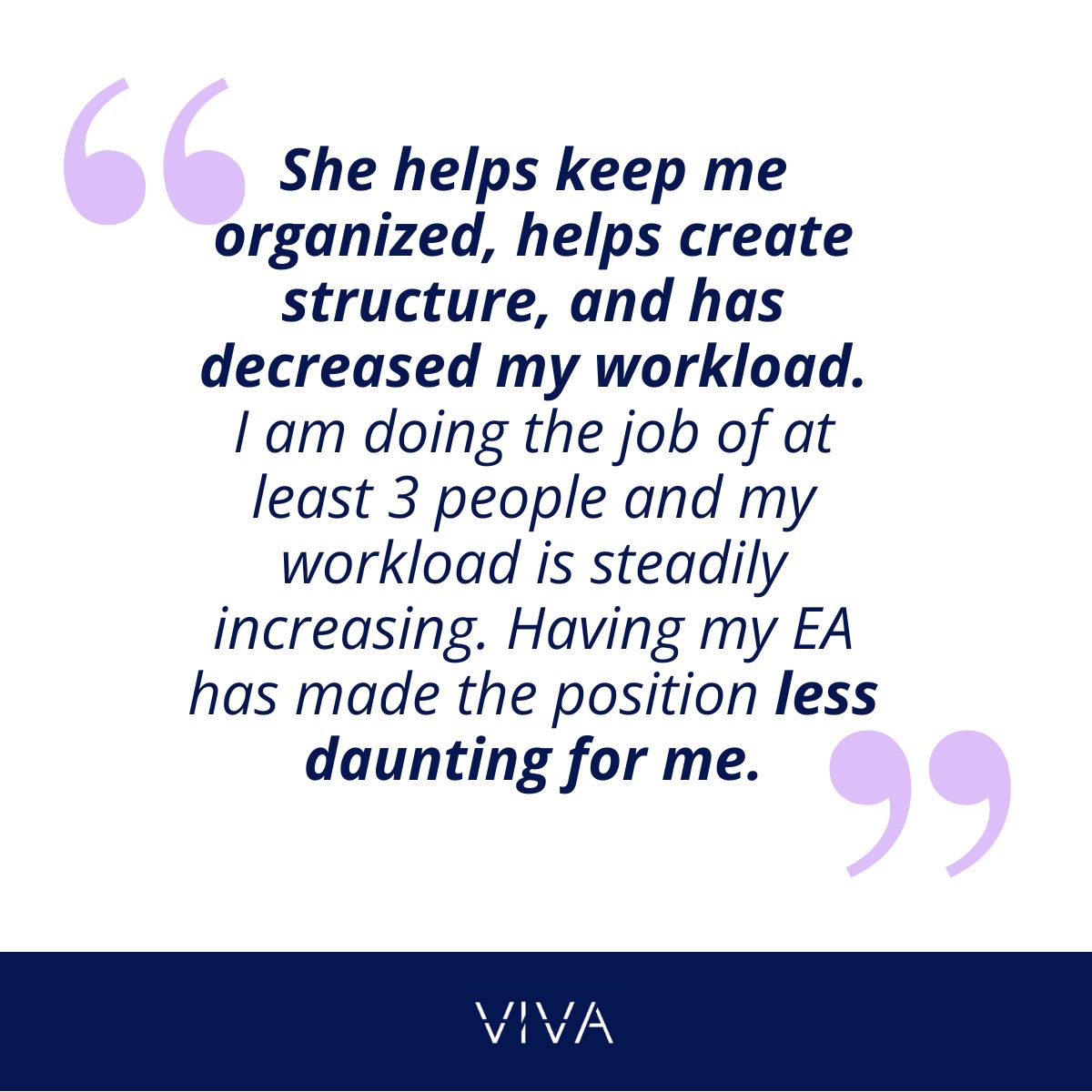
“She helps keep me organized, helps create structure, and has decreased my workload. I am doing the job of at least 3 people and my workload is steadily increasing. Having my EA has made the position less daunting for me.”
What is your #1 personal reason for hiring an EA?
We’ve worked with executives across the board in multiple roles: CEOs, CFOs, CTOs, CROs, VPs of People, Sales, CIOs, CPOs, VPs of Operations, VPs of Engineering, VPs of Strategy, Founders, and more.
Even as they find themselves with similar support needs (like calendar and email management, travel arrangements, team engagements, and special ops) all of them have very specific needs. The value is actually found in the nuances of those needs.
Think of the many differences and nuances between the calendar of a Chief Medical Officer of a Series C healthtech in San Mateo, CA, and the Head of Operations from a B2C company in Austin, TX. Just the fact that they’re in different cities, let alone different industries, would make their needs unique – even more so if we take their personalities and preferences into account.
This is why having an experienced team who recruits, onboards, and constantly monitors your EA’s performance is crucial to success in your experience.
Interested in knowing more? Reach out to us so we can talk.