Executive Assistants
The evolution of the executive assistant: white-glove service
Jun 25, 2024
5 min read


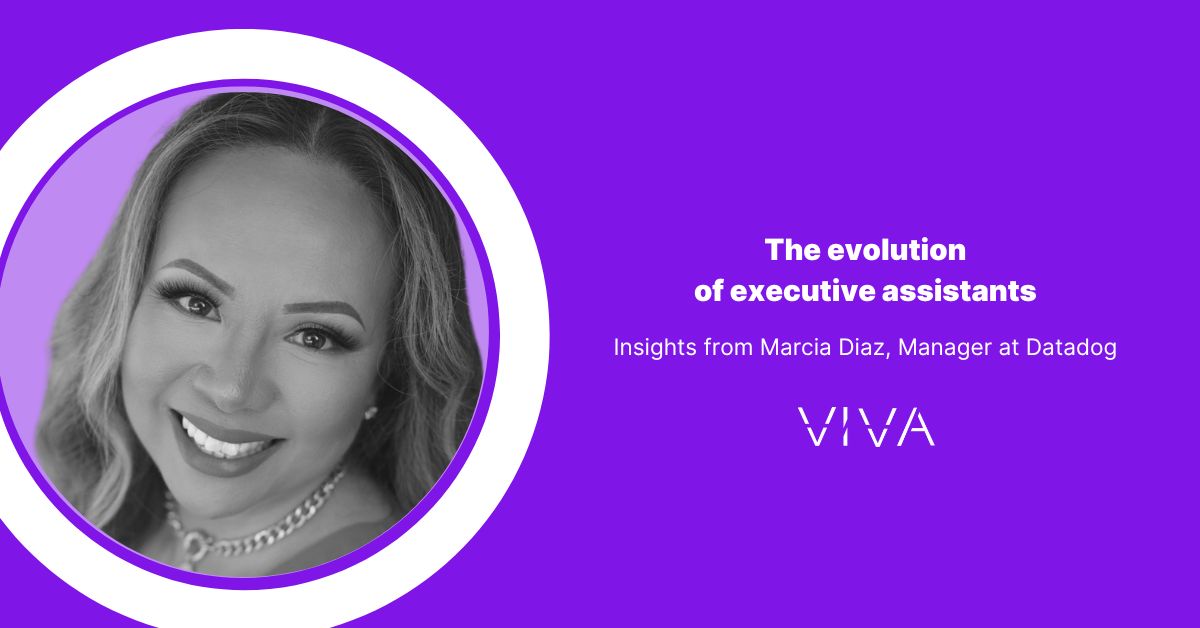
We recently had the privilege of interviewing Marcia Diaz, a senior executive assistant and manager at Datadog with nearly 30 years of experience. Marcia has provided support to every role on the leadership team, from SVPs to CHROs, and from presidents to CEOs, and her experience spans many industries: she started in banking and then moved on to media and, most recently, tech.
Marcia has a privileged point of view since she has been in the field so long, working in several industries, and supporting all kinds of leaders. She knows what works for an executive and what doesn’t, she can train teams of EAs, and she knows how to help executives get the most out of them.
Even though our interview was just 30 minutes, Marcia gave us an EA masterclass filled with valuable lessons. In this article we’ll explore some of Marcia’s secrets for maximizing mutual success: how executives can get the most out of their EAs, and how EAs can get more buy-in from their executives.

Table of contents:
- Two questions that will help you build trust with any executive
- How can an executive assistant make a real difference?
- How can you get the most out of your executive assistant?
- How can your EA help you become a better executive?
Two questions that will help you build trust with any executive
Startup executives and their needs can vary significantly. Some travel every week. Others are drowning in an overflowing inbox. Their biggest pain points tend to indicate what they need the most from their executive assistant. However, not every executive is receptive to EA support, and many struggle with delegation and building trust with an executive assistant.
Marcia explains that some executives are just interested in having a transactional relationship with their EAs, meaning they delegate only what is strictly necessary. As a result, these executives limit the positive impact they would enjoy if they entrusted their EAs with heftier projects. Other executives are willing to let their EAs be more hands-on and become fully integrated into their teams. How can an EA turn a purely transactional relationship into a hands-on one that provides maximum value?
Marcia offers three powerful suggestions for EAs who want to do just that:
- Observe your executive: Learn their mannerisms and how they talk, analyze their decision-making process, and try to understand how they think.
- Keep lots of notes: Pay attention to the big things, like family details, but keep your eyes on the small stuff, too. Write down everything, even if it seems insignificant. Make a note of their allergies, favorite food, preferred airline, preferences for airplane seats (aisle or window?), and even their favorite table at specific restaurants.
- Ask them these two questions:
- What did your previous EA do that worked well for you?
- What didn’t work well and could be better?
The combination of these three elements gives EAs a comprehensive overview of the person behind the title and will make the executive feel that their new executive assistant cares about who they are as a whole. In her experience, this approach builds trust almost immediately, and when trust is part of the equation, real impact is the only possible outcome.
If you’ve never had an executive assistant, ask yourself two discovery questions:
- What is my biggest pain point?
- What do I want to feel after the first month of getting executive support?
Use those answers as a base for what will become your EA’s top priorities.
“Building strong communication and organizational skills is a must. Be resourceful, innovative, and most of all, proactive. You always want to be 10 steps ahead of your executive,” Marcia says.
How to make a real difference as an executive assistant?
Most of us know the basics of what’s expected from an executive assistant: calendar and email management, travel planning, and strategic support. But when we asked Marcia how to really provide value and go the extra mile, she answered with a concept that we loved: Provide white-glove service. We discussed what that meant and she put it as simply as this: Think about your executive’s needs from a customer service perspective.
She gave us many examples of what her white-glove service looks like, but this one is our favorites. At a previous job, her executive decided Marcia would start running the quarterly board of director meetings. Before she started taking over, the board of directors meeting was simply a room where stakeholders found a copy of the agenda and nothing else.
That’s when her white-glove service was born. She started making little changes, from adding docking stations for meeting participants to charge their phones, to bringing in iPads so they could visualize data. She began using different catering vendors to make sure all executives were fully taken care of. Her impact was so large, that a number of those executives reached out to ask about some vendors for their personal use. What’s even more impressive is that when Marcia left the company, one of those executives offered her a job as his personal assistant.
Her work left a mark not only on her executive but on the entire board of directors. That’s the power of white-glove service.
“Develop that mentality of white-glove service because when you execute at that level, you always want the best, you’re going to strive for the best, and always get the best for your executive. That’s what makes you valuable to your executive.”
How can you get the most out of your executive assistant?
Executive assistants share a lot of traits, one of them being their relentless desire to learn and try new things. A truly outstanding EA will never settle for what you delegate to them; they will always try to get involved in other areas of your work where they can make positive impacts and learn new skills. Follow Marcia’s advice if you’re struggling to see that side of your executive assistant.
The first thing she swears by is personality alignment. Marcia hasn’t only been an executive assistant herself; she currently leads an entire team of EAs. That’s why we believe she knows a thing or two about executive support. Sometimes, when she pairs an executive with a new EA, their relationship is transactional and when she realizes the resistance comes from a personality misalignment, she quickly pivots and assigns a new EA to that executive. The results are dramatic. The executive is suddenly communicative, willing to delegate, and seems to trust their EA with their life. If you experience disconnection, it might stem from how different your personalities are. Look for a new EA, one who gets you on a professional and even personal level.
“If there’s no chemistry, personality-wise, they’re not going to get the best out of each other. It’s not just one way; it’s both ways.”
The second element that helps executives get the most out of their EAs is to challenge them continuously. If you think your EA is there just to help you manage your inbox and your calendar, you’re not getting as much value out of your EA as you could. Executive assistants are extremely skilled and can help you with more than you think. Some of our Viva executive assistants facilitate all-hands meetings, build entire SOPs, optimize processes for the company, and much, much more.
One way to challenge your EA is to choose a big project from your to-do list and just let them roll with it. Give them guidance and tell them what the expected output is, but let them make all the executive decisions to reach that goal. The second way to challenge your executive assistant is to let them confront and resolve unexpected impasses. What might seem like an impossible-to-solve situation can motivate your EA and even more importantly, solve the matter.
Let us paint a real-life picture for you. One of Marcia’s executives was traveling for a big event. All of a sudden, he messaged her from the airport and shared what he thought was going to be a big problem: “I forgot to pack my sports coat.” Marcia remained calm and assured him she’d fix it.
While her executive was on his flight, Marcia started calling department stores and got on the phone with a personal shopper. She gave them her executive’s measurements and by the time he landed, the problem was solved. He went into the store and tried a couple of options perfectly tailored to his needs. In less than 30 minutes, he was on his way to an important event, looking sharp and feeling stress-free.
Knowing you can afford to make a couple of mistakes because your EA has your back, is a great feeling.
How can your EA help you become a better executive?
We just saw an example of how an executive assistant can make you look good and keep you out of trouble, but can they consistently help you become a better leader? We believe so, and after seeing how Marcia has done it, you’ll see why.
One of the strongest skills of an EA is their ability to build bridges between you and the entire company. They can help you nurture better relationships with your direct reports and even grow new ones with major stakeholders. Not all executives have the time or the people skills to build those relationships themselves. When that’s the case, there’s nothing better than having your EA give you a hand.
A while back, one of Marcia’s executives struggled to build relationships with the corporate office. For that reason, she couldn’t get the meetings she wanted with the people she needed to see, and she kept getting shut down every time she requested an office in the main building.
Marcia saw these struggles and knew that if she wanted her executive to get what she wanted, she would need to take care of it herself. That’s when she started befriending the corporate EAs, trying to get past them. Soon enough, she managed to get the meetings her exec wanted and even the office space she had been requesting for so long.
“That experience made me resilient in two ways: One, don’t take no for an answer, and two, spend time building those relationships.”
Being a growth-stage startup executive is already hard enough. Don’t make it harder by trying to operate solo. Getting an executive assistant can help you in more ways than you know. Take a look at our customer stories if you want to know more about all the things an executive assistant can do for you. They used to struggle with the same challenges you’re confronting now until they decided to open themselves to executive support.