Executive Assistants
Secretary, office manager, and executive assistant: How are they different?
Apr 18, 2024
10 min read


Hiring the right support is essential to ensure your business runs smoothly. Understanding the differences between a secretary, an office manager, and a virtual executive assistant is key to making an informed decision. These roles often overlap in duties but serve distinct purposes that align with different organizational needs.
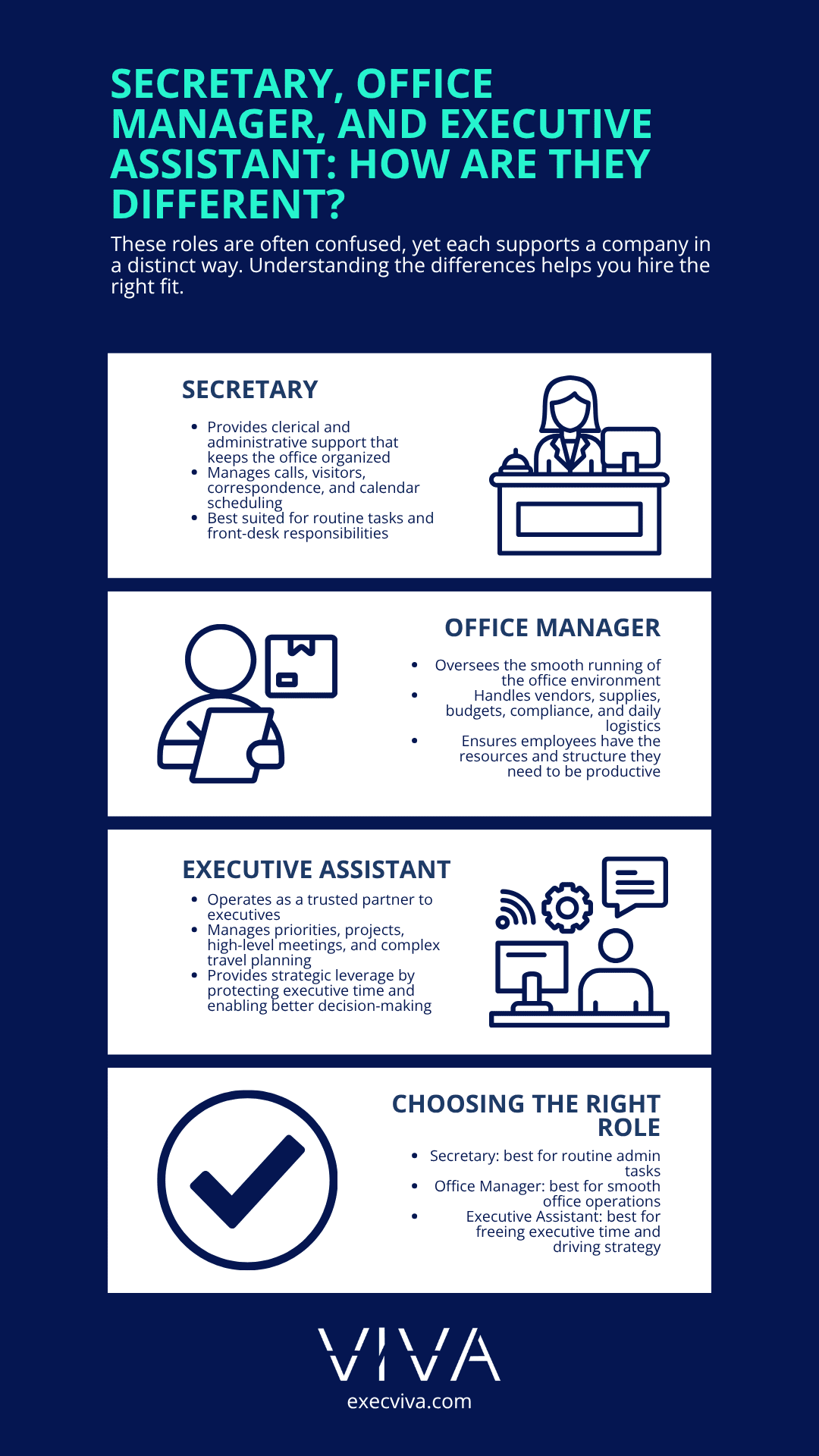
Table of contents:
- What does a secretary do?
- What does an office manager do?
- What does an executive assistant do?
- Key similarities among roles
- Who should you hire: an office manager, a secretary, or an executive assistant?
- Viva Executive Assistants offers top-tier talent
- Making the right choice for your business support
What does a secretary do?
A secretary typically handles administrative tasks and clerical support. Their role focuses on ensuring daily operations run efficiently by executing instructions and managing routine duties. Secretaries act as the first point of contact between the organization and external parties, maintaining communication flows and handling various office functions. Secretaries might support specific individuals or teams within the organization.
Common tasks:
- Managing office correspondence and scheduling meetings
- Handling phone calls and greeting visitors
- Assisting with bookkeeping and basic accounting
- Organizing office supplies and maintenance requests
- Occasionally supporting project management tasks
Example:
A secretary at a tech startup might manage visitor check-ins and maintain office records, ensuring the office environment runs smoothly.
What does an office manager do?
Office managers are essential as companies grow, especially when operational complexity increases. They ensure the office runs smoothly, managing resources, vendor relationships, and day-to-day operational logistics. The role is more focused on the office’s functionality rather than supporting an individual executive.
Common tasks:
- Managing office supplies, conditions, and budgets
- Coordinating meetings and handling internal communications
- Assisting HR with resume screening, interviews, and onboarding
- Overseeing compliance and vendor relations
Example:
An office manager at a growing SaaS company might ensure that all employee onboarding materials are prepared, and IT equipment is readily available. An office manager at a finance firm might oversee vendor contracts and enforce office security policies, such as ensuring that only authorized personnel have keycard access to sensitive areas and implementing visitor check-in procedures.
What does an executive assistant do?
An executive assistant (EA) serves as a critical extension of an executive, handling high-level responsibilities that directly impact strategic decision-making. Unlike secretaries or office managers, EAs manage executive priorities, oversee special projects, and take on decision-making tasks that help streamline operations at the highest level.
Common tasks:
- Managing email and calendar with strategic prioritization
- Overseeing travel logistics and expense reports
- Supporting hiring processes, internal workflows, and team engagement
- Handling special projects, from product launches to policy development
Example:
An EA for a Series B VP of Engineering might restructure 1:1 meetings to free up more time for strategic projects. An EA for a Series C CRO might flawlessly organize an offsite, managing everything from logistics to event coordination.
Key similarities among roles
Though distinct, there are areas of overlap among the roles of a secretary, office manager, and executive assistant. These include administrative duties like managing schedules, organizing meetings, and handling correspondence. However, the scope and strategic involvement of each role differ greatly.
Overlap includes:
- Planning meetings and managing travel
- Handling correspondence and communication
- Maintaining office functions
Key differences:
- EAs focus on executive priorities, manage high-level meetings, and follow up on critical action items.
- Office managers ensure operational continuity and handle logistics.
- Secretaries primarily provide general administrative support, often acting as the first point of contact between the organization and external parties.
Who should you hire: an office manager, a secretary, or an executive assistant?
Choosing the right role for your business depends on your needs and goals, as well as the support you need for your business. If you have narrowed it down to an EA, compare the best executive assistant services in 2026.
- Need someone to oversee office operations, manage vendors, and ensure smooth day-to-day functioning? Hire an office manager.
- Need help with answering calls, greeting visitors, and handling administrative tasks like scheduling and correspondence? Hire a secretary.
- Need strategic support to optimize your time, manage high-level projects, and handle complex workflows? Hire an executive assistant.
If you’re unsure about which role best fits your business, consider scheduling a call to explore how each role can align with your team’s unique needs.
Viva Executive Assistants offers top-tier talent
By handling tasks such as prioritizing emails, organizing travel logistics, preparing for meetings, and engaging with teams, our EAs allow executives to stay organized and efficient. With tailored solutions that improve productivity and maintain smooth operations, Viva’s EAs empower executives to concentrate on what matters most—growing and leading their businesses.
Viva offers:
- Instant access to highly- skilled support
With Viva, you don’t need to wait months to find the right person. Our assistants are pre-trained and experienced, providing immediate value to your organization. - Ongoing coaching and integration
We offer continuous coaching and support to ensure your EA integrates seamlessly into your business. Our onboarding process guarantees alignment with your team’s tools, culture, and priorities, so you can start delegating with confidence. - Remote or hybrid? Viva EAs fit all work models
Whether your team is fully remote, works in a hybrid model, or in-person, our executive assistants integrate seamlessly into any work environment. They manage everything from scheduling to meetings, ensuring smooth coordination regardless of the setup. - Cost-effective and transparent pricing
Unlike the unpredictable costs of recruitment agencies, Viva offers a flat monthly rate that’s half the cost of hiring a US-based in-house assistant. You’ll receive a fully-equipped, pre-trained EA with no hidden fees or additional charges. - Flexibility for growth
Viva provides scalable solutions to support your growth whether you need one assistant or an entire team. We offer flexible plans tailored to your business needs, ensuring you have the right support as your company evolves.
FAQ: office manager vs. executive assistant
What is the difference between an office manager and an executive assistant?
An office manager keeps the whole office running, handling vendors, supplies, facilities, and budgets. An executive assistant gives dedicated, strategic support to one to three leaders, owning calendar control, inbox triage, meeting prep, and projects.
Should I hire an office manager or an executive assistant?
If your main need is smooth office operations across the company, an office manager is the right fit. If you need to protect a leader’s time and move priorities forward, an executive assistant is the better investment. If you are weighing broader admin support, see our executive administrator vs. executive assistant guide.
Can an executive assistant do the work of an office manager?
An executive assistant can cover some office coordination, but their real value is executive-level support. For company-wide facilities and vendor management, a dedicated office manager remains the better fit.
Is an executive assistant more expensive than an office manager?
It depends on the model and location. A dedicated remote EA can be a cost-effective way to get senior support without a full in-house hire. Compare options in the best executive assistant services in 2026.
Making the right choice for your business support
When deciding among an office manager, secretary, or executive assistant, it’s important to align the role with the specific needs of your business. Whether you need someone to manage daily operations, streamline administrative tasks, or provide high-level strategic support, each role brings distinct advantages.
Assessing your priorities and understanding the scope of each position can help ensure you select the right fit for your team. If you’re unsure or need guidance, reach out for a call to help clarify which role will drive your business forward with efficiency and focus.