Executive Assistants
The ultimate guide to hiring executive assistants
Aug 27, 2024
10 min read


This guide is designed to help you navigate the process of hiring executive assistants. Whether you’re considering bringing on an executive assistant for the first time or looking to refine your hiring strategy, this guide provides a comprehensive look at the essential steps involved.
From understanding the role and necessary skills to effective recruitment strategies and onboarding practices, you’ll find valuable insights to ensure you make the best hiring decision for your organization.
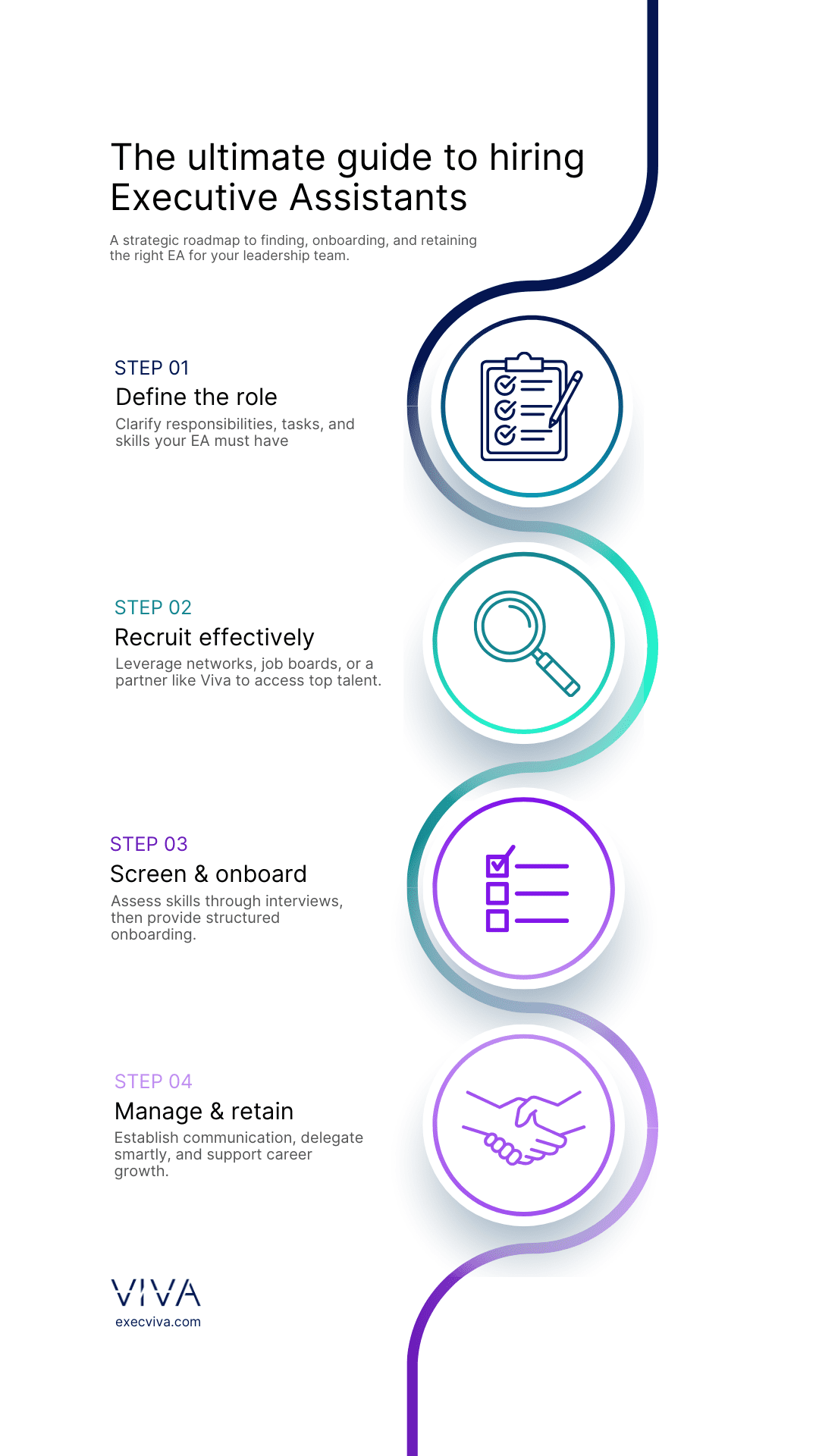
Table of Contents
What is the role of an executive assistant?
- Overview of the role
- Strategic partnership with executives
What will be the tasks of your executive assistant?
- Assessing your specific needs
- Defining responsibilities
Key skills of an executive assistant
- Communication
- Attention to detail
- Problem-solving
- Organization and time management
- Intuition
- Tech-savvy
- Proactiveness
- Receptiveness to feedback
- Resourcefulness
- Sense of urgency and accountability
Qualifications of an executive assistant
- Educational background
- Relevant experience
- Certifications
How to create a job description for an executive assistant
- Crafting a precise job description
- Key elements to include
How to recruit an executive assistant
- Utilizing job boards and professional networks
- Leveraging recruitment services
Screening and interview process
- Resume screening
- Interview techniques
- Skills assessments
Onboarding your executive assistant
- Steps in a successful onboarding process
Managing an executive assistant
- Establishing communication channels
- Delegating tasks
- Providing feedback
Retaining an executive assistant
- Career development
- Recognition and rewards
- Supporting work-life balance
Addressing common challenges and solutions
- Miscommunication
- Training and coaching
This guide was written with Viva Executive Assistants’ method of hiring highest quality EAs. Consider this your roadmap to hiring executive assistants.
With Viva Executive Assistants, you gain access to the highest quality talent, ready to contribute to your organization’s success. Viva hires, trains, onboards, and coaches the highest-quality talent so you can focus on your strategic priorities while your EA handles the rest.
1. What is the role of an executive assistant?
An executive assistant (EA) is more than just a support role; they are a strategic partner who enhances an executive’s effectiveness.
The primary function of an EA is to manage and streamline admin tasks, including calendar management, meeting support, inbox management, organizing travel arrangements, and doing operations work and special projects.
They often serve as gatekeepers, ensuring that executives’ time is used efficiently by filtering and prioritizing requests from both internal and external stakeholders.
EAs are also integral in managing projects and ensuring smooth communication among departments. Their role often extends to coordinating events, preparing reports, or building playbooks.
Understanding the full scope of an EA’s role is crucial in hiring someone who can align with your business needs and contribute to your organization’s success.
2. What will be the tasks of your executive assistant?
Before you embark on the search for an executive assistant, it’s vital to assess your specific needs. This involves evaluating the tasks and responsibilities that the EA will handle and how these tasks fit into your broader organizational goals. Consider the following questions:
- Is my calendar constantly overbooked?
- Do I feel overwhelmed by my inbox?
- Am I dropping the ball on my priorities? Which ones?
- What am I looking to accomplish within three months after hiring an EA? What specific tasks would I like to delegate to a highly proficient executive assistant?
By answering these questions, you can create a clearer picture of what you need from an executive assistant, which will guide you in crafting a precise job description and identifying the right candidates.
3. Key skills of an executive assistant
When hiring an executive assistant, it’s crucial to recognize the diverse skills that contribute to their effectiveness in supporting high-level executives.
The right executive assistant can transform the efficiency of an organization by managing complex schedules, handling critical tasks, and anticipating needs.
- Excellent communication skills: Executive assistants must excel in communication to manage dialogue with stakeholders and draft accurate, clear emails in the executive’s voice. Effective communication also involves preparing briefing documents and facilitating presentations.
- Attention to detail: Precision in scheduling and communicating information is crucial. EAs need to ensure error-free reports and catch potential issues early, such as managing executive schedules and reviewing documents meticulously.
- Problem-solving skills: EAs should be adept at anticipating challenges and devising solutions. Whether it’s resolving scheduling conflicts or handling last-minute changes, proactive problem-solving aligns with the executive’s goals and ensures smooth operations.
- Organization and time management: Effective EAs excel in organizing tasks, managing calendars, and optimizing workflows. They implement systems to automate tasks, coordinate travel, and ensure deadlines are met, allowing executives to focus on strategic goals.
- Good intuition: Strong intuition helps EAs make smart decisions and anticipate needs.
- Tech-savvy: Proficiency with digital tools and platforms is essential. EAs manage virtual meetings, troubleshoot tech issues, and utilize software like CRM platforms to enhance productivity and streamline processes.
- Proactiveness: Proactive EAs anticipate needs and address potential issues before they turn into problems. They maintain a steady routine, organize tasks efficiently, and suggest improvements to support the executive’s strategic goals.
- Receptive to feedback: EAs should actively seek and act on feedback to improve their performance. This involves implementing suggestions and showing measurable progress in their role.
- Resourcefulness: Resourceful EAs find creative solutions and leverage tools and networks to enhance productivity. This includes using AI technology and tools for project management and research.
- Sense of urgency and accountability: EAs must manage priorities with urgency and ensure timely completion of tasks. They take ownership of responsibilities and adapt quickly to changes, such as travel itinerary adjustments, to ensure that their executive’s life runs as smoothly as possible.
4. Qualifications for hiring executive assistants
In addition to skills, certain qualifications are important when hiring an executive assistant.
- Educational background: A degree in business administration or a related field can be advantageous, but isn’t necessarily essential.
Traditional business backgrounds are valuable, but at Viva Executive Assistants we’ve found that diverse backgrounds, including teaching, HR, NGOs, and equestrian instruction, can also provide the essential traits that make an EA excel.
For example, teaching fosters communication and organization, NGO experience enhances problem-solving and resourcefulness, and equestrian instruction develops discipline and quick decision-making. Embracing these diverse experiences can lead to exceptional executive assistants who excel in various aspects of the role.
- Relevant experience: Prior experience as an executive assistant or in a similar administrative role is highly valuable. Look for candidates with a proven track record of handling high-level administrative tasks.
Don’t stop there. Look for candidates who have experience dealing with challenging situations where they had to use their intuition or where proactiveness is required.
- Certifications: Certifications can indicate a higher level of expertise or demonstrate deep familiarity with a specific industry. That’s why it’s good to have a hiring partner who can support onboarding and coaching.
Say you find a great candidate, someone who is proactive, intuitive and efficient at handling admin tasks but they lack a certification. A subscription service like Viva can help you by finding a great high-quality executive assistant and coaching them in any certification or additional training they need to succeed at supporting the executive they work with.
5. How to create a job description for an executive assistant?
A well-crafted job description is crucial for attracting the right candidates. It should clearly outline the responsibilities, required skills, and qualifications. Here’s how to create a precise job description:
- Job title: Use a clear and specific title, such as “Executive Assistant to the CEO.”
- Responsibilities: List the primary tasks and duties, including any specialized responsibilities.
- Qualifications: Detail the required qualifications, including education, experience, and skills.
- Company overview: Provide a brief overview of your company and its values to attract candidates who align with your organizational culture.
Download our executive assistant job description template. It includes a comprehensive list of activities an Executive Assistant can perform and the skills and abilities they should bring to the job. Leaders can easily identify the support they need and the required qualifications using our template. It also provides a ready-to-use job description for recruitment efforts.
6. How to recruit an executive assistant?
Employ a strategic recruitment approach to find the best executive assistant:
- Check out Viva Executive assistant’s subscription service. Viva is the strategic EA partner of 100+ executives at fast-growing companies in the U.S. We provide the highest-quality, most proactive, and resourceful EAs, ensuring leaders thrive in their roles.
- Leverage job boards: Post the job on popular job boards and specialized platforms for executive assistants. LinkedIn can be a great place to look for EAs, too.
- Utilize professional networks: Tap into professional networks and industry connections. Recommendations from trusted colleagues can be invaluable.
Finding the right executive assistant goes beyond just posting a job online; it’s about creating a smooth and organized hiring process. Using SenseHR SaaS software can make a real difference by helping you manage the details. For example, you can easily track each candidate’s progress, schedule interviews without hassle, and keep all communication in one place. This keeps the process moving forward smoothly and gives you more time to focus on evaluating the best fit for your team. With the right tools in place, recruiting becomes less about the stress of logistics and more about finding that perfect match who will truly support your leadership.
7. Screening and interview process for hiring executive assistants
Whether you plan on recruiting yourself or hiring through a partner, the screening and interview process is critical for selecting the right candidate. Follow these steps to ensure a thorough evaluation:
- Resume screening and filtering: Review resumes to identify candidates with the right mix of skills and experience. For this step, make sure you pick 3 non-negotiable traits that will be difficult for you to train for. We recommend proactiveness, intuition, and adaptability.
- Interview your candidates: Go deeper into the candidate’s qualifications, skills, and personality. Use behavioral interview questions to gauge how they handle various situations.
- Skills assessment: Consider administering practical tests or assessments to evaluate specific skills relevant to the role. Most candidates will provide similar answers or results when given the same assessment. To minimize this, ask candidates to be specific. Assess for practical skills and for your core, non-negotiable skills. Leave room for opportunities to upskill, train, or coach an individual. The highest performers tend to be fast learners. Find out how to assess the 3 skills for an executive assistant.
8. Onboarding your executive assistant
An effective onboarding process is crucial for shaping an employee’s experience and performance within your company. Research shows that 93% of employers recognize the impact of a positive onboarding experience on a new hire’s decision to stay. However, 29% of employees feel they weren’t adequately supported during onboarding.
Follow these 5 steps to ensure your new EA has a successful onboarding experience:
- Develop a pre-onboarding protocol.
- Provide your EA with an itinerary for the first few days.
- Assign an onboarding buddy.
- Allow your EA to shadow you in as many meetings as possible.
- Schedule weekly one-on-one meetings with your new EA.
9. Managing an executive assistant
Effective communication is essential for a successful working relationship between a startup executive and an executive assistant.
- Start by establishing clear communication channels and creating a communication strategy. Decide which channels to use for different types of messages—email for detailed tasks, Slack for quick updates, and text for urgent matters.
- Allowing your EA to shadow you, sharing your personal operating manual, and using specific codes can help them understand your work style and preferences, saving you time and effort.
- Set SMART goals for your executive assistant and practice ruthless prioritization. Delegate tasks like calendar management, meeting support, and travel planning to free your time for high-priority activities.
- Constructive feedback is also crucial in building a strong relationship with your EA; be specific, timely, and supportive to help them grow and improve. By sharing both your professional and personal priorities, your EA can better support you in all aspects of your life.
10. Retaining executive assistants
Retention strategies are crucial for maintaining a stable and effective team:
- Career development: Offer opportunities for professional growth and development to keep your executive assistant engaged. If you have a partner like Viva, they can make sure that your EA’s career expectations are aligned with the role and that there is a clear growth path for them.
- Recognition and rewards: Acknowledge and reward their contributions to foster a positive work environment through recurring methods like a weekly merit recognition or a monthly meeting to talk about performance. Use the skill/will matrix for this.
- Work-life balance: Support a healthy work-life balance to enhance job satisfaction and reduce turnover. Allow your EA to log off and silence their notifications once their shift has ended.
11. Common challenges and solutions
Working with an executive assistant can come with challenges. Here are some common issues and their solutions:
- Miscommunication: Schedule a daily 10-minute check-in with your EA to clarify priorities and address any questions to avoid misunderstandings. For instance, if a meeting agenda is unclear, use the check-in time to review and align expectations.
- Training and coaching: Provide targeted training or coaching if your EA is struggling with a particular task. For example, if they need to improve their skills in managing a CRM, they can take a certification class or shadow a colleague who can teach the fundamentals. If you have a partner like Viva Executive Assistants, your EA will be automatically coached to acquire the new skills that their workload demands.
- Changing needs: Update your EA’s responsibilities if your business priorities shift. For instance, if your focus moves from client acquisition to product development, adjust your EA’s tasks to support this new priority. This might involve reallocating time from sales meetings to product research coordination.
Conclusion
Hiring an executive assistant is a strategic decision that can significantly impact your organization’s efficiency and success.
- This guide has provided a thorough exploration of the process, from defining the role and necessary skills, to crafting a compelling job description, and from navigating the recruitment process to effective onboarding and management.
- The right EA is not just performing a support role; they are a partner in your journey to achieving your strategic goals. Use this guide as your roadmap, and confidently move forward in hiring an executive assistant who will exceed your expectations.
With Viva Executive Assistants, you gain access to the highest quality talent, ready to contribute to your organization’s success. Viva hires, trains, onboards, and coaches the highest-quality talent so you can focus on your strategic priorities while your EA handles the rest.