Executive Assistants
What is a C level executive assistant? Responsibilities and skills
Apr 27, 2024
5 min read


A C level executive assistant is the ideal business partner to support any C-level executive at the company. This role includes; Calendar management, Email management, Travel and expense management, Meeting support, Team engagement, Operations, and special projects
Leadership team executives include the CEO, COO, or CFO of an organization, and they are responsible for leading the company and ensuring it stays profitable. That responsibility comes with an endless amount of work. That’s why most startup executives would highly benefit from getting c-level support.
Download our customizable job description template and find the best EA for your needs.
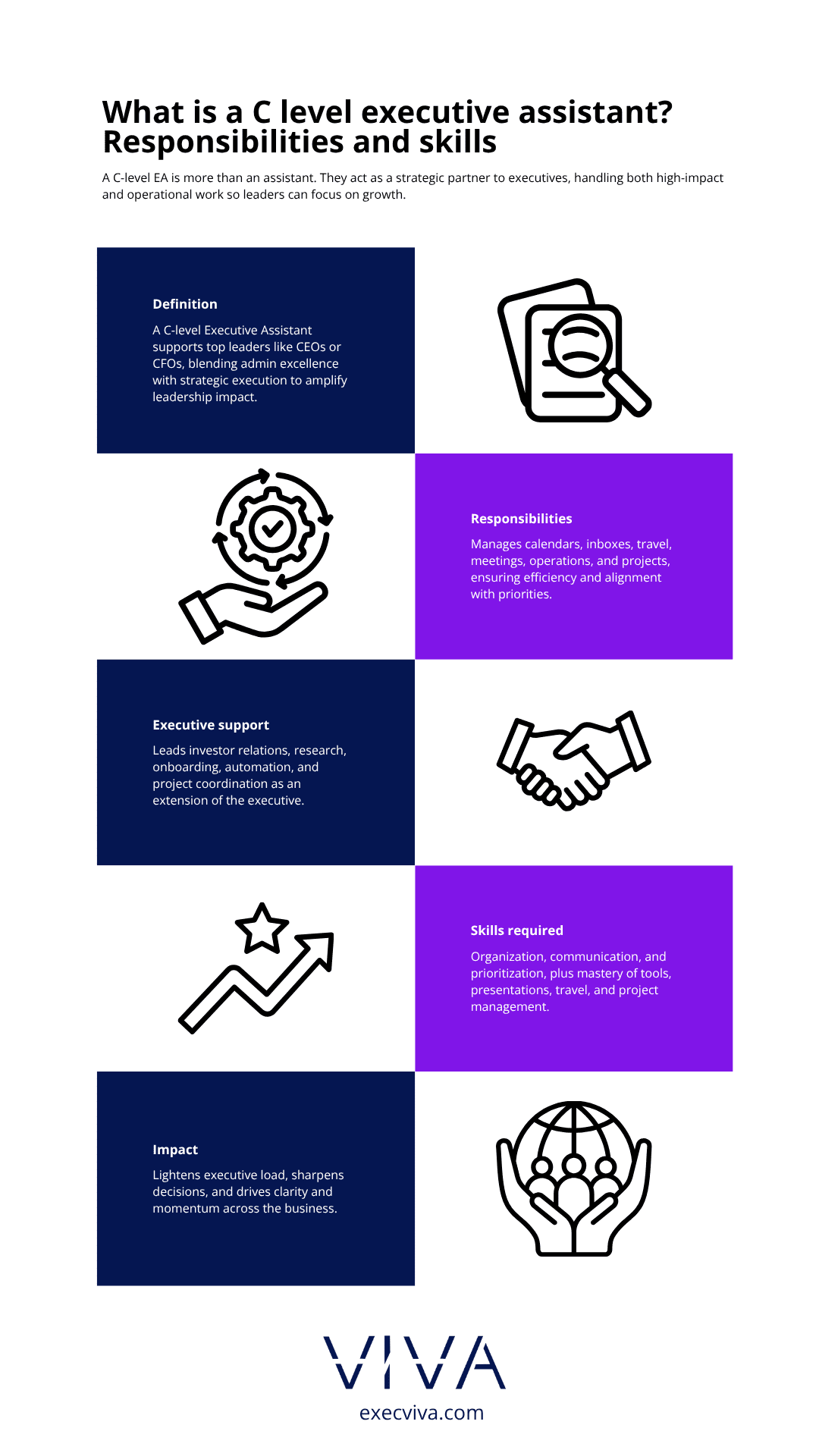
Table of contents
- Understanding the role of a C-level executive assistant
- Key responsibilities of a C-level executive assistant
- Essential skills of a C-level executive assistant
- The impact of a C-level executive assistant on business success
Understanding the role of a C level executive assistant
We have previously established the differences among an admin, a virtual assistant, an EA, an office administrator and much more, but what is a C-level executive assistant exactly? How is c-level support different from the other assistants? The answer is tied to the executive or executives they support.
Some C-level assistants support directors, heads of department, or vice presidents, and they do a remarkable job. But C-level executive assistants exclusively support C-level executives. The higher the title of the executive they support, the more refined and strategic is the work they must perform.
Executive assistants who support heads of department, for instance, may not have enough exposure to the most critical processes, meetings, or decisions that are made in the company. That kind of information is reserved for execs in the highest positions and their own c-level support.
A C-suite executive assistant is more than your right hand. Some of our customers consider their EAs to be their “thought partner” because that is what a C-level EA does: they don’t just perform admin and ops tasks, but actually help you think clearer, make better decisions, and help you guide your team, your department, and your company in the right direction.
Key responsibilities of a C level executive assistant
There are three ways to look at the responsibilities of a C-level executive assistant. First, there are the typical tasks that fall under their job description:
- Calendar management
- Email management
- Travel and expense management
- Meeting support
- Team engagement
- Operations and special projects
Yes, C-level executive assistants do all of the above, but they do so much more. The second way to understand what c-level support does on a daily basis is to look directly at what you, the executive, are in charge of. Your role dramatically changes their scope of work. After all, the CEO, the CFO, and the CHRO have completely different responsibilities, and the support each of you will need from your C-level executive assistant is completely different. The EA to the CEO’s day-to-day might look like this:
- Preparing for and debriefing about board meetings
- Hiring, onboarding, and training new staff
- Conducting customer and prospect research
- Automating company processes
- Maintaining investor relations
- Handling project management
Even these tasks just scratch the surface of a C-level EA’s potential and what they can contribute to you and your team. The true power of an EA is unlocked when you think outside the box, assess your specific pain points and how an EA could alleviate them, and get comfortable with the idea of delegating key tasks to an EA so that you can focus on higher-level concerns.
One of our customers, the CEO of Gridwise, uses his creativity to leverage his EA in ways we couldn’t even imagine. We took notes about our favorite ones so you can follow his approach to use your EA to the best of their capacities and reduce cognitive overload while you’re at it.
- Delegate repetitive tasks, such as onboarding new team members.
- Appoint your EA as the tool-adoption leader for your tech stack.
- Give your EA access to your email to reach inbox zero every day.
- Ask your EA to share an end-of-day Slack message that summarizes your email.
- Have your EA attend all meetings, take notes, track action items, put decks together, and provide feedback.
- Text or send your EAa voice message whenever you think of something important to add to their to-do list.
Essential skills of a C level executive assistant
As a company who pairs startup executives with remote executive assistants, we know all the reasons why executives might be hesitant to hire an EA. One of the most common reasons is the fear that hiring an EA will involve a lengthy onboarding process. We get it: startup execs don’t have time to waste; they can’t afford to spend a couple of weeks or months training someone before they see value.
That’s why we take charge of the process: we hire EAs and take care of training them for c-level support. That’s how our customers see results in less than a week. Matching this speed isn’t easy if you’re hiring, onboarding, and training on your own, but if you’re looking for a C-level executive assistant, these are the core skills you should be looking for:
Soft skills of C level executive assistants
We’ve put together a list of the most important soft skills a C-level executive assistant should have for c-level support.
Organizational skills
- Essential for managing meetings, deadlines, and tight schedules.
- Must balance tasks and prioritize effectively.
- Use productivity tools like Notion to organize tasks and information.
- Screen by asking candidates how they stay organized and handle multiple deadlines.
Time management skills
- Crucial for managing their own and their executive’s time.
- Use planning techniques to keep tasks, appointments, and meetings on track.
- Screen by asking candidates for examples of how they have handled multiple projects and strict deadlines.
Communication skills
- Excellent communication is vital for filtering information and facilitating details.
- Must communicate effectively with clear, concise emails and appropriate body language.
- Screen by evaluating their communication style during the interview process.
Problem-solving skills
- Essential for finding creative solutions.
- Think critically to manage tight schedules and reprioritize tasks.
- Screen by giving candidates specific scenarios to solve, focusing on their approach and solutions.
Prioritizing
- Important for assigning, triaging, and reprioritizing tasks.
- Understand the executive’s priorities and goals.
- Screen by giving candidates a list of tasks to categorize by urgency and importance.
Hard skills of C level executive assistants
Having an EA who is up to your standards isn’t easy. These are five of the most important hard skills a C-level executive assistant should have for c-level support.
Calendar and email management
- Effective calendar management involves performing a calendar audit and scheduling tasks based on productivity peaks.
- Managing an inbox that receives hundreds of emails every day needs an extremely proactive approach to control chaos.
- Screen by assessing candidates’ prior experiences in calendar management and tool proficiency.
Meeting support and presentation design
- Your new thought partner will ensure every meeting contains a detailed agenda and clear action points for you.
- They will provide support during meetings ensuring you’re prepared, they will take notes, and follow up with meeting minutes.
- Screen by having candidates take notes during a mock meeting and evaluate their presentation design skills.
Travel research and event planning
- C-level executive assistants have planned a number of work trips and company-wide offsites. They can plan entire schedules and take charge of logistics, lodging, and transportation for any type of event.
- Screen by providing a scenario for a last-minute business trip and evaluating their planning steps.
Project management
- As we mentioned before, C-level executive assistants can do much more than what’s in their job description. They can handle project planning, coordination, and execution, anticipating potential difficulties.
- Screen by asking for references related to previous projects and providing a scenario to manage a mini-project within the company.
Research
- Researching can be time-consuming and, if not done properly, won’t be insightful enough. C-level executive assistants are experts in researching in-depth topics and providing key findings for their executives.
- Screen by asking candidates to explain how they would research a specific topic and structure a report.
The impact of a C level executive assistant on business success
C-level executives are typically swamped, especially when they’re at a startup. They often spend entire mornings in back-to-back meetings, travel several times a week, or are busy with new fires that start burning here and there. They have so much on their plate, that it’s almost impossible to get to the end of their to-do-list on a consistent basis.
If this sounds like you, don’t worry. You’re not doing anything wrong. Your role is simply too big for a single person to take care of everything.
“I cannot imagine an executive who operates without support, let alone a CEO. There are not enough hours in the day for them to manage and execute their agenda. They wouldn’t be a part of the ELT if they didn’t have an executive assistant”.
Camila Brandoni Allende, EA at Workday
If you’re in the C-suite of your company and still don’t have a C-level executive assistant, let’s chat. Our team can show you all the benefits you’ll get from hiring your own c-level support.
..